


CONFIDENCE IN EVERY SEARCH
Modern data infrastructure
The Land Data Trust Framework is the ‘trust layer’ for Next Gen NLIS. Together, these infrastructures, regulated and governed by Land Data, create an environment for sharing and accessing trusted property data between authoritative data custodians, including every local authority in England and Wales, and the property market.


WHAT IS IT?
A framework for trusted property data
The Land Data Trust Framework creates an environment for organisations to share and access trusted property data. It acts as the ‘trust layer’ for Next Gen NLIS.
Together, these infrastructures, regulated and governed by Land Data, support the exchange of information between authoritative data custodians, including every local authority in England and Wales, and the property market.
WHY IT MATTERS
A digital property market needs data it can trust.
Where does the information come from?
Who supplied it? Can it be trusted?
As the property market becomes more digital, these questions are critical.
Upfront property information, automated data sharing and government reforms, including the development of a Smart Data scheme for property, make this confidence increasingly important. The Land Data Trust Framework has been developed to meet that need.

BENEFITS ACROSS THE PROPERTY MARKET
Consistent and trusted data sharing
Whether your organisation supplies, shares or uses property information, the framework provides a common basis for trusted data exchange.
Confidence in the source
Understand where information originated and verify its provenance, helping organisations make informed decisions about the data they use.
Integrity as information is shared
Digital assurance helps recipients identify whether information has been altered after it was issued, supporting confidence as it passes between organisations.
Clear standards and responsibilities
Participating organisations work to common rules, with defined responsibilities, compliance requirements and assurance processes.
Trusted onward sharing
The framework supports information sharing between verified participants within defined rules, helping trust extend beyond the original exchange.
DIGITALLY CERTIFIED DATA
Confidence in every Official Search
Every Official Search delivered through Next Gen NLIS carries the Land Data Trust Framework’s digital certification mark.
The mark provides assurance of the information’s provenance and the trusted, regulated process through which it has been shared.
A FIRST FOR THE PROPERTY MARKET
Pioneering trusted
property data
The Land Data Trust Framework is the first live trust framework in the home buying and selling market.
It has been designed to support future interoperability with other property sector trust frameworks and emerging industry standards.

UNDERSTAND THE FRAMEWORK
Explore the rules
and guidance
Land Data has worked with specialist trust framework consultants ID Crowd to develop the framework’s governance structure.
The Needs, Rules and Governance document explains how the framework operates, including its operating model, responsibilities, applicable legislation and compliance requirements.
For participating organisations, it sets out what is required, what is expected and the common standards everyone works to.
Transparency is central to the framework. Anyone interested in its development or participation is encouraged to explore the document.
LAND DATA TRUST FRAMEWORK
Needs, Rules and Governance
Explore the operating model, responsibilities, compliance requirements and common standards
WHAT IS IT?
A framewrok for trusted property data
The Land Data Trust Framework sets out the rules, responsibilities and standards that help organisations share and access trusted property information. It provides confidence in where information comes from, who supplies it and how it is shared.
Governed by Land Data, the framework underpins information exchanged through Next Gen NLIS, which connects authoritative sources—including local authorities across England and Wales—with the property market.
As the property market and Government reform move towards greater digitisation, upfront information, automated data sharing and the development of a Smart Data scheme for property, knowing where information comes from, who has supplied it and whether it can be trusted is critical. The Land Data Trust Framework has been developed to address these market needs and provide that confidence.
Digitally certified data
Every Official Search delivered through Next Gen NLIS will carry the Land Data Trust Framework’s digital certification mark, providing assurance of provenance and confirming that the information has been obtained from a verified, authoritative source and shared through a trusted, regulated process.
A pioneering trust framework
The Land Data Trust Framework will be the first live trust framework in the home buying and selling market. It has been designed to support future interoperability with other property sector trust frameworks and emerging industry standards.
Land Data Trust Framework - needs, rules & governance
Land Data has worked closely with specialist trust framework consultants, ID Crowd to create the governance structure for the Land Data Trust Framework.
The ID Crowd team has written a comprehensive document covering all (non-sensitive) aspects of the LDTF’s creation and approach, including operating model, design considerations, liability and responsibility, applicable legislation and more. See document below.
For organisations participating in the Land Data Trust Framework, this document sets out their compliance requirements, obligations and expectations, and the common standards to which everyone is working.
Transparency is an important principle of a trust framework. Land Data encourages anyone interested in trust framework development and/or participation to read this document.
Owned by Land Data
Author: The ID Crowd
Document Date 13th October 2026

Contents
Rules
Owned by Land Data
Author The ID Crowd
Document Date 14th October 2026
Land Data Trust Framework
Needs, Rules and Governance
Introduction to the Land Data Trust Framework (LDTF)
Buying and selling property is one of the most important financial transactions that most people and organisations will undertake. Every transaction depends on many independent organisations working together to exchange information, confirm legal rights and fulfil their respective responsibilities.
These organisations include buyers and sellers, conveyancers, mortgage lenders, estate agents, local authorities, HM Land Registry, search providers and Land Data. Each plays a different role, but every participant depends on information provided by others. The accuracy, integrity and timely exchange of that information are essential to completing a property transaction safely and efficiently.
Conveyancing searches uncover legal, environmental and structural risks about a property before a buyer legally commits to purchase. They inform solicitors and mortgage lenders about liabilities so they can advise accordingly.
Land Data plays an important role within this ecosystem by enabling the delivery of authoritative property information, including local authority search information, through the National Land Information Service (NLIS). This helps authorised organisations obtain the information they need from authoritative sources through a consistent and reliable service.
As the property sector continues to modernise, organisations increasingly rely on digital services to exchange information and support property transactions. Participants need confidence that they are dealing with legitimate organisations, that information originates from an authorised source, that it has not been altered without authority, and that each participant is operating to agreed standards.
The LDTF establishes the rules, responsibilities and operating arrangements that enable this confidence. It provides a common framework through which participating organisations can work together, exchange information securely and consistently, and establish mutual trust.
Enabling Future Expansion
The LDTF provides a scalable model that can accommodate new participants, new services and any future government initiatives to restructure the sector, without requiring the underlying trust arrangements to be redesigned. This is achieved by establishing a common framework for trust that is independent of any individual service or business process. The same principles apply whether information is requested at the start of a property transaction or further into the conveyancing process.
Structure of a Trust Framework

Needs of the LDTF
Purpose
The purpose of the LDTF is to establish the common rules, responsibilities and assurance arrangements that enable organisations to exchange and rely upon authoritative property information with confidence. It provides a consistent framework through which organisations can participate, exchange information and rely upon one another's services while maintaining confidence in the provenance, integrity and appropriate use of that information.
The information made available through the National Land Information Service (NLIS) is fundamental to the conveyancing process and supports the legal, financial and commercial decisions made by buyers, sellers, conveyancers, mortgage lenders and other participants.
This information may identify legal restrictions, planning matters, highways information and other issues that could affect a purchaser's decision to proceed, influence the value of a property or impact a lender's willingness to provide finance. The value of this information depends on more than its content alone. Participants must have confidence that it has been provided by the appropriate authoritative organisation, obtained through an authorised process, and has not been altered without authority. This confidence enables authorised participants to rely upon the information when making decisions, not only during the conveyancing process but throughout the lifetime of property ownership.
The LDTF governs participation in the Next Generation NLIS ecosystem and does not supersede the statutory responsibilities, legal obligations or professional duties of participants.
LDTF participants are accountable for the obligations they undertake, and liability is determined by whether those obligations have been discharged in accordance with the LDTF, applicable scheme rules, contractual arrangements and relevant legal or regulatory requirements.
Participants are expected to demonstrate compliance with the LDTF through appropriate governance, operational controls, assurance and audit. The LDTF does not create new liabilities; rather, it provides a consistent governance framework against which participants' responsibilities, compliance and accountability can be assessed.
Objectives
The LDTF is designed to achieve the following objectives:
-
Establish a trusted environment in which organisations can exchange information with confidence through trusted digital transactions and documents throughout the conveyancing process and wider property ecosystem.
-
Enable participants to rely on authoritative property information when making legal, financial and commercial decisions.
-
Create a single, consistent set of rules that applies to all participants.
-
Clearly define the roles, responsibilities and obligations of every participating organisation.
-
Ensure participating organisations are accountable for meeting the standards and obligations of the LDTF.
-
Establish consistent processes for organisations joining, participating in, being suspended from, or leaving the LDTF.
-
Provide governance, assurance and oversight arrangements that maintain confidence in the operation of the LDTF.
-
Establish the authority and enforceability of the LDTF through the application of relevant legislation, regulations, commercial contracts and memoranda of understanding.
-
Define liability arrangements that allocate responsibility according to each participant's compliance with the LDTF's rules and obligations.
-
Establish principles and processes for mediation, dispute resolution and appeals, ensuring issues are resolved fairly, consistently and transparently.
-
Enable the LDTF to evolve as new participants, services and government initiatives are introduced.
-
Enable interoperability with other trusted frameworks, services and participants across the wider property ecosystem.
Functions of the LDTF
The key principle functions are:
Establish trust (participants and information)
The LDTF establishes trust by defining who may participate, the conditions they must meet and the responsibilities they undertake. It provides confidence that participants are legitimate organisations, operating within an agreed governance framework and meeting an appropriate level of organisational, operational and technical assurance.
The framework also establishes trust in the information exchanged between participants. It ensures that authoritative property information can be identified that its provenance is understood and that participants can rely upon its integrity when making legal, financial and commercial decisions.
Manage trust (governance and assurance)
Trust must be actively governed throughout the lifetime of the framework. The LDTF establishes the governance arrangements through which participants are onboarded, participant profiles are maintained, changes are managed and decisions are made.
It also defines the assurance model, enabling participants to demonstrate continued compliance with the requirements applicable to their role. Governance ensures that trust is not established once, but is maintained through effective oversight, accountability and continual improvement.
Maintain trust (compliance, audit, disputes, liability)
Maintaining trust requires participants to continue meeting their obligations throughout their participation in the framework. The LDTF therefore establishes arrangements for compliance monitoring, audit, incident management and ongoing assurance.
It also defines the principles for managing non-compliance, disputes, appeals and liability. Where issues arise, the framework provides clear processes for investigation, resolution and, where appropriate, the suspension or removal of participants. These arrangements ensure that confidence in the LDTF is maintained over time.
Extend trust (new participants, new services, interoperability)
The LDTF has been designed to support the future evolution of the property ecosystem. New participant types, services, authoritative data providers and business models can be incorporated through the introduction of additional participant profiles without changing the underlying trust model.
The framework also supports interoperability with other trust frameworks, government initiatives and future digital services, allowing trust to be extended beyond the initial scope of the Next Gen NLIS Platform while maintaining a consistent governance and assurance model.
The Chain of Trust
Trust in organisations → Trust in information → Trust in transactions
The LDTF is based on this key principle. Trust in a property transaction is built progressively, with each stage depending upon the integrity of the stage before it.
The LDTF therefore establishes a chain of trust that extends from participating organisations, through the information they exchange, to the transactions that rely upon that information.
The LDTF establishes and maintains this chain of trust by ensuring that confidence is created at every stage. Without confidence in participating organisations there can be no confidence in the information they provide. Without confidence in the information, participants cannot confidently rely upon the transactions and decisions that depend upon it.
Trust in information
When trusted organisations exchange authoritative property information in accordance with the LDTF, participants can have confidence in the provenance, integrity and appropriate use of that information. They know where the information originated, that it has been obtained through authorised processes, and that it has been exchanged within the rules of the framework.
Trust in transactions
Property transactions depend upon participants being able to rely on authoritative information when making legal, financial and commercial decisions. Buyers, sellers, conveyancers, mortgage lenders and other organisations rely on this information throughout the conveyancing process. Trust in the transaction is therefore a direct consequence of trust in both the organisations participating in the framework and the information they exchange.
How to establish trust in an organisation
The detailed compliance requirements applicable to each participant type are set out in the scheme profiles. The profiles define the assessment criteria and evidence required to demonstrate compliance, whether through self-assessment, independent certification or other approved assurance mechanisms.
The LDTF establishes this confidence through a combination of legal recognition, organisational assurance, governance and ongoing compliance.
Legal identity
Organisations must have a recognised legal identity and be able to demonstrate that they are authorised to undertake the activities for which they are participating in the LDTF. This may include registration with Companies House, public authorities or other recognised legal or statutory bodies, depending on the participant's role.
Organisational legitimacy
Beyond legal existence, organisations must demonstrate that they are legitimate operating entities. This may include evidence of an established operational presence, financial standing, regulatory status, professional memberships or other indicators appropriate to the organisation's role within the LDTF.
Governance and accountability
Participating organisations must demonstrate appropriate governance arrangements, including clearly defined management responsibilities and named individuals accountable for compliance with the LDTF. These arrangements ensure that responsibilities are understood and that accountability exists for decisions and actions undertaken within the framework.
Organisational assurance
The LDTF requires organisations to demonstrate that they have appropriate operational, information security and cyber security controls. Depending on the participant's role and the level of risk associated with their activities, this may include recognised certifications, professional accreditations and compliance with applicable standards.
Ongoing compliance
Trust is maintained throughout an organisation's participation in the LDTF. Organisations may be required to demonstrate continued compliance through periodic review, independent audit, certification, self-assessment, incident reporting or other assurance activities appropriate to the level of risk.
Proportionate assurance
The LDTF adopts a risk-based approach to organisational trust. The level of assurance required will be proportionate to the participant's role, the services they provide and the risks associated with those services. Participants undertaking activities with greater responsibility or higher levels of risk may therefore be required to demonstrate stronger governance, assurance and operational controls.
How to establish trust in information
Trust in information extends beyond confidence in the organisations participating in the LDTF. Participants must also be confident that the information they receive is authentic, originates from an authorised source, has not been altered without authority, is protected throughout its lifecycle, and can be relied upon when making legal, financial and commercial decisions.
The LDTF establishes confidence in information through a combination of governance, technical controls and cryptographic protections that collectively preserve the integrity, confidentiality and authenticity of authoritative property information as it moves between participants.
Information integrity
Participants must be able to demonstrate that information remains complete and unaltered from the point it is created by an authoritative source until it is consumed by an authorised participant. Mechanisms must exist to detect any unauthorised modification, corruption or loss of information during storage, transmission or processing.
Information authenticity
Participants must have confidence that information originates from the organisation claiming to have produced it. The LDTF establishes mechanisms through which authoritative data providers and other trusted participants can authenticate the origin of information, enabling relying parties to verify its provenance before acting upon it.
Confidentiality
Property information shall be protected against unauthorised disclosure throughout its lifecycle. Appropriate technical and organisational controls shall ensure that information is only accessible to authorised participants with a legitimate business need, and that confidentiality is maintained during transmission, storage and processing.
Non-repudiation
Participants must not be able to deny the creation, transmission or receipt of information where evidence exists that the transaction occurred. The LDTF establishes evidential mechanisms, including cryptographic signatures and comprehensive audit records, that provide assurance regarding the origin, integrity and handling of information, and support compliance, audit and dispute resolution where required.
The LDTF also recognises that the need to demonstrate the authenticity and provenance of property information extends beyond the completion of an individual property transaction. Property information and the decisions based upon it may need to be relied upon months or years later in connection with subsequent sales, legal proceedings, regulatory investigations, complaints or liability claims. Participants shall therefore maintain appropriate evidential records and cryptographic proof for the periods defined by applicable legal, regulatory and operational requirements, ensuring that information can continue to be verified long after the original transaction has completed.
Cryptographic protection
The Technical LDTF will define the cryptographic controls required to protect authoritative property information. These controls include digital signatures to provide assurance of authenticity and integrity, encryption to protect confidentiality, and secure cryptographic key management to ensure that cryptographic protections remain trustworthy throughout their lifecycle. The specific cryptographic standards, algorithms, trust anchors and key management arrangements will be defined within the Technical Framework.
Audit and traceability
The LDTF requires that the exchange of authoritative property information can be traced throughout its lifecycle. Sufficient audit evidence shall be maintained to demonstrate when information was created, by whom, how it was transmitted, and which participants subsequently relied upon it. This enables compliance monitoring, incident investigation and the resolution of disputes.
Proportionate implementation
The detailed technical controls required to establish trust in information will be proportionate to the risks associated with the information being exchanged and the role of the participant. The specific technical requirements, including cryptographic protocols, digital signature formats, encryption mechanisms and interoperability standards, are defined separately within the Technical Framework.
How to establish trust in a property transaction
A buyer decides to purchase a property and appoints a conveyancer to act on their behalf. Where the purchase is mortgage funded, the lender may also appoint or approve the same conveyancer to act on its behalf. Both the buyer and the lender therefore place trust in the conveyancer to undertake appropriate legal due diligence and obtain the information necessary to assess the property and protect their respective interests.
To fulfil these obligations, the conveyancer instructs a search intermediary or search company to obtain the required property searches. The search intermediary submits requests through the Next Gen NLIS platform.
Next Gen NLIS authenticates the participating search organisations and securely routes requests to the relevant authoritative data providers, such as the appropriate local authority, water companies, HM Land Registry or the Mining Remediation Authority. Each authoritative data provider returns official search data to the platform, which is then routed back through the search intermediary to the conveyancer.
The conveyancer reviews the search results and uses them to advise both the buyer and, where applicable, the lender. If applicable, the lender relies on the conveyancer's professional judgement and due diligence when deciding whether to release mortgage funds, while the buyer relies on the conveyancer's advice before completing the purchase.
Throughout this process, trust is established through multiple complementary mechanisms.
-
Legal and professional trust exists between the buyer, lender and conveyancer. The LDTF does not govern these relationships.
-
Commercial and contractual trust governs the relationships between the conveyancer, search intermediary and platform participants.
-
Technical trust ensures that authenticated organisations exchange information securely and that data originates from authoritative sources without unauthorised modification.
Threats, Risks and Mitigations
The LDTF is designed to support the secure and reliable exchange of authoritative property information. As the property sector continues to adopt digital services, the LDTF must address the threats that could undermine confidence in participating organisations, the information they exchange and the transactions that rely upon it.
The LDTF adopts a risk-based approach, identifying the principal threats to the operation of the ecosystem and establishing governance, operational and technical controls that are proportionate to those risks. These controls are intended to reduce the likelihood of incidents occurring, minimise their impact and ensure that confidence in the LDTF can be maintained.
Maintaining confidence
The purpose of these controls is not simply to reduce technical risk, but to maintain confidence in the operation of the LDTF. By protecting participating organisations, preserving the integrity of authoritative property information and supporting trusted digital transactions, the LDTF provides a foundation upon which the wider property ecosystem can confidently rely.
Business continuity
The availability of the Next Gen NLIS platform is fundamental to the efficient operation of the property market. Disruption caused by cyber attack, malicious insiders, operational failure or other disruptive events could prevent participants from obtaining or exchanging authoritative property information, resulting in delays to property transactions and wider business disruption.
The LDTF establishes requirements for operational resilience, business continuity, disaster recovery, service availability and incident management to ensure that participating organisations can continue to operate and recover from disruptive events.
Information integrity
Participants rely upon authoritative property information to make legal, financial and commercial decisions. Any unauthorised modification, substitution or manipulation of this information, whether by external attackers or internal threat actors, could undermine confidence in the property transaction and facilitate fraud.
The LDTF establishes controls to maintain the provenance, integrity and traceability of authoritative information throughout its lifecycle. These controls enable participants to understand where information originated, how it has been exchanged and provide confidence that it has not been altered without authority.
Identity and access
Trust depends upon participants having confidence that organisations, users and technical systems are who they claim to be and are authorised to undertake the activities they perform.
The LDTF establishes requirements for organisational onboarding, identity verification, authentication, authorisation and the ongoing management of participant access. These controls help prevent unauthorised access and reduce the risk of impersonation or misuse of trusted identities.
Organisational accountability
Participating organisations are responsible for protecting the information they receive, maintaining appropriate governance and security controls, and complying with the obligations placed upon them.
The LDTF establishes clear accountability, supported by assurance, audit and compliance arrangements, ensuring that participants remain responsible for meeting their obligations throughout their participation.
Monitoring and response
No control can completely eliminate risk. The LDTF therefore requires participants to maintain appropriate monitoring, incident reporting and response arrangements to detect, investigate and respond to security incidents or operational failures.
Effective audit and monitoring support the identification of incidents, enable appropriate remedial action to be taken and provide evidence to support compliance, dispute resolution and continual improvement.
Scope of the LDTF
In Scope
The LDTF applies to:
-
Land Data and the operation of the Next Gen NLIS.
-
Organisations providing authoritative property information, including local authorities, MRA, HM Land Registry and other recognised data providers
-
Search intermediaries and other trusted third parties participating in the delivery of services.
-
Local Authority software providers integrating with the Next Gen NLIS platform.
-
The governance, onboarding, participation and offboarding of organisations.
-
The exchange of search requests, responses and related property information.
-
Identity, authentication, authorisation and audit arrangements supporting trusted participation.
-
Operational policies, assurance requirements and compliance obligations applying to participants.
Out of Scope
-
Conveyancers, solicitors and other authorised organisations consuming services provided through the platform, these are defined as Relying Parties.
-
Define the legal content of property records or search responses.
-
Replace the statutory responsibilities of local authorities, the MRA and HMLR.
-
Replace the professional or regulatory obligations applying to participants.
-
Define the internal business processes or technical architecture operated by individual participant organisations, except where required to support participation in the LDTF.
-
Replace contractual agreements or statutory powers governing the creation or maintenance of authoritative property information.
-
Transaction payment and settlement functions.
Ownership and Operating Model
Who owns the framework?
Land Data owns and governs the LDTF within the scope of its mandate as the scheme owner and operator.
Land Data is a Community Interest Company (CIC) established in 2001 following a cross-government initiative to operate and regulate the National Land Information Service (NLIS).
Land Data operates NLIS and enters into contractual agreements with NLIS Search Intermediaries and participating data providers governing participation, service standards and operational requirements.
Land Data manages Official NLIS Searches through the LDTF, accreditation requirements and operational rules.
Who operates it?
Land Data is accountable for the day-to-day operation and administration of the LDTF, including participant onboarding, governance, compliance, assurance, change management and the maintenance of the LDTF's policies, rules and supporting documentation. Operational activities may be delegated to authorised service providers where appropriate; however, accountability remains with Land Data.
Who maintains it?
Land Data maintains the LDTF, ensuring that its governance, rules, policies and supporting documentation remain current, effective and aligned with its mandate and the needs of the Land Data NLIS ecosystem.
How the LDTF evolves
The Land Data LDTF is intended to evolve incrementally through a controlled governance process. Land Data will periodically review the LDTF to reflect changes in legislation, industry standards, technology, emerging risks, operational experience and the evolving needs of the property ecosystem. Material changes will be subject to appropriate stakeholder consultation and governance before implementation.
Participants

Overview
The LDTF establishes the participants that are permitted to operate within the Next Generation National Land Information Service (Next Gen NLIS) and the roles they perform within the property information ecosystem.
The initial scope of the LDTF is focused on participants involved in the provision, exchange and fulfilment of authoritative property information. Together, these participants enable trusted information to be exchanged and relied upon throughout the conveyancing process.
Participants perform different functions and therefore have different responsibilities, obligations and assurance requirements. All participants are subject to the common principles, governance arrangements and rules defined by the LDTF. Where additional or different requirements apply to a particular participant type, these are defined through participant profiles.
A participant profile defines the roles, responsibilities, obligations, assurance requirements and technical controls applicable to a particular class of participant. This enables the LDTF to apply a common governance model while recognising the different functions performed within the ecosystem.
As the Next Gen NLIS platform evolves and expands, new participant types can be introduced by defining additional participant profiles without requiring changes to the underlying LDTF. This approach allows the framework to accommodate new participants, services and business models while maintaining a single, consistent trust model.
Categories
The LDTF recognises two broad categories: participants and relying parties.
Participants operate within the LDTF and are governed by its rules, responsibilities and assurance requirements. They are directly involved in the provision, exchange and fulfilment of authoritative property information through the Next Gen NLIS Platform.
Relying parties are the people and organisations that place trust in the information, services and transactions enabled by the LDTF to support their own decisions and activities. They rely upon the trusted outcomes of the framework but are not themselves governed by it.
Relying parties remain subject to their own legal, regulatory and professional obligations, together with any contractual arrangements, trust frameworks or schemes that apply to their activities. These obligations may complement or overlap with those defined by this Trust Framework. For example, organisations may also be required to comply with UK data protection legislation, professional standards, financial services regulation or other statutory requirements.
Whilst the commercial operating model distinguishes between customers and consumers according to the services they receive, the LDTF classifies both as relying parties.
The participants identified within the LDTF reflect scope of the Next Gen NLIS Platform. As the framework evolves, additional participant profiles may be introduced to support new services, new business models and wider participation across the property ecosystem.
Examples of participants
-
Land Data
-
Platform operator
-
Authoritative data providers
-
Local authorities
-
The Mining Remediation Authority
-
HM Land Registry
-
Water Companies
-
Other authoritative data providers
-
Search intermediaries and their sub-users.
-
Other data consumers, i.e. property logbooks
-
Help desk service providers
-
Payment service providers
Examples of relying parties
-
Buyers
-
Sellers
-
Conveyancers
-
Mortgage lenders
-
Estate agents
-
Other people and organisations that rely upon authoritative property information when making legal, financial or commercial decisions.
High-level responsibilities
Governing Authority (Land Data)
Land Data is the owner and governing authority for the LDTF. It is responsible for establishing and maintaining the LDTF, ensuring that it continues to meet the needs of the property ecosystem and evolves in line with changes in legislation, policy, technology and business requirements.
Land Data is responsible for:
-
Owning and governing the LDTF.
-
Defining the rules, policies and participant profiles that govern participation.
-
Approving, suspending and removing participants in accordance with the LDTF.
-
Monitoring participant compliance and overseeing assurance activities.
-
Managing governance processes, including change management, dispute resolution and appeals.
-
Maintaining the LDTF documentation and supporting schedules.
-
Promoting adoption of the LDTF across the property ecosystem.
-
Defining the functional and operational requirements of the Next Gen NLIS ecosystem.
-
Overseeing the operation and continual improvement of the Next Gen NLIS platform.
-
Establishing the standards and requirements necessary to maintain trust in organisations, information and transactions.
Platform Operator
The Platform Operator is responsible for the day-to-day operation of the Next Gen NLIS platform and for delivering the technical services required by the LDTF.
Responsibilities include:
-
Operating the Next Gen NLIS platform.
-
Maintaining the availability, resilience and security of the platform.
-
Maintaining Technical Trust Framework documentation, for both technical and user onboarding.
-
Delivering the identity, authentication, authorisation and audit services required by the LDTF.
-
Managing participant onboarding from a technical perspective.
-
Monitoring platform performance and service levels.
-
Managing operational incidents and service continuity.
-
Supporting integration with participants and software providers.
-
Maintaining the technical controls necessary to support trusted transactions.
Authoritative Data Provider
An Authoritative Data Provider is responsible for creating, maintaining and supplying official property information within its statutory or organisational remit. It is the authoritative source of the information made available through the LDTF.
Responsibilities include:
-
Create, maintain and manage authoritative property information.
-
Ensure information is accurate, complete and up to date.
-
Respond to authorised requests for information received throu.gh the Next Gen NLIS or intermediary software providers.
-
Protect and validate the integrity of information throughout its lifecycle.
-
Comply with the operational and technical requirements of the LDTF.
-
Participate in assurance and compliance activities.
-
Support the resolution of operational issues relating to information supplied through the LDTF.
Search intermediaries, property logbook providers and other data consumers
Search Providers and Intermediaries act as the primary interface between relying parties and the Next Gen NLIS Platform. They receive requests from relying parties, submit authorised requests through the LDTF and return the resulting information and services to the relying party.
Responsibilities include:
-
Acting as a trusted intermediary between relying parties and the LDTF.
-
Accept search requests in accordance with the LDTF.
-
Receiving and returning authoritative property information to relying parties.
-
Maintaining the integrity, confidentiality and security of information throughout the services they provide.
-
Complying with the governance, operational and technical requirements of the LDTF.
-
Maintaining appropriate audit records and supporting compliance activities.
-
Ensuring that only authorised requests are submitted through the LDTF.
-
Supporting incident management, dispute resolution and operational enquiries relating to the services they provide.
-
Ensure contractual arrangements with relying parties reflect the relevant obligations of the LDTF.
-
Ensure compliance with applicable legislation.
Local authority Software Providers
Local authority Software Providers supply and support back-office search facilities used by authoritative data providers to receive, manage and fulfil search requests. They enable the efficient, secure and consistent delivery of services through the Next Gen NLIS Platform but do not themselves become the authoritative source of the information they process.
The use of a 3rd party software provider does not transfer responsibility for the accuracy, completeness or authority of the information supplied. The Authoritative Data Provider remains responsible for the information it creates and returns through the LDTF.
Responsibilities
-
Provide software that supports participants in fulfilling their responsibilities under the LDTF.
-
Integrate with the Next Gen NLIS platform using the approved technical standards and interfaces.
-
Support the secure exchange of search requests, responses and related information.
-
Maintain the availability, security and integrity of the software services they provide.
-
Support participant onboarding, operational support and technical change where required.
-
Comply with the applicable technical, security and assurance requirements defined by the LDTF.
Helpdesk Providers and payment service providers
The Helpdesk provides first-line operational support to authorised users of the service. It acts as a central point for receiving, recording, managing and responding to support queries through approved service channels, escalating issues to Land Data, Data Providers, other participants or relevant third parties where resolution falls outside its authorised scope.
Helpdesk service providers support the effective operation of the service but does not ordinarily form part of the primary transaction flow. Its role may, however, involve access to participant and transaction information, communication of trusted service information, and the escalation or resolution of issues affecting transactions. Its position within the trust model, including the information it may access, the authority it may exercise and the obligations arising from that role, is considered within the LDTF.
Payment service providers also support the effective operation of the service but do not ordinarily form part of the trusted data transaction flow. Their services and systems are, however, critical to the operation and availability of the service, as transactions may be dependent upon the successful processing of payment. Their obligations therefore address the availability, resilience and security of the payment service, together with the appropriate protection of any participant or transaction information they process. Their role and associated obligations are considered within the LDTF to the extent necessary to maintain the availability, integrity and effective operation of the service.
Who trusts whom and what?
Trust within the property ecosystem is established through a network of relationships between participants and relying parties. Each party places trust in one or more other parties to fulfil their responsibilities, provide authoritative information or support trusted transactions.
The table below illustrates the principal trust relationships within the initial scope of the LDTF, identifying who places trust in whom and the reason for that trust. It is intended to describe the trust relationships that exist within the ecosystem rather than the detailed responsibilities or obligations of individual participants. Those are defined later within the participant profiles and the Rules.
Party | Places trust in | Reason for Trust |
|---|---|---|
Buyer (Relying Party) | Conveyancer, mortgage lender (where applicable), and the authoritative property information provided through the LDTF | To make an informed decision about purchasing a property. |
Seller (Relying Party) | Conveyancer and the property transaction process | To complete the sale of a property with confidence. |
Conveyancer (Relying Party) | Search Providers and Intermediaries, and the authoritative information supplied through the LDTF. | To provide legal advice and complete the conveyancing process. |
Mortgage Lender (Relying Party) | Conveyancer and the authoritative information relied upon by the conveyancer. | To assess lending risk and determine whether to provide finance. |
Design Considerations
The LDTF has been developed in accordance with a number of guiding principles. These principles have shaped the design of the framework and provide a consistent basis for future decisions as the framework evolves.
Build on Existing Practices
The LDTF is intended to complement the existing conveyancing process rather than replace it. Wherever possible, it builds upon established legal, operational and commercial arrangements, introducing trust requirements only where they add value to the operation of the Next Gen NLIS Platform.
Minimise Disruption
The framework has been designed to minimise disruption to existing participants. Organisations should be able to adopt the LDTF through incremental changes to their existing business processes and technical systems rather than requiring wholesale transformation.
Proportionate Assurance
Assurance requirements should be proportionate to the risks presented by each participant and the services they provide. The framework applies appropriate levels of governance, assurance and technical controls without imposing unnecessary burden on participants.
Trust Through Accountability
Trust is established through clearly defined responsibilities, obligations and accountability. Every participant is responsible for fulfilling its role within the framework and can be held accountable for meeting the requirements applicable to its participant profile.
Interoperability
The framework promotes interoperability between participants and external environments outside of the NLIS ecosystem, by establishing common governance, operational and technical principles. Participants should be able to work together through consistent processes and standards regardless of the systems they operate.
Scalability
The framework has been designed to accommodate growth. New participants, services, data providers and business models can be introduced through additional participant profiles without requiring changes to the underlying LDTF.
Transparency
The governance, decision-making processes, participant obligations and assurance arrangements defined by the LDTF should be clear, consistent and transparent. Participants should understand their responsibilities, how trust is established and how compliance is assessed.
Future Evolution
The LDTF is intended to evolve alongside the property ecosystem. It should support future government initiatives, emerging technologies and new business requirements while maintaining a stable and consistent trust model.
Technology Neutrality
The framework defines the outcomes that participants are expected to achieve rather than mandating specific technical solutions. This allows participants to adopt appropriate technologies provided they continue to meet the governance, assurance and trust requirements of the framework.
Risk-Based Approach
The framework adopts a risk-based approach to governance and assurance. Controls should address identified risks to organisations, information and transactions, with assurance increasing where the potential impact of failure is greater.
The framework adopts a risk-based approach to governance and assurance. Controls should address identified risks to organisations, information and transactions, with assurance increasing where the potential impact of failure is greater.
Needs of the LDTF
Rules governing the LDTF
The rules defined within this document establish the requirements that Participants MUST meet to participate in the Land Data (LDTF).
Requirements are expressed using the terms MUST, MUST NOT, SHOULD, SHOULD NOT and MAY. MUST and MUST NOT identify mandatory requirements. SHOULD and SHOULD NOT identify requirements that are expected to be followed unless there is a documented and justified reason for an alternative approach. MAY identifies a permitted option.
Where a Participant enables another organisation or user to access information or services through its participation in the Next Gen NLIS ecosystem, the Participant MUST ensure that such access is subject to the applicable requirements of the LDTF and associated agreements.
Participants MUST maintain sufficient records and evidence to demonstrate their compliance with the LDTF and MUST make such evidence available for authorised assurance and compliance activities.
Requirements for participation, assurance, access and compliance MUST be applied consistently to Participants performing equivalent roles, except where different treatment is justified by risk, legal requirements or the nature of the service provided.
Hierarchy of governing rules
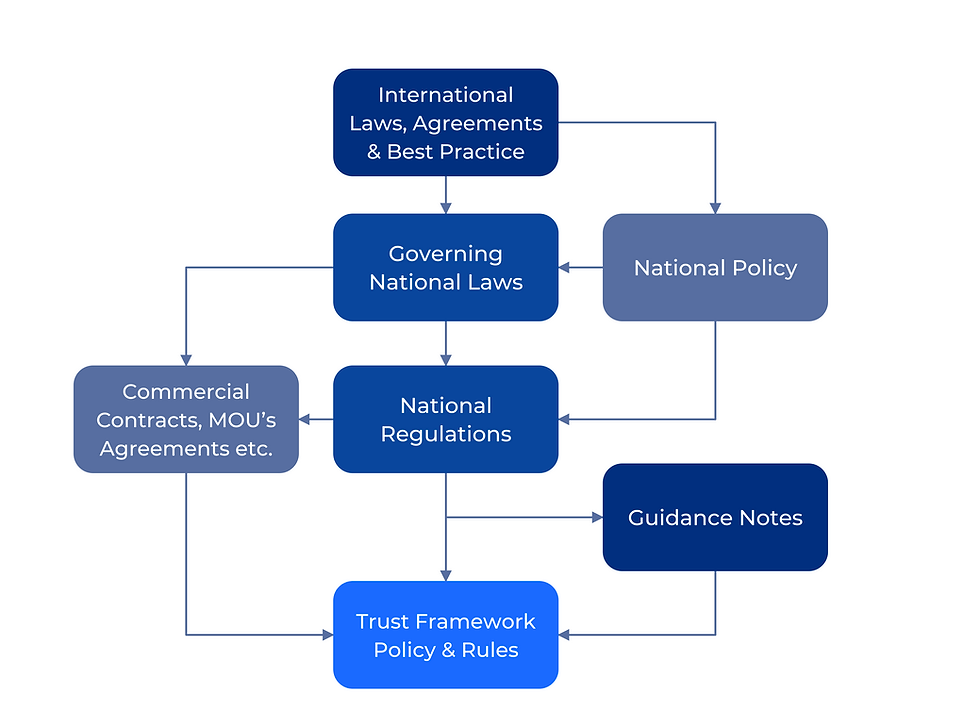
The LDTF and the obligations placed upon Participants operate within a hierarchy of governing artefacts.
Participants MUST comply with the requirements applicable to their role, activities and participation in the LDTF.
Obligations applicable to Participants may arise from:
-
Applicable laws and regulations, which establish statutory and regulatory obligations with which Participants MUST comply.
-
LDTF Policy and Rules, which establish the common requirements that MUST be satisfied as a condition of participation in the LDTF.
-
Participation agreements, User Agreements, contracts, schedules, Memoranda of Understanding and other binding agreements, which establish obligations applicable to the parties to those agreements.
-
Role or service-specific policies, standards and requirements, which establish additional obligations applicable to particular Participant types, services, information or activities.
-
Guidance, which describes recommended approaches to meeting requirements but MUST NOT create additional mandatory obligations unless explicitly incorporated into a governing artefact.
The LDTF Operator MUST maintain the authoritative hierarchy of LDTF artefacts and MUST identify which artefacts contain mandatory requirements and which provide supporting guidance.
Precedence
Participants MUST comply with all applicable requirements where those requirements are compatible.
Where requirements conflict, Participants MUST apply the order of precedence established by the LDTF.
Mandatory requirements of applicable law and regulation MUST take precedence over conflicting LDTF or contractual requirements.
LDTF Rules MUST take precedence over LDTF guidance.
Role or service-specific requirements MAY supplement the common LDTF Rules but MUST NOT override them unless the LDTF expressly permits the variation.
Where contractual documents establish an order of precedence between LDTF Rules, Participation Agreements, User Agreements, schedules or other contractual artefacts, Participants MUST apply that agreed contractual hierarchy.
A Participant MUST NOT assume that compliance with one governing artefact removes an obligation imposed by another governing artefact.
Where a Participant identifies a material conflict or ambiguity between applicable governing artefacts, the Participant MUST notify the LDTF Operator.
The LDTF Operator MUST determine or obtain an authoritative determination of the applicable LDTF requirement and MUST communicate that determination to affected Participants.
Compliance with applicable rules
Participants MUST:
-
Comply with all applicable laws and regulations relevant to their participation in the LDTF and the services they provide;
-
Comply with contractual obligations and binding agreements applicable to their participation in the LDTF;
-
Comply with mandatory LDTF Rules applicable to their Participant role, services and activities;
-
Comply with role or service-specific requirements applicable to the services, information or activities they provide;
-
Identify and maintain responsibility for the legal, regulatory and contractual obligations applicable to their organisation and activities;
-
Notify the LDTF Operator where they identify a conflict between an applicable legal or regulatory requirement and a LDTF requirement;
-
Apply external legislation, regulation, standards or policies referenced by the LDTF in accordance with the version required by law or specified by the LDTF; and
-
Be able to demonstrate initial and ongoing compliance with applicable LDTF requirements through the assurance, certification, audit and compliance processes established by the LDTF.
-
Notify Land Data of any material change to their organisation, services, systems or arrangements that may affect their ability to meet the requirements of the LDTF.
Compliance with the LDTF MUST NOT be represented as removing or replacing a Participant's responsibility to comply with applicable legal, regulatory or contractual obligations.
Applicable legislation and regulatory requirements
All Participants MUST identify and comply with the legislation applicable to their participation in the LDTF.
The following legislation forms part of the common legal baseline and MUST be complied with where applicable to a Participant's activities.
UK General Data Protection Regulation (1)
Participants processing personal data MUST comply with the UK GDPR.
Participants MUST ensure that personal data processed as part of their participation in the LDTF is processed lawfully, fairly and transparently and in accordance with applicable requirements relating to purpose limitation, data minimisation, accuracy, storage limitation, integrity, confidentiality and accountability.
Participants MUST implement appropriate technical and organisational measures to protect personal data processed through or in connection with the LDTF.
Data Protection Act 2018
Participants MUST comply with the Data Protection Act 2018 where applicable to their processing, protection, retention or disclosure of personal data.
Participants MUST ensure that any processing subject to requirements or exemptions established by the Data Protection Act 2018 is undertaken in accordance with those requirements.
Computer Misuse Act 1990
Participants MUST NOT knowingly undertake, facilitate, authorise or permit unauthorised access to systems, services, credentials or information used within the LDTF.
Participants MUST NOT knowingly undertake, facilitate, authorise or permit unauthorised modification, deletion, corruption or interference with information, systems or services used within the LDTF.
Participants MUST ensure that individuals and systems acting on their behalf are authorised to undertake the actions they perform within the LDTF.
Electronic Communications Act 2000
Where applicable, Participants MUST comply with requirements governing the use of electronic communications, electronic signatures and associated electronic authentication mechanisms.
Where electronic signatures or related mechanisms are used to establish the authenticity, integrity or provenance of information, Participants MUST preserve the information necessary to support their evidential use in accordance with applicable requirements.
Electronic Identification and Trust Services for Electronic Transactions Regulations 2016, as amended
Where electronic signatures, electronic seals, electronic timestamps or regulated trust services are used within the LDTF, Participants MUST comply with the applicable requirements governing those services.
Participants MUST NOT represent an electronic signature, seal, timestamp or other trust service as meeting a regulated status unless the applicable requirements for that status have been satisfied.
Freedom of Information Act 2000
Public Authority Participants subject to the Freedom of Information Act 2000 MUST comply with the applicable requirements of the Act in respect of information held by them, or held on their behalf, in connection with their participation in the LDTF.
Participants MUST NOT impose contractual, technical or LDTF requirements that prevent a Public Authority Participant from complying with its statutory obligations under the Freedom of Information Act 2000.
Where a Participant holds information on behalf of a Public Authority Participant, the Participant MUST provide reasonable assistance necessary to enable the Public Authority Participant to identify, retrieve and provide that information where required to meet its statutory obligations.
Sector-specific legislation
Participants MUST identify and comply with legislation applicable to the land and property information, statutory functions and services they provide through the LDTF.
Where a Participant provides, processes, transmits or relies upon information originating from a statutory register or statutory function, the Participant MUST comply with the legislation governing that information or function where applicable to its role.
The following legislation forms part of the sector-specific legal framework relevant to the LDTF.
Land Registration Act 2002 and Land Registration Rules 2003
Participants accessing, requesting, receiving, processing, transmitting or presenting information obtained from HM Land Registry MUST comply with the applicable requirements of the Land Registration Act 2002 and the Land Registration Rules 2003.
Participants MUST preserve the content, meaning, integrity, provenance and status of information obtained from HM Land Registry when it is processed, transmitted or presented through the LDTF.
Participants MUST comply with any conditions or restrictions applicable to the inspection, copying, electronic delivery, use or disclosure of information or documents obtained from HM Land Registry.
Participants MUST preserve the distinction between information obtained from the register, copies or extracts of that information, and official copies issued in accordance with the applicable statutory requirements.
Where information is provided as an official copy within the meaning of section 67 of the Land Registration Act 2002, Participants MUST preserve its content, provenance and status. Participants MUST NOT modify or corrupt an official copy, or represent an extract, transformed version or other altered representation as the original official copy.
Participants MUST NOT represent information, extracts, reproductions or other representations of HM Land Registry information as an official copy unless issued as such in accordance with the applicable statutory requirements.
Participants MUST preserve and enforce any restrictions applicable to information or documents that are exempt from, or subject to restrictions on, inspection or disclosure.
Participants MUST NOT represent information obtained or transmitted through the LDTF as having a statutory or evidential status different from that provided by HM Land Registry.
Where a Participant identifies an apparent error or discrepancy in authoritative HM Land Registry information, the Participant MUST NOT modify that information to correct the discrepancy and MUST follow the applicable HM Land Registry process for correction or alteration.
Local Land Charges Act 1975 and Local Land Charges Rules 2018
Participants providing, maintaining, accessing, processing or transmitting Local Land Charges information MUST comply with the applicable requirements of the Local Land Charges Act 1975 and the Local Land Charges Rules 2018.
Participants responsible for providing information for the registration, variation or cancellation of a Local Land Charge MUST ensure that information provided through the LDTF is complete and accurate in accordance with the applicable statutory requirements.
Participants MUST preserve the content, meaning, integrity, provenance and status of Local Land Charges information when it is processed, transmitted or presented through the LDTF. This MUST include preserving the relationship between a Local Land Charge and the land affected and, where provided, the identity of the relevant registering or originating authority.
Participants providing or transmitting Local Land Charges search results MUST preserve the relationship between the search request, the property or land searched and the corresponding search result.
Participants MUST preserve the distinction between information obtained through a personal search and an official search undertaken in accordance with the applicable statutory requirements.
Where an official search result or official search certificate is provided through the LDTF, Participants MUST preserve its content, provenance and status and MUST NOT modify it or represent a reproduction, extract or transformed version as the original official search result or certificate. Participants MUST preserve information necessary to establish the property or land searched, the date and time of the search, the search result and, where applicable, the official search certificate associated with that search.
Participants MUST NOT represent Local Land Charges information transmitted through the LDTF as having a statutory or evidential status different from that of the information or search result originally provided by the relevant authority.
Where a Participant identifies an apparent error or omission in authoritative Local Land Charges information, the Participant MUST NOT modify that information unless authorised to do so and MUST refer the matter through the applicable process to the relevant registering or originating authority.
Environmental Information Regulations 2004
Public Authority Participants holding environmental information within the meaning of the Environmental Information Regulations 2004 MUST comply with the applicable requirements of those Regulations.
Where environmental information is provided through the LDTF, Participants MUST preserve any conditions, restrictions or limitations applicable to its disclosure or use.
Participants MUST NOT impose contractual, technical or LDTF requirements that prevent a Public Authority Participant from complying with its statutory obligations under the Environmental Information Regulations 2004.
Other applicable legislation
Participants MUST identify and comply with any additional legislation applicable to their organisation, Participant role, statutory functions, services, information, systems or activities within the LDTF.
The legislation identified within the LDTF is not exhaustive and does not remove or replace a Participant's responsibility for identifying and complying with applicable law.
The LDTF Operator MAY identify additional legislation applicable to particular Participant roles, authoritative data providers, information products or services and MAY maintain role or service-specific schedules identifying such legislation.
Where the LDTF Operator identifies additional legislation as applicable to a Participant role, service or activity, the relevant Participant MUST demonstrate compliance where required through the LDTF assurance and compliance processes.
Contracts/User Agreements
Participation in the Next Gen NLIS ecosystem shall be subject to an appropriate agreement between Land Data and each organisation undertaking a role governed by the LDTF.
An organisation shall not become, or continue to act as, an Authorised Participant unless it has entered into the agreement applicable to its role, has completed the applicable authorisation requirements and maintains the Trust Status required by the LDTF.
The contractual framework shall comprise common contractual terms, role-specific User Agreements and, where applicable, schedules setting out operational, technical, service or data-specific requirements.
The contractual arrangements shall give legal effect to participation in the Next Gen NLIS ecosystem and shall require each Authorised Participant to comply with the LDTF insofar as its requirements apply to that participant's authorised role. The agreements shall establish the contractual rights, obligations and remedies necessary to support the LDTF, including provisions relating to compliance, audit, liability, suspension, termination and dispute resolution.
The LDTF shall define the common requirements for establishing and maintaining trust across the Next Gen NLIS ecosystem, including governance, assurance, authorisation, participant lifecycle, security, information integrity and other common requirements within its scope. These requirements should be defined once within the LDTF and incorporated into the contractual relationship by reference rather than unnecessarily reproduced within individual User Agreements.
Role-specific, commercial and legally negotiated obligations shall be established through the applicable User Agreement. Detailed requirements that vary according to participant, service, data set or technical implementation shall be specified within the applicable schedules.
Where a requirement of the LDTF is incorporated into a User Agreement, failure to comply with that requirement may constitute a breach of the relevant agreement and may result in remediation, suspension, withdrawal of authorisation, termination or other contractual remedies in accordance with that agreement.
Applicable User Agreements
Each Authorised Participant shall enter into the agreement applicable to the role it performs within the Next Gen NLIS ecosystem.
Data Providers
Data Providers shall enter into the Next Gen NLIS Platform User Agreement for Data Providers as a condition of participation in the Next Gen NLIS ecosystem.
The User Agreement shall give contractual effect to the requirements applicable to the Data Provider’s role and shall define the Data and Data Sets that the Data Provider is authorised to make available. It shall establish role-specific obligations relating to data supply and availability, data quality and currency, licensing and permitted use, technical interfaces, security, service levels, reporting, assurance, change control, business continuity and exit.
Data Provider-specific requirements shall be established through the User Agreement and its schedules. These may include statutory requirements, reliance conditions, restrictions on use, disclaimers, attribution requirements, third-party rights and Mandatory User Terms that must be applied or flowed down through the Next Gen NLIS ecosystem.
Data Providers shall maintain the authorisation and Trust Status required by the LDTF throughout their participation and shall comply with the applicable User Agreement, Core Terms and Conditions and schedules.
Data Consumers
Data Consumers shall enter into the Next Gen NLIS Platform User Agreement for Data Consumers as a condition of accessing or using Data through the Next Gen NLIS ecosystem.
The User Agreement shall give contractual effect to the requirements applicable to the Data Consumer’s role and shall establish the scope within which the Data Consumer is authorised to access, request, receive, use, store, process or distribute Data. It shall establish role-specific obligations relating to permitted use, access control, End User arrangements, security, confidentiality, retention, technical integration, payment, records, audit and compliance with applicable Data Provider Conditions and Mandatory User Terms.
Each Data Consumer shall be authorised for a defined Consumer Category and Permitted Purpose. Consumer Categories may include Search Intermediaries, Professional Users, Platform Integrators, Public Sector Users, Analytical Users and other categories approved by Land Data. The applicable User Agreement and schedules shall define the access rights, permitted activities, restrictions and obligations associated with the relevant Consumer Category and Permitted Purpose.
Data Consumers shall maintain the authorisation and Trust Status required by the LDTF throughout their participation and shall not access or use Data outside the scope of their authorisation.
Authorised Service Providers
Organisations providing operational services in support of the Next Gen NLIS ecosystem shall enter into the applicable Authorised Service Provider Agreement as a condition of providing those services.
The User Agreement shall give contractual effect to the requirements applicable to the Authorised Service Provider’s role and shall define the scope of services that the provider is authorised to perform. Role-specific obligations shall be established through the agreement and its schedules, including applicable requirements for service performance, service levels, reporting, security, confidentiality, incident management, audit, business continuity and exit.
The current Next Gen NLIS Authorised Service Provider Agreement for Helpdesk and Payment Service Providers applies to the provision of helpdesk, payment, transaction support and related operational services. It establishes additional requirements relating to query handling, payment processing and reconciliation, fraud prevention and the protection and segregation of Data Consumer information.
Authorised Service Providers shall maintain the authorisation and Trust Status required by the LDTF throughout their participation and shall act only within the scope of the services for which they have been authorised.
Relationship between the LDTF and contractual documents
The document structure described below is an allocation hierarchy, not the contractual order of precedence. It defines where different types of requirements should be established and maintained across the LDTF, Core Terms and Conditions, User Agreements and Schedules, with the aim of providing a clear and consistent source for each requirement and avoiding unnecessary duplication.
Where documents form part of a contractual relationship, the legal order of precedence shall be determined by the express precedence provisions contained within the applicable agreement. Nothing in the LDTF shall alter or override that contractual order of precedence.
Document | Function |
|---|---|
LDTF | Shall establish common trust, governance, assurance, authorisation and participant lifecycle requirements. |
Core Terms and Conditions | Shall establish the common contractual terms governing participation and provide contractual effect to applicable LDTF requirements. |
User Agreement | Shall establish obligations, rights and responsibilities specific to the participant's authorised role. |
Schedules | Shall establish participant, service, data set or implementation-specific requirements, including service levels, reporting, technical requirements and Data Provider conditions. |
LDTF Policies
The LDTF establishes the common policies that govern participation in, and the operation of, the Next Gen NLIS ecosystem. These policies define the principles and requirements by which trust shall be established, maintained and evidenced between participants, and in the information and transactions exchanged through the Next Gen NLIS ecosystem.
All Authorised Participants shall comply with the policies applicable to their role and shall implement appropriate organisational, operational and technical measures necessary to meet the requirements arising from them. The application of individual requirements shall be proportionate to the participant's role, the nature and sensitivity of the information or services concerned, and the risks associated with their participation.
The policies provide the basis for the specific rules and obligations established by the LDTF. Where further role-specific, contractual, operational or technical requirements are necessary, these shall be established through the applicable User Agreements, schedules, standards or operational procedures. Such requirements shall support and give effect to the policies of the LDTF and shall not, except where expressly provided by the applicable contractual order of precedence, be inconsistent with them.
Establish trust in participants
The LDTF shall require the identity and legal status of each participant to be established to an appropriate level of confidence before that organisation is authorised to participate in the Next Gen NLIS ecosystem.
An organisation shall be verified against an appropriate authoritative or otherwise recognised source capable of demonstrating the organisation’s legal existence and status. The method by which this is established may vary according to the nature of the organisation, including companies, public authorities, government bodies and other forms of legal entity.
The LDTF shall also require sufficient assurance that an organisation seeking participation is entitled to act in the capacity claimed and that individuals acting on its behalf have appropriate authority to represent or bind that organisation where required.
Organisational participation and authorisation
Participation in the Next Gen NLIS ecosystem shall be restricted to the participant types and roles defined within the scope and participant sections of the LDTF.
All participants shall be authorised by Land Data before undertaking a role, accessing services, providing or consuming information, or performing other activities governed by the LDTF. Authorisation shall be granted only where the participant has satisfied the requirements applicable to its role and has demonstrated that it is capable of meeting its obligations under the LDTF.
Authorisation shall be limited to the role, activities and permissions for which it has been granted. A participant shall not undertake activities outside the scope of its authorisation without prior approval and, where required, further assessment or authorisation.
Authorisation shall be a continuing condition of participation. Participants shall remain subject to the applicable requirements of the LDTF throughout their participation and shall notify Land Data of material changes that may affect their ability to meet those requirements.
Land Data shall have the authority to impose conditions upon, restrict, suspend or withdraw a participant's authorisation where the participant no longer meets applicable requirements, acts outside the scope of its authorised role, or where such action is reasonably necessary to protect the security, integrity, availability or trustworthiness of the Next Gen NLIS ecosystem.
The detailed requirements and processes for application, assessment, approval, changes of role, re-authorisation, suspension, withdrawal and exit shall be defined within the participant lifecycle and onboarding provisions of the LDTF.
Organisational identity and status shall remain subject to continuing assurance throughout participation. Material changes affecting the organisation’s identity, legal status, authority or eligibility to participate shall be notified and may require reassessment.
The specific evidence, verification methods and assurance processes required to satisfy this policy shall be defined through the applicable technical, onboarding and authorisation requirements.
Identity, authentication and access
Access to the Next Gen NLIS ecosystem shall be restricted to appropriately identified and authorised participants, systems and users. The LDTF shall require sufficient assurance that an entity seeking access is the entity it claims to be and is authorised to act in the relevant capacity.
Participants shall ensure that individuals and systems acting on their behalf are appropriately identified and authenticated before access is granted. Authentication controls shall provide a level of assurance proportionate to the nature of the access, the information or service concerned and the associated risk.
Access shall be granted on the principle of least privilege and shall be limited to the information, services, functions and activities necessary for the participant's authorised role and purpose. Access rights shall not confer permissions beyond those established through the participant's authorisation.
Participants shall maintain appropriate controls for the granting, management, review and removal of access. Access shall be amended or withdrawn where it is no longer required, where the individual's or system's authority changes, or where continued access may present a risk to the ecosystem.
Authentication credentials and other means of establishing identity or access shall be protected against unauthorised use, disclosure or compromise. Actual or suspected compromise shall be managed in accordance with the applicable security and incident management requirements of the LDTF.
The specific identity assurance, authentication, credential and access control requirements shall be defined through the applicable technical, onboarding and operational requirements.
Personnel security and competence
Participants shall ensure that personnel acting on their behalf within the Next Gen NLIS ecosystem are appropriately authorised, competent and, where appropriate to their role and level of access, subject to suitable pre-employment or other personnel screening.
Participants shall ensure that personnel receive appropriate induction, training and ongoing awareness necessary to understand and comply with the obligations relevant to their role, including applicable laws and regulatory requirements, the LDTF, information security, confidentiality, data protection and the appropriate handling and use of information.
The level of screening, training and oversight shall be proportionate to the responsibilities performed, the information and systems to which personnel have access and the risks associated with that access.
Participants shall maintain appropriate processes for changes in personnel responsibilities and for the timely removal of access and authority when an individual changes role or ceases to act on behalf of the participant.
Specific requirements relating to personnel screening, training, competence, records and review shall be defined in the applicable User Agreements, schedules and participant assurance requirements.
Information provenance and integrity
Information exchanged through the Next Gen NLIS ecosystem shall be capable of being associated with its source and, where applicable, the participant responsible for its provision. Sufficient provenance shall be maintained to enable recipients to establish the origin of information and the basis upon which it may be relied upon.
Information shall be protected against unauthorised or undetected alteration, substitution or corruption throughout its exchange between participants. Appropriate controls shall provide assurance that information received is consistent with that provided by its authoritative source and has not been improperly modified during transmission or processing.
Participants shall preserve provenance and integrity information associated with Data and shall not remove, alter or obscure information required to establish its source, authenticity or integrity except where expressly authorised.
The level of provenance and integrity assurance required shall be proportionate to the nature of the information, its intended use and the consequences of unauthorised alteration or loss of integrity.
Specific technical controls, standards and implementation requirements for establishing provenance and protecting information integrity shall be defined in the Technical LDTF.
Information security and confidentiality
Information exchanged, accessed or processed through the Next Gen NLIS ecosystem shall be protected against unauthorised access, disclosure, alteration, loss, destruction or misuse.
Participants shall maintain appropriate organisational, operational and technical security measures proportionate to their role, the nature and sensitivity of the information they handle and the risks arising from their participation in the Next Gen NLIS ecosystem.
Information shall only be accessed, used or disclosed where necessary for an authorised purpose. Participants shall protect confidential information obtained through their participation and shall not disclose or use such information for any unauthorised purpose or for the benefit of another party except where expressly permitted or required by law.
Participants shall take appropriate measures to protect information throughout its lifecycle, including its receipt, transmission, processing, storage, retention and disposal, and shall ensure that equivalent requirements are applied to personnel, systems and third parties acting on their behalf.
Actual or suspected compromise of information security or confidentiality shall be managed in accordance with the incident management requirements of the LDTF.
Specific security controls, confidentiality requirements, technical standards and implementation requirements shall be defined in the applicable Technical LDTF.
Data use and purpose limitation
Information accessed, received or exchanged through the Next Gen NLIS ecosystem shall only be used for an authorised and lawful purpose consistent with the participant's role and scope of authorisation.
Participants shall only access, process, store, share, distribute or otherwise use information to the extent necessary for the purpose for which access has been authorised. Information shall not be used for unrelated, secondary or additional purposes unless such use is expressly authorised.
Use of information shall comply with any conditions imposed by the relevant Data Provider, including restrictions on use, reliance, onward disclosure, retention, attribution or other applicable conditions. Participants shall preserve and, where required, flow down such conditions to other authorised recipients.
All access to and use of information shall comply with applicable laws and regulatory requirements identified within the LDTF, together with any additional legal obligations applicable to the participant, the information concerned or the purpose for which it is being used.
Specific permitted purposes, Data Provider conditions, restrictions on use and other data-specific requirements shall be defined in the applicable User Agreements and schedules.
Accountability, auditability and non-repudiation
Activities and transactions undertaken through the Next Gen NLIS ecosystem shall be attributable to the participant, system or authorised user responsible for them and shall be supported by sufficient records to enable their subsequent verification and review.
Participants shall maintain appropriate records and audit evidence to demonstrate compliance with the LDTF and to establish, where required, the origin, transmission, receipt, processing and handling of information and transactions. Such evidence shall be sufficient to support investigation, assurance, dispute resolution and other legitimate governance or legal purposes.
Controls shall be established to provide appropriate assurance that significant actions and transactions cannot subsequently be repudiated where reliable evidence exists that they occurred. The strength and duration of the evidence maintained shall be proportionate to the nature of the activity, its legal or financial significance and the consequences of a dispute.
Compliance with applicable accountability, auditability and evidence requirements shall form part of participant onboarding and authorisation and shall remain subject to continuing assurance throughout participation. Participants shall provide relevant evidence to Land Data, or an appropriately authorised assurance or audit body, where required to demonstrate compliance.
Specific requirements for audit records, transaction evidence, cryptographic controls, retention periods, access to records and other implementation measures shall be defined in the applicable schedules.
Interoperability
The Next Gen NLIS ecosystem shall support the consistent, secure and interoperable exchange of information between authorised participants and systems.
Participants shall comply with the interoperability requirements applicable to their role and technical integration. These requirements shall support the consistent exchange and processing of information while maintaining the security, integrity and provenance required by the LDTF.
The technical requirements necessary to support interoperability within the Next Gen NLIS ecosystem form part of the Technical Trust Framework. This document does not define or duplicate those technical elements.
Where compliance with the Technical Trust Framework is required for participation, participants shall maintain such compliance for the duration of their participation in the Next Gen NLIS ecosystem.
Operational resilience
The Next Gen NLIS ecosystem shall be operated in a manner that supports the continued availability and reliability of the services and information upon which participants depend.
Participants shall maintain appropriate arrangements to manage operational disruption, service failure and the loss or degradation of systems, information or other dependencies necessary to perform their authorised role.
Participants shall have appropriate business continuity and disaster recovery arrangements and shall take reasonable measures to minimise the impact of disruption on other participants and the wider Next Gen NLIS ecosystem. Where a disruption affects, or is reasonably likely to affect, the operation of the ecosystem, participants shall cooperate with Land Data and other relevant parties in managing and recovering from that disruption.
Operational resilience requirements shall be proportionate to the participant's role, the services or information for which it is responsible and the potential impact of their loss or unavailability.
Specific requirements relating to availability, service levels, continuity, recovery, dependencies and other operational resilience measures shall be defined in the applicable User Agreements and schedules.
Incident management
Participants shall maintain appropriate arrangements for the identification, reporting, management and resolution of incidents that may affect the security, integrity, confidentiality, availability or trustworthiness of the Next Gen NLIS ecosystem, its information or services.
Participants shall notify Land Data of incidents relevant to their participation and shall take appropriate action to contain, investigate, remediate and recover from those incidents. Participants shall cooperate with Land Data and other relevant parties where coordinated action is necessary to protect the Next Gen NLIS ecosystem or minimise the impact of an incident.
Incident management shall include defined arrangements for establishing the cause and impact of an incident, preserving relevant evidence, communicating with affected parties and identifying corrective or preventative actions where required.
Specific requirements relating to incident classification, notification, escalation, response times, reporting, responsibilities and resolution shall be defined in the applicable User Agreements and schedules.
Change management
Changes affecting the Next Gen NLIS ecosystem shall be managed in a controlled manner to ensure that trust, security, interoperability and continuity of service are maintained.
Participants shall identify and manage changes within their control that may materially affect their ability to meet the requirements of the LDTF, perform their authorised role or interact with other participants within the Next Gen NLIS ecosystem.
Material changes that may affect a participant's Trust Status, authorised role, services, information provision or consumption, security arrangements, or other dependencies upon which participation relies shall be notified to Land Data where required.
Changes initiated by Land Data that materially affect participants shall be subject to appropriate assessment, communication and implementation arrangements, allowing affected participants a reasonable opportunity to understand and implement the change.
Specific requirements relating to change classification, notification, assessment, approval, implementation and applicable notice periods shall be defined in the relevant User Agreements, schedules and change control procedures.
Compliance and enforcement
Compliance with the LDTF shall be a continuing condition of participation in the Next Gen NLIS ecosystem.
Participants shall maintain compliance with the requirements applicable to their authorised role and shall cooperate with reasonable monitoring, assurance and review activities undertaken to establish or confirm continuing compliance.
Where non-compliance is identified, appropriate and proportionate action shall be taken having regard to the nature, severity and potential impact of the non-compliance and the risk presented to the ecosystem. Such action may include corrective or remedial measures, enhanced assurance, restrictions on participation, suspension or withdrawal of Trust Status and, where applicable, contractual enforcement.
The governance arrangements, responsibilities and decision-making processes for monitoring compliance, determining non-compliance, agreeing remediation and applying enforcement measures shall be defined within the Governance section of the LDTF.
Transparency and governance
The LDTF shall be governed in a transparent, accountable and proportionate manner, with appropriate oversight of decisions affecting participants and the operation of the ecosystem.
Governance decisions shall be made through established structures and by persons or bodies with appropriate authority. Decision-making shall take account of the nature and significance of the matter, its potential impact on participants and the wider ecosystem, and any applicable legal, regulatory or contractual requirements.
Material decisions affecting participants, LDTF requirements or the operation of the ecosystem shall be appropriately recorded and communicated to affected participants. Governance arrangements shall provide appropriate mechanisms for oversight, accountability, escalation and review.
The governance structures, roles, responsibilities, delegated authorities, decision-making procedures, escalation arrangements and associated governance processes shall be defined within the Governance section of the LDTF.
Liability and responsibility
The LDTF establishes common requirements applicable to Participants within the Next Gen NLIS ecosystem. Compliance, or failure to comply, with the requirements applicable to a Participant's role shall be taken into account, where relevant, when determining responsibility for an act, omission or failure. Liability arising from such an act, omission or failure shall be determined in accordance with the applicable User Agreement and applicable law.
Each Participant MUST be responsible for the acts and omissions within its control and for meeting the LDTF requirements applicable to its authorised role. A Participant MUST NOT be considered responsible under the LDTF for a failure attributable to another Participant where it has complied with its own applicable obligations, subject to the terms of the relevant User Agreement and applicable law.
Where loss, error, omission, unauthorised activity or other failure occurs, compliance with the LDTF MAY be considered in determining the respective responsibilities of the Participants involved. Relevant considerations may include whether the Participant complied with the requirements applicable to its role, acted within the scope of its authorisation, maintained the required Trust Status and controls, and took appropriate action where a failure or incident became known.
The LDTF does not itself determine financial liability, create indemnities, establish limitations or exclusions of liability, or determine the availability of contractual remedies. Such matters SHALL be determined by the applicable User Agreement, Core Terms and Conditions, other contractual arrangements and applicable law.
Nothing in the LDTF shall exclude, limit or otherwise modify any liability that cannot lawfully be excluded or limited, or any statutory responsibility or liability applicable to a Participant.
Where a User Agreement makes compliance with the LDTF a contractual obligation, failure to comply with an applicable LDTF requirement MAY constitute a relevant breach for the purposes of determining responsibility and liability under that agreement.
Out of Scope for Compliance
Guidance
Land Data MAY publish guidance to assist Participants in understanding, interpreting and applying the requirements of the LDTF.
Guidance is non-mandatory and does not create additional obligations upon Participants. It MAY describe recommended practices, implementation approaches, examples, procedures or other information intended to support compliance with the LDTF. Participants MAY adopt alternative approaches where these continue to satisfy the applicable mandatory requirements.
Guidance shall be published separately from the normative LDTF Rules and MAY be provided through guidance schedules or other supporting documents. Guidance MUST clearly identify its status and MUST NOT be presented as a mandatory LDTF requirement unless expressly incorporated into a binding requirement elsewhere in the LDTF or applicable contractual arrangements.
Guidance shall be owned and maintained by the LDTF Scheme Owner. It MAY be reviewed and updated more frequently than the LDTF Rules to reflect operational experience, changes in good practice, emerging risks, changes to supporting standards or other developments affecting the operation of the ecosystem.
Changes to guidance shall not, by themselves, alter the mandatory obligations of a Participant or require re-authorisation. Where a change is intended to introduce or modify a mandatory requirement, that change MUST be made through the LDTF, contractual or governance change process rather than through guidance alone.
The Scheme Owner shall maintain appropriate version control for published guidance and shall notify affected Participants when guidance is materially amended, replaced or withdrawn. Participants SHOULD have regard to current guidance when determining how to meet applicable LDTF requirements.
Governance
Oversight and governance
Establishment of oversight
The LDTF (LDTF) MUST operate under governance arrangements that provide clear accountability for its operation, maintenance and development.
The arrangements MUST provide appropriate separation between strategic oversight, policy and rule-making, Framework Administration, Compliance and Assurance, and stakeholder or specialist advice.
The Governing Authority MUST establish and maintain the functions necessary for effective governance of the LDTF. A function MAY be performed by an individual, a team or an external provider, or within existing Land Data arrangements, subject to documented responsibilities and authority.
Where a governance function is delegated, the scope of the delegation, decision-making authority, accountability, reporting arrangements and any limitations on that authority MUST be documented. Delegation of a function MUST NOT remove the accountability of the Governing Authority for the effective governance of the LDTF.
The governance arrangements MUST ensure that:
-
Responsibilities and decision-making authority are clearly allocated;
-
Individuals or organisations carrying out governance functions have an appropriate mandate, sufficient capacity and relevant competence;
-
Potential, actual or perceived conflicts of interest are identified and appropriately managed;
-
Decisions affecting Participants are made through documented and transparent processes;
-
Appropriate separation is maintained between rule-making, operational administration and independent assurance functions;
-
Participants and relevant stakeholders have appropriate mechanisms through which they can provide input into the development and operation of the LDTF;
-
Significant decisions, approvals, delegations and changes to the LDTF are recorded and retained; and
-
Appropriate escalation arrangements exist for matters that cannot be resolved within delegated authority.
Governance structure
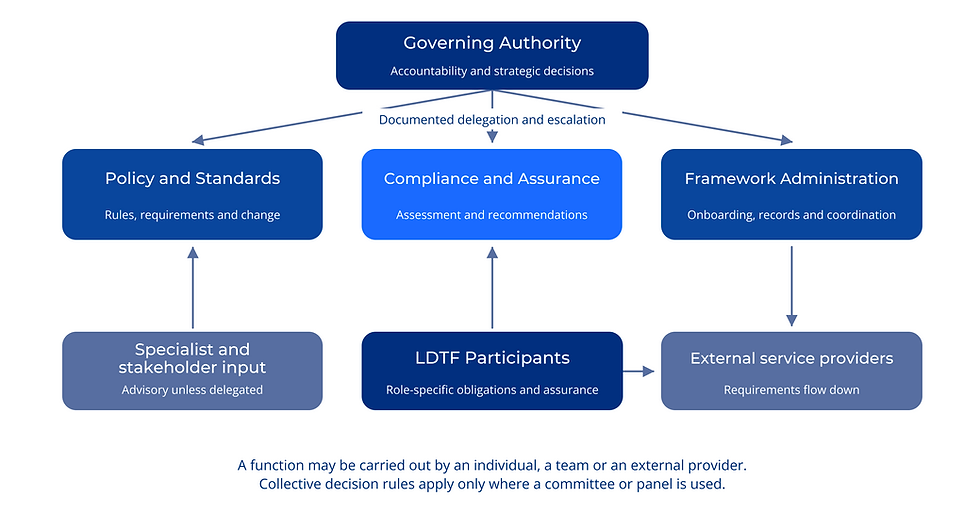
The governance of the LDTF MUST comprise the functions described below. A person or organisation MAY perform more than one function where responsibilities, decision-making authority and conflicts of interest are documented and appropriately managed. Framework Administration and Compliance and Assurance MUST have sufficient capacity for initial onboarding and continuing oversight, whether delivered internally, externally or through a combination.
Governing Authority
The Governing Authority is accountable for the overall governance and strategic direction of the LDTF.
The Governing Authority MUST:
-
Approve the LDTF and material changes to it;
-
Establish the strategic direction and governance principles of the LDTF;
-
Approve the establishment, mandate and delegated authority of governance functions;
-
Oversee the performance and effectiveness of the LDTF;
-
Consider significant risks affecting the LDTF or Next Gen NLIS ecosystem;
-
Resolve matters escalated beyond the authority of delegated functions;
-
Oversee material compliance, assurance and Participant matters requiring strategic intervention;
-
Monitor relevant legal, regulatory, technological and market developments and consider their implications for the LDTF.
-
Ensure that the governance arrangements remain appropriate as the ecosystem develops.
Policy and Standards function
The Policy and Standards function MUST oversee the development and maintenance of LDTF Policy, Rules, standards and associated requirements.
Within its delegated authority, the Policy and Standards function MUST:
-
Consider proposed changes to requirements;
-
Assess the impact of proposed changes upon Participants and the Next Gen NLIS ecosystem;
-
Maintain alignment between LDTF requirements, applicable standards, contractual arrangements and relevant legal or regulatory requirements;
-
Determine where specialist or stakeholder consultation is required;
-
Make decisions within its delegated authority; and
-
Submit material changes or matters outside its delegated authority to the Governing Authority for approval.
Compliance and Assurance function
The Compliance and Assurance function MUST oversee Participant conformity with applicable LDTF requirements.
The Compliance and Assurance function MUST have sufficient independence from Framework Administration to provide objective assurance.
The Compliance and Assurance function MUST:
-
Establish or apply the assurance requirements applicable to Participants;
-
Oversee certification, accreditation or other conformity assessment processes established under the LDTF;
-
Consider evidence of Participant compliance;
-
Oversee periodic or event-driven assurance activities;
-
Identify and report material non-conformities;
-
Require or recommend remediation where appropriate;
-
Escalate material or persistent non-compliance in accordance with the governance and compliance procedures; and
-
Provide assurance information to the Governing Authority necessary for effective oversight.
Where independent third parties undertake assessment, audit or certification activities, their role, competence, independence, authority and reporting obligations MUST be defined.
Framework Administration function
The Framework Administration function MUST be responsible for the day-to-day administration of the LDTF.
Within its delegated authority, the Framework Administration function MUST:
-
Administer Participant onboarding and lifecycle processes;
-
Maintain authoritative records of Participants, roles, status and relevant authorisations;
-
Maintain the Trust Registry or equivalent authoritative Participant record;
-
Administer LDTF documentation and approved changes;
-
Coordinate operational communications with Participants;
-
Maintain governance and administrative records;
-
Provide information required by other governance functions;
-
Administer routine compliance and Participant management activities within its delegated authority; and
-
Escalate matters requiring policy, assurance or strategic decisions to the function with the appropriate authority.
Framework Administration MUST NOT make policy, assurance or enforcement decisions outside its documented delegated authority.
Decision-making and delegation
Each governance function MUST have a documented mandate defining its responsibilities, decision-making authority, accountability, reporting obligations and escalation routes. Where a committee or panel performs the function, its terms of reference MUST also address membership, chairing, quorum and decision-making arrangements.
Governance decisions MUST be made at the lowest level possessing the necessary delegated authority.
Matters MUST be escalated where they:
-
Exceed delegated authority;
-
Would result in a material change to the LDTF;
-
Materially affect Participant rights or obligations;
-
Create significant legal, operational, financial or reputational risk;
-
Involve significant or systemic non-compliance; or
-
Cannot be resolved through the applicable governance process.
The Governing Authority MUST maintain a record of material delegations of authority.
Governance records and transparency
Material governance decisions MUST be recorded with sufficient information to establish the decision, the function or authority making it, the date and, where appropriate, the basis for it.
Governance records MUST be retained for an appropriate period and made available to authorised governance, assurance or audit functions where required.
Participants MUST be informed of governance decisions that materially affect their obligations, participation status or operation within the LDTF.
Review of governance arrangements
The Governing Authority MUST periodically review the effectiveness of the LDTF governance arrangements.
A review MUST also be undertaken where there is a material change to the Next Gen NLIS ecosystem, operating model, applicable law or regulation, Participant population, technology or risk environment that could materially affect the suitability of the governance arrangements.
Changes resulting from such reviews MUST be managed through the LDTF change management process administered by Framework Administration.
Governance functions
Each governance function MUST have a documented mandate appropriate to its purpose and the risks of the decisions it makes. A function MAY be carried out by an individual, a team, an external provider or a collective arrangement.
Mandate and delegation
The mandate MUST define the function’s purpose, responsibilities, accountable authority, delegated powers, reporting and escalation arrangements, competence requirements and arrangements for review. A function MUST operate within its mandate.
The Governing Authority MUST retain accountability for delegated functions. Assignment to an external provider MUST specify its duties, authority, access to information, reporting obligations and oversight arrangements.
Competence and representation
Those carrying out a function MUST possess, or have access to, the expertise needed for its responsibilities. Relevant Participants, trade bodies, professional organisations, public authorities, regulators, industry representatives and subject matter experts MAY provide input where this supports effective governance.
A Participant MAY nominate a supplier or other representative to fulfil an agreed representative role, but MUST remain accountable for that role and ensure the representative is bound by applicable governance obligations.
Governance arrangements MUST provide a means for matters arising within a delegated function to be reported to the function responsible for its oversight and for relevant expertise to inform decisions at that level. A person MAY carry out responsibilities across functions where appropriate, subject to documented authority and management of conflicts.
Conflicts of interest
Persons carrying out governance functions MUST declare actual, potential or perceived conflicts of interest relevant to matters under consideration. The responsible function MUST record and manage those conflicts. A person whose conflict could reasonably affect an objective decision MUST NOT take part in that decision unless the applicable arrangements permit it and suitable controls are in place.
Processes and decisions
Each function MUST maintain proportionate processes for receiving and considering matters, assigning responsibility, obtaining evidence and advice, making decisions within delegated authority, recording material reasons and actions, communicating outcomes, contributing to the LDTF risk register and escalating matters beyond its authority.
Where a collective arrangement carries out a function, its terms of reference MUST specify membership, chairing, quorum, voting or consensus arrangements, substitutes and decisions outside scheduled meetings. These requirements apply only where relevant to the form in which the function is performed.
A decision MUST be made only by a function or person possessing the necessary authority. Material decisions MUST identify the authority exercised and any resulting actions.
Specialist and stakeholder advice
The Governing Authority or a function with expressly delegated authority MAY establish a specialist advisory arrangement where stakeholder, technical, legal or operational input is required. This may take the form of a time-limited consultation, forum, panel or another suitable advisory arrangement.
A request for such an arrangement MUST set out its purpose, scope, participants, expected outputs, reporting route and anticipated duration. Its establishment MUST be approved by the Governing Authority or a function to which it has expressly delegated that authority. Framework Administration MUST maintain a record of approved arrangements.
Unless expressly delegated decision-making authority, an advisory arrangement MUST NOT create or change binding LDTF requirements, determine Participant status or exercise powers reserved to another function. Its recommendations MUST be referred to the function with authority to decide the matter.
Governance function records and reporting
Each function MUST maintain sufficient records to demonstrate the exercise of its responsibilities, including, where applicable, appointments, conflicts, matters considered, decisions, recommendations, actions and escalations.
A delegated function MUST report to its accountable authority at a frequency and level of detail appropriate to its mandate. Material risks, unresolved matters and decisions outside its delegated authority MUST be reported without undue delay.
Review
Governance functions MUST be reviewed periodically, normally at least annually, to determine whether their mandate, resourcing, delegated authority and operating arrangements remain appropriate. Changes to delegated authority MUST be approved by the authority empowered to make them.
Compliance obligations and assessment
All Participants in the LDTF MUST be subject to appropriate compliance and audit arrangements to provide assurance that they continue to meet the requirements applicable to their participation in the LDTF.
Compliance MUST be assessed against the requirements applicable to the Participant, including, as relevant:
-
LDTF Rules;
-
Participant and role-specific requirements;
-
User agreements and their schedules, operating agreements and other contractual obligations associated with participation in the LDTF;
-
Applicable technical, security, operational and assurance requirements;
-
Applicable legal and regulatory requirements; and
-
Any other binding instruments, conditions or obligations established under or recognised by the LDTF.
The requirements applicable to a Participant MUST be determined by its role, the services or functions it performs, the information it accesses, provides or processes, and any additional obligations arising from its participation in the LDTF.
Compliance with the LDTF is an ongoing obligation and MUST NOT be treated solely as a condition of initial onboarding or approval.
Participants MUST maintain sufficient records and evidence to demonstrate their compliance with applicable requirements and MUST make such evidence available for authorised compliance, assurance and audit activities.
The Governing Authority MUST establish and maintain arrangements for monitoring and assessing Participant compliance with the LDTF.
Compliance activities MUST be proportionate to the Participant's role, the nature and significance of the services it provides, the information it handles and the risks associated with its participation.
Compliance MAY be assessed through one or more mechanisms, including:
-
Participant attestations or declarations;
-
Review of compliance records and evidence;
-
Periodic or risk-based assessments;
-
Monitoring of operational performance or compliance indicators;
-
Investigation of incidents, complaints or suspected non-compliance;
-
Other assurance activities considered appropriate under the LDTF; and
-
Independent certifications or assurance reports.
The nature, scope and frequency of compliance activities MAY differ between Participant roles and MAY be adjusted in response to changes in risk, services, performance or compliance history.
Recognition of other compliance and assurance regimes
The LDTF MAY recognise compliance, certification, accreditation or assurance obtained under other recognised schemes, standards or regulatory regimes where these are relevant to demonstrating a Participant's compliance with the LDTF or associated instruments. Such regimes MAY include, but are not limited to:
-
Cyber Essentials or Cyber Essentials Plus (cyber security controls and protection against common cyber threats);
-
ISO/IEC 27001 (information security management);
-
ISO 9001 (quality management);
-
ISO 22301 (business continuity management);
-
ISO/IEC 20000-1 (IT service management);
-
ISO/IEC 27701 (privacy information management); and
-
Other recognised industry, professional or regulatory assurance schemes relevant to the Participant's role or activities.
Recognition of such evidence MUST be proportionate to its relevance, scope, currency and level of assurance and MUST NOT, by itself, be taken as evidence of compliance with LDTF requirements that fall outside the scope of the applicable scheme, standard or assurance activity.
Other equivalent international, national or industry standards MAY be accepted where the Compliance and Assurance function determines that they provide an appropriate and equivalent level of assurance for the applicable LDTF requirements.
Third-party and subcontracted services
Where a Participant relies upon a third party or subcontractor to perform a function, provide a service, operate a system or process, store or otherwise handle information that is subject to LDTF requirements, the applicable LDTF requirements MUST extend to those activities.
The Participant MUST ensure that the third party or subcontractor meets the compliance, security, assurance, audit and other LDTF requirements applicable to the functions, services, systems or information for which the third party or subcontractor is responsible.
The Participant MUST ensure that the requirements applicable to a third party or subcontractor are covered by its contractual or other binding arrangements. Existing arrangements MAY be relied upon where sufficient; any gap MUST be addressed through an appropriate variation or other binding measure. The arrangements MUST include rights to obtain evidence of compliance and support authorised assurance activity where required.
The use of a third party or subcontractor MUST NOT transfer or diminish the Participant's accountability for compliance with the LDTF.
Where a third party or subcontractor performs a key function or handles information material to the operation or security of the LDTF, the Compliance and Assurance function MAY require direct evidence of compliance, independent assurance or audit of that third party or subcontractor.
Where a third party or subcontractor provides equivalent functions or services to more than one Participant, evidence of compliance or assurance already established against defined LDTF requirements MAY be recognised and reused. The third party or subcontractor SHOULD NOT be required to repeat equivalent assurance activities for each Participant where the existing assurance remains current, valid and applicable to the functions or services being provided.
Reuse of such assurance MUST be limited to the requirements, functions, services and operating arrangements within its assessed scope. Each Participant MUST demonstrate that its use of the third party or subcontractor falls within that scope and MUST address any Participant-specific arrangements, configurations, integrations, responsibilities or risks that are not covered by the existing assurance.
The Participant MUST notify Framework Administration of a material change to a third party or subcontractor, the assured service, systems or operating arrangements that could affect compliance. The Compliance and Assurance function MUST determine whether existing assurance remains sufficient or proportionate further evidence or assessment is required.
Where permitted by the LDTF, a third party or subcontractor that has demonstrated compliance with defined requirements MAY be authorised to use a distinct Trust Mark appropriate to the scope of its assurance. Such use MUST NOT imply that the third party is an LDTF Participant unless separately authorised as one.
Changes to recognised compliance or assurance status
Where a Participant relies upon certification, accreditation, compliance or assurance under a third-party regime as evidence of its compliance with the LDTF or associated instruments, the Participant MUST notify the Compliance and Assurance function as soon as reasonably practicable where that certification, accreditation, compliance or assurance is withdrawn, suspended, expires without renewal, becomes subject to a material qualification or restriction, or otherwise ceases to provide the assurance previously relied upon.
The Participant MUST provide sufficient information to enable the impact upon its LDTF compliance to be assessed and MUST cooperate with any resulting compliance or assurance activity.
A change in third-party compliance or assurance status MUST be assessed to determine whether the Participant continues to meet the applicable LDTF requirements and whether remediation, additional assurance, restrictions or other action is required.
Periodic assessment and audit
Participants MUST cooperate with periodic or risk-based assessments and audits authorised under the LDTF and MUST provide reasonable access to relevant information, records, evidence, systems and personnel in accordance with the applicable arrangements.
The scope of an audit MUST be defined and MUST relate to requirements applicable to the Participant under the LDTF or associated binding instruments.
Audits MAY be undertaken by the Compliance and Assurance function, an appropriately authorised third party, or another authorised function to undertake the audit.
Persons or organisations undertaking audits MUST have appropriate competence and MUST be sufficiently independent of the activities being assessed to provide objective findings.
Where existing independent certification, audit or other assurance provides sufficient evidence of compliance with an LDTF requirement, the LDTF MAY recognise that evidence in place of undertaking duplicative assurance activity.
Such recognition MUST be based on an approved assurance profile or other documented assessment that identifies the external certification, audit or assurance scheme, the LDTF requirements against which it may be recognised, the scope and conditions of recognition, and any additional evidence or assessment required.
The LDTF MUST define the evidence required to demonstrate that the recognised certification, audit or assurance remains valid and applicable to the Participant and the activities within scope.
Non-compliance
Where a compliance or audit activity identifies actual or suspected non-compliance, the finding MUST be recorded and assessed in accordance with the applicable compliance process.
The Participant MUST be informed of material findings affecting its compliance status and, where appropriate, provided with an opportunity to respond and provide additional evidence.
The Participant MUST address identified non-compliance within any period specified by the applicable governance or assurance process.
The response to non-compliance MUST be proportionate to its nature, severity, duration and potential impact upon the LDTF, other Participants, relying parties or the integrity of the ecosystem.
Material, persistent or systemic non-compliance MUST be escalated to the function possessing the appropriate authority.
Non-compliance MAY result in corrective or remedial action, increased monitoring or assurance, restrictions upon participation, suspension or termination, in accordance with the applicable LDTF Rules and contractual or other binding arrangements.
Compliance records and reporting
Compliance and audit activities MUST be appropriately documented.
Records MUST include, as applicable, the scope and basis of the assessment, evidence considered, findings, identified non-compliance, required remediation, decisions made and closure of resulting actions.
Material compliance issues MUST be reported to the function with appropriate authority in accordance with the governance and escalation arrangements established under the LDTF.
Compliance records MUST be retained for an appropriate period and MUST be available to authorised governance, assurance and audit functions where required.
Certification and assurance
The LDTF MUST define the method by which compliance with applicable requirements is demonstrated and assessed for each Participant role and requirement.
The method of assurance MUST be proportionate to the nature of the Participant's role, the services and information for which it is responsible, the potential impact of non-compliance and the level of risk presented to the LDTF and its Participants.
Compliance and assurance methods MAY include:
-
Self-assessment or self-declaration against defined LDTF requirements;
-
Submission and review of documentary evidence;
-
Recognition of relevant existing certification, accreditation or other independent assurance;
-
Assessment or audit undertaken by the Framework Administration or Compliance and Assurance function;
-
Assessment, audit or certification undertaken by an appropriately qualified independent assurance body;
-
Periodic assessments or audits;
-
Targeted or for-cause audits arising from incidents, complaints, material changes or identified risks; and
-
Combinations of these methods where a single form of assurance does not provide sufficient evidence of compliance.
Where independent assurance is required, the LDTF MUST define any requirements applicable to the competence, independence, accreditation or approval of the body undertaking the assessment. The LDTF MAY require the use of an accredited or otherwise recognised certification or conformity assessment body where the nature or level of risk warrants independent assurance.
Where self-assessment is permitted, the Participant MUST provide an accurate assessment against the applicable requirements and MUST retain sufficient evidence to substantiate the assessment. The LDTF MAY require supporting evidence, undertake verification or subject the Participant to subsequent periodic assessment or audit.
The applicable assurance method, scope, frequency and level of evidence MAY vary between Participant roles and MAY vary between requirements applicable to the same Participant. A Participant MUST comply with the assurance method specified for its role and applicable requirements.
Risk and maturity
The Governing Authority MUST periodically review the compliance and assurance methods applied under the LDTF to ensure that they remain proportionate to risk and provide sufficient confidence in Participant compliance.
The level and method of assurance MAY change in response to the risk presented by a Participant or Participant role, changes to the services or information being provided, compliance history, incidents, changes to the wider ecosystem, or other factors that materially affect the level of assurance required.
The assurance model MAY also evolve as the LDTF matures. The LDTF MAY initially permit proportionate forms of self-assessment, existing third-party assurance or targeted assessment and subsequently introduce more formal, independent or standardised assurance requirements as participation, risk, operational experience and the maturity of the LDTF develop.
Changes to assurance requirements MUST be managed through the applicable LDTF governance and change management processes and MUST be communicated to affected Participants.
Assurance outcomes
The outcome of an assurance activity MUST be recorded and MUST provide sufficient information to determine whether the Participant meets the applicable LDTF requirements.
Where assurance identifies deficiencies or non-compliance, the Participant MAY be required to provide additional evidence, undertake corrective action or remediation, or undergo further assessment before compliance is accepted or continued participation is permitted.
The LDTF MUST define the authority responsible for accepting assurance outcomes and determining whether the evidence provided is sufficient to demonstrate compliance.
Continuing assurance
Certification, assessment or other evidence of compliance MUST remain valid and appropriate for the period for which it is relied upon.
The LDTF SHOULD define periods of validity, reassessment or renewal requirements, periodic assessment or audit activities or other continuing assurance requirements appropriate to the Participant role and level of risk.
Participants MUST notify the Framework Administration or Compliance and Assurance function of material changes that could affect the validity of an assurance outcome or their continued compliance with applicable requirements.
Such changes MAY include material changes to services, systems, operating arrangements, ownership or control, key suppliers, certifications or accreditations, or other circumstances upon which the previous assessment relied.
Additional assurance
The LDTF MAY require additional or enhanced assurance where existing evidence is insufficient to provide appropriate confidence in a Participant's compliance.
Additional assurance MAY be required following a material change, incident, complaint, identified non-compliance, deterioration in compliance or assurance status, significant change in risk, or other circumstances that give reasonable grounds to reconsider the Participant's compliance.
The requirement for additional assurance MUST be proportionate to the nature and significance of the matter giving rise to it.
Participant status and continuity
Onboarding and transition
An organisation MUST complete the applicable onboarding process before becoming a Participant in the LDTF.
Onboarding MUST establish that the organisation is eligible to perform the applicable Participant role, has entered into or is otherwise bound by the applicable agreements, schedules and other legal or binding instruments, and has demonstrated compliance with the LDTF requirements applicable to that role.
The onboarding and compliance requirements applicable to a Participant MUST be determined by its Participant role and the applicable Policy, Rules, schedules, agreements and other associated instruments.
Where an organisation performs more than one Participant role, the LDTF MUST determine the onboarding and compliance requirements applicable to each role and whether evidence provided for one role may be relied upon for another.
A Participant MUST NOT be recorded as active in the Trust Registry, or exercise rights or authorisations arising from participation, until the applicable onboarding requirements have been satisfactorily completed or a transitional arrangement expressly permitted by the LDTF applies.
Transition of existing NLIS users
Existing users of NLIS who will participate in Next Gen NLIS MAY be onboarded into the LDTF through a phased transitional process during the switchover. Each MUST undergo due diligence and assessment against the requirements applicable to its intended Participant role.
Existing evidence of onboarding, compliance or assurance MAY be recognised where it is determined to be current, relevant and equivalent to the applicable LDTF requirements. Where such equivalence is established, the Participant MAY be granted a waiver from repeating the corresponding onboarding or assurance activity.
Any requirements for which existing evidence is absent, insufficient or not equivalent MUST be satisfied through the transitional onboarding process, including through additional evidence, self-assessment, assurance or remedial action as applicable.
The basis for any equivalence determination or waiver MUST be documented. Where a waiver is granted an associated memorandum of understanding may be issued that contains appropriated mitigation and a remediation plan.
As part of transitional onboarding, each existing Participant MUST confirm its compliance with the LDTF requirements applicable to its role. This MAY initially be demonstrated through self-assessment or self-certification, supported by such evidence as the LDTF considers appropriate.
Acceptance through the transitional onboarding process MUST NOT remove the Participant's obligation to comply with the LDTF or prevent the LDTF from subsequently requiring further evidence, independent assurance, audit or other compliance activity.
Where transitional onboarding identifies requirements that have not yet been fully satisfied, remedial action MAY, by exception, be agreed and managed under the transitional arrangements for the switchover to Next Gen NLIS.
Any such switchover remediation MUST be documented, identify the outstanding requirements and actions required, assign responsibility for their completion and specify an appropriate period for remediation.
The use of switchover remediation MUST NOT be permitted where the identified deficiency presents an unacceptable risk to the security, integrity or operation of the LDTF, its Participants, relying parties or information.
The Governing Authority MUST determine when the switchover arrangements cease to apply. Following the end of the switchover period, all Participants MUST be subject to the normal onboarding, compliance, assurance and remediation requirements of the LDTF.
Organisational change and transfer of responsibility
Changes to the organisational structure, legal status, ownership, responsibilities or operating arrangements of a Participant MUST NOT, in themselves, remove, suspend or transfer the Participant's obligations under the LDTF.
Where an organisational change affects multiple Participants, each Participant MUST continue to comply independently with the LDTF and its applicable Rules, schedules, agreements and other associated instruments until responsibility has been formally transferred to, and accepted by, another organisation in accordance with the applicable contractual and LDTF requirements.
A Participant undergoing, or becoming aware of, a material organisational change that could affect its participation or compliance MUST notify Framework Administration or the Compliance and Assurance function as soon as reasonably practicable.
Framework Administration and the Compliance and Assurance function MUST assess the effect of the change upon the Participant’s status, responsibilities, assurance and compliance requirements and determine whether further evidence, assessment, onboarding or other action is required.
Responsibility for compliance MUST NOT be treated as transferred solely because operational functions, personnel, systems, assets or services have transferred between organisations.
A transfer of responsibility MUST only take effect for the purposes of the LDTF when:
-
The organisation assuming responsibility has formally accepted the applicable LDTF obligations;
-
Any applicable contractual or other binding arrangements have been established or amended;
-
Any required onboarding, compliance or assurance activities have been satisfactorily completed;
-
The transfer has been approved or recognised by the appropriate LDTF authority; and
-
The Participant records and Trust Registry have been updated to reflect the change.
Until these conditions have been satisfied, each existing Participant MUST remain accountable for the LDTF obligations applicable to it.
The LDTF MAY establish transitional arrangements where necessary to maintain continuity of participation, services, information and accountability during organisational change. Such arrangements MUST clearly identify the Participants involved, their respective responsibilities, the period for which the transitional arrangements apply and the conditions under which responsibility will transfer.
Following completion of a transfer, the Framework Administration MUST ensure that the Trust Registry and other authoritative records identify the organisation accountable for the applicable Participant role and the effective date from which that responsibility applies.
Continuity and recognition of existing status
For the purposes of the LDTF, recognition of existing status means the controlled recognition and continuation or transfer of an existing Participant's participation rights, approvals, authorisations, assurance outcomes or other recognised status following an organisational or structural change, without requiring the affected organisation to repeat requirements that have already been satisfactorily met.
Recognition of existing status MAY be permitted where the Governing Authority determines that existing participation or compliance arrangements remain applicable and that their continuation or transfer does not materially increase risk to the LDTF or its Participants.
Recognition of existing status MUST NOT be automatic. The appropriate LDTF authority MUST determine whether existing rights or participation status may be recognised by a successor or reorganised Participant and whether any conditions, additional evidence or assurance are required.
In determining whether recognition of existing status is appropriate, consideration SHOULD be given to the continuity of the Participant's functions, responsibilities, personnel, systems, services, contractual arrangements, assurance status and risk profile, and to any material change in the legal entity or operating arrangements.
Recognition of existing status MAY apply to all or part of a Participant's existing participation, rights, approvals or assurance status and MAY be subject to conditions, limitations or a defined transitional period.
Where recognition of existing status is permitted, the decision, its scope, any conditions and its effective date MUST be documented, and the Trust Registry and other applicable Participant records MUST be updated accordingly.
Recognition of existing status MUST NOT remove any obligation to comply with applicable LDTF requirements and MUST NOT prevent the LDTF from requiring additional assurance or reassessment where subsequently considered necessary.
Until recognition of existing status or transfer has been formally approved, the existing accountability and compliance arrangements MUST continue to apply.
Termination and leaving the LDTF
A Participant's participation in the LDTF MAY end through voluntary withdrawal, termination by the Governing Authority or another function with delegated authority, expiry or termination of an applicable agreement, cessation of the Participant's relevant activities, or another circumstance defined by the LDTF or associated contractual arrangements.
Termination or withdrawal MUST be managed in a controlled manner to protect the continuity, integrity and security of the LDTF, its Participants, relying parties and information.
Voluntary withdrawal
A Participant MAY withdraw from the LDTF in accordance with the notice periods, conditions and processes established by the LDTF and applicable contractual arrangements.
A Participant intending to withdraw MUST notify the Framework Administration in accordance with the terminate procedures as set out in the relevant User Agreement and MUST cooperate with activities reasonably necessary to manage its exit.
Withdrawal MUST NOT take effect until the applicable exit requirements have been completed or the effective date of withdrawal has otherwise been agreed or determined in accordance with the applicable contractual arrangements.
Termination of participation
A Participant's participation MAY be terminated where permitted by the LDTF or applicable contractual arrangements.
Grounds for termination MAY include:
-
Material, persistent or systemic non-compliance;
-
Failure to remediate identified non-compliance within a required period;
-
Loss of a certification, authorisation, licence or other status necessary for participation;
-
Conduct that creates an unacceptable risk to the LDTF, other Participants or relying parties;
-
Material breach of an applicable agreement;
-
Insolvency, dissolution or cessation of relevant activities; or
-
Other grounds for termination established by the LDTF or applicable contractual arrangements.
Except where immediate action is necessary to manage a material risk, the Participant SHOULD be informed of the grounds for proposed termination and provided with an appropriate opportunity to respond or remediate before a final decision is made. A decision to terminate participation MUST be made by the function possessing the necessary delegated authority and MUST be recorded.
Exit requirements
On withdrawal or termination, the Participant MUST comply with applicable exit requirements.
These MAY include requirements to:
-
Cease representing itself as an active or approved LDTF Participant;
-
Cease exercising rights, permissions or authorisations arising from participation;
-
Return, revoke, disable or securely dispose of credentials, keys, certificates or other access mechanisms where required;
-
Complete or appropriately transfer outstanding transactions, responsibilities or services;
-
Cease using the Trust Mark and cease any representation, branding, marketing or other activity that could reasonably imply current participation in, approval by, endorsement by or association with the LDTF, Land Data or NLIS, except where expressly permitted;
-
Preserve, transfer, return or securely dispose of information in accordance with applicable requirements;
-
Provide information or assistance necessary to support an orderly transition;
-
Complete outstanding compliance, remediation or reporting obligations where these remain applicable; and
-
Satisfy any other exit obligations established by the LDTF or applicable contractual arrangements.
The Framework Administration MUST update the Trust Registry and other authoritative records to reflect the Participant's changed status and the effective date of withdrawal or termination.
Relevant Participants and relying parties MUST be informed where the change in status materially affects their ability to rely upon, interact with or receive services from the departing Participant.
Continuing obligations
Withdrawal or termination MUST NOT extinguish obligations that, by their nature or under the applicable LDTF Rules, legal requirements or contractual arrangements, are intended to continue after participation ends.
Continuing obligations MAY include requirements relating to confidentiality, information protection, retention and disposal, audit records, evidence, liability, dispute resolution, outstanding compliance matters and cooperation with investigations relating to activities undertaken while the organisation was a Participant.
The period for which an obligation continues MUST be determined by the applicable LDTF requirement, legal requirement or contractual arrangement.
Re-entry
A former Participant seeking to re-enter the LDTF MUST follow the onboarding and assurance requirements applicable at the time of re-entry.
The LDTF MAY take account of previous participation, assurance and compliance history when determining the onboarding or assurance activities required.
Previous participation MUST NOT create an automatic entitlement to re-entry or restoration of previous rights or authorisations.
Participant status and Trust Marks
The LDTF MAY establish one or more Trust Marks to identify an approved status. The Governing Authority MUST define what each Trust Mark represents, including whether it indicates participation, a specified assurance status or another approved status. A participation mark MUST NOT imply independent certification unless that claim is expressly authorised. The LDTF MAY also maintain a digitally signed online list of Participants.
Use of each Trust Mark MUST be subject to rules established by the Governing Authority. These rules MUST define eligibility, the claim made, permitted scope and presentation, and the circumstances in which authorisation may be suspended or withdrawn.
A Participant MUST NOT use the Trust Mark in a manner that misrepresents the scope of its participation, compliance, assurance status, services or activities. Where participation or compliance applies only to particular roles, services or activities, use of the Mark MUST NOT imply that other parts of the Participant's organisation or services have been assessed or approved under the LDTF.
The LDTF MAY establish different forms or levels of the Mark where it is necessary to distinguish between Participant status, compliance status, certification or other levels of assurance.
Right to use a Trust Mark
A Participant MAY use the Trust Mark only while it satisfies the eligibility requirements established for its use.
The right to use the Mark MUST NOT, by itself, constitute certification, accreditation, regulatory approval or a warranty of the Participant or its services unless the LDTF expressly defines the Mark as representing such status.
The Governing Authority or an appropriately delegated function MAY suspend or withdraw a Participant's right to use the Trust Mark where the Participant no longer satisfies the applicable requirements, its compliance or assurance status is under review, or continued use could misrepresent its status under the LDTF.
Cessation of use
Where a Participant withdraws from, is terminated from, or otherwise ceases to participate in the LDTF, any right to use a Trust Mark based upon that participation MUST cease from the effective date of the change in status.
The former Participant MUST cease displaying or representing itself as entitled to use the Trust Mark and MUST, within any period specified by the LDTF, remove the Mark from websites, documentation, marketing materials, systems and other materials under its control.
Where use of the Trust Mark has been suspended, the Participant MUST cease its use for the duration of the suspension unless expressly permitted otherwise.
Termination, withdrawal or suspension of the right to use the Trust Mark MUST NOT require the alteration or destruction of historical records where the Mark accurately represented the Participant's status at the time the record was created, provided that continued retention cannot reasonably be interpreted as representing current participation or compliance.
Protection and misuse
Participants MUST NOT permit another organisation to use the Trust Mark by virtue of their own participation unless expressly permitted under the LDTF.
Actual or suspected unauthorised, misleading or fraudulent use of the Trust Mark MAY be treated as a compliance matter and MAY result in enforcement action under the LDTF or applicable contractual, intellectual property or other legal arrangements.
The Framework Administration MUST maintain sufficient records to establish which Participants are currently authorised to use the Trust Mark and the status upon which that authorisation is based.
Third-party and subcontractor use of a Trust Mark
Where permitted by the LDTF, a third party or subcontractor that has independently demonstrated compliance with defined requirements MAY be authorised to use a distinct Trust Mark appropriate to the scope and status of that assurance. Such use MUST NOT imply that the organisation is an LDTF Participant unless it is separately authorised as one.
Use of the Trust Mark by a subcontractor MUST be limited to the functions, services or products within the scope of the assurance upon which the authorisation is based and MUST NOT imply that the subcontractor is an LDTF Participant where this is not the case.
The right to use the Trust Mark MUST be subject to the applicable LDTF branding and usage requirements and MAY be suspended or withdrawn where the subcontractor's assurance expires, is suspended or withdrawn, or the subcontractor otherwise ceases to meet the conditions under which use was authorised.
Where the same assured function, service or product is provided to multiple Participants, the subcontractor MAY continue to use the Trust Mark without obtaining separate authorisation in respect of each Participant, provided that the underlying assurance remains valid and applicable.
Enforcement and dispute resolution
Principles
The LDTF MUST maintain arrangements for responding to non-compliance, breaches of LDTF requirements and other conduct that may adversely affect the operation, security, integrity or trustworthiness of the LDTF.
Enforcement action MUST be proportionate to the nature, severity, duration and potential impact of the matter and SHOULD, where appropriate, provide a Participant with a reasonable opportunity to remedy non-compliance before more restrictive action is taken.
In determining the appropriate response, consideration SHOULD be given to:
-
The nature and severity of the non-compliance;
-
The actual or potential impact upon the LDTF, other Participants, relying parties or information;
-
Whether the matter is isolated, repeated, persistent or systemic;
-
The Participant's compliance history;
-
The Participant's willingness and ability to remediate the matter;
-
Whether the Participant notified the LDTF of the matter and cooperated with its resolution;
-
Any immediate or continuing risk arising from the non-compliance; and
-
Any mitigating or aggravating circumstances relevant to the matter.
Enforcement action under the LDTF MUST NOT prevent action being taken under applicable contractual arrangements, law or regulation where separately available or required.
Remediation and corrective action
Where non-compliance can reasonably be remedied without unacceptable risk to the LDTF, the Participant MAY be required to undertake corrective or remedial action.
Required remediation MUST identify the non-compliance to be addressed, the action or outcome required and the period within which remediation is expected to be completed.
The Participant MUST cooperate with the remediation process and provide sufficient evidence to demonstrate completion of required actions.
The Compliance and Assurance function MAY undertake or require additional assessment, audit or assurance to confirm that remediation has been satisfactorily completed.
Failure to complete agreed or required remediation within the applicable period MAY result in escalation or further enforcement action.
Enforcement measures
Where appropriate, the function with documented delegated authority MAY apply one or more enforcement measures in response to non-compliance. The Compliance and Assurance function MUST assess the matter and MAY recommend action; material decisions MUST be reserved to or escalated to the Governing Authority as defined in the delegation.
Measures MAY include:
-
A requirement to provide further information or evidence;
-
A formal notification or warning;
-
A requirement to undertake corrective or remedial action;
-
Increased monitoring, reporting, audit or assurance;
-
Conditions or restrictions upon particular activities, services, permissions or authorisations;
-
Suspension of particular rights or authorisations;
-
Suspension of participation in the LDTF;
-
Suspension or withdrawal of the right to use the Trust Mark;
-
Termination of participation; and
-
Where an enforcement measure affects only a particular role, service or activity, the authorised function MAY restrict the measure to that scope where doing so provides sufficient protection.
The imposition of an enforcement measure MUST be documented together with its basis, scope, effective date, any conditions attached to it and, where applicable, the requirements for its removal.
Where an enforcement measure affects only a particular role, service or activity, the LDTF MAY restrict the measure to that scope where doing so provides sufficient protection.
Suspension
A Participant's participation, or specified rights, services, permissions or authorisations associated with its participation, MAY be suspended where continued unrestricted participation presents an unacceptable risk or where suspension is otherwise permitted under the applicable LDTF or contractual arrangements.
Suspension MAY be imposed where:
-
Material non-compliance has been identified;
-
Required remediation has not been completed;
-
A material incident or risk requires investigation;
-
Certification, accreditation, authorisation or other assurance relied upon by the LDTF has been suspended or withdrawn;
-
The Participant has failed to cooperate with an authorised compliance or assurance activity; or
-
Other circumstances create reasonable grounds to restrict participation pending investigation, remediation or determination.
Suspension MUST NOT, by itself, terminate the Participant's membership of or obligations under the LDTF.
The scope and conditions of suspension MUST be documented and communicated to the Participant. The Participant MUST continue to comply with all LDTF obligations that remain applicable during the suspension.
Where appropriate, the Participant MUST be informed of the actions or conditions necessary for suspension to be lifted.
The Framework Administration MUST ensure that the Participant's status and any affected rights or authorisations are appropriately reflected in the Trust Registry.
Where a suspension materially affects other Participants or relying parties, those parties MUST be informed where necessary to prevent inappropriate reliance upon the suspended Participant, service or authorisation.
Urgent and protective action
Framework Administration, or another function with expressly delegated authority, MAY take immediate protective action where there are reasonable grounds to believe that continued participation or activity presents a material and immediate risk to the LDTF, its Participants, relying parties, information or services.
Such action MAY include immediate restriction or suspension without completion of the normal remediation or enforcement process. Circumstances MAY include a material cyber security compromise, loss or suspected compromise of cryptographic keys, or another incident creating an immediate risk.
Any urgent action MUST be limited to what is reasonably necessary to manage the identified risk and MUST be subject to review as soon as reasonably practicable.
The affected Participant MUST be informed of the action, the reason for it and the applicable review or dispute process as soon as it is appropriate to do so.
Enforcement decisions
Enforcement decisions MUST be made by the function with appropriate authority or function possessing the necessary delegated authority.
The Participant MUST be informed of any material enforcement decision affecting its participation and MUST be provided with sufficient information to understand the basis for the decision, subject to any lawful restrictions upon disclosure.
Except where urgent protective action is required, a Participant SHOULD be provided with an appropriate opportunity to respond to material findings before a decision to suspend or terminate participation is made.
Material enforcement decisions MUST be recorded, including the evidence considered, the decision made, the authority under which it was made and any resulting actions or conditions.
Review and appeal
A Participant MUST have access to a documented process, administered by Framework Administration, through which it may request review of a material compliance or enforcement decision affecting its participation, rights or authorisations.
The review process MUST define the grounds upon which review may be requested, the period within which a request must be made, the body responsible for considering the review and the possible outcomes.
Where reasonably practicable, a review SHOULD be undertaken by persons who were not responsible for the original decision.
A request for review MUST NOT automatically suspend the original decision. The body responsible for the review MAY suspend, vary or otherwise modify the effect of the decision while the review is undertaken where appropriate.
The outcome of the review and the reasons for it MUST be recorded and communicated to the Participant.
Dispute resolution
The LDTF MUST maintain operational and governance steps for resolving disputes arising from participation in, or the operation or interpretation of, the LDTF. The applicable agreement MUST identify the binding dispute resolution route and its relationship to those steps.
Participants SHOULD seek to resolve disputes at the lowest appropriate level and through the applicable operational or governance process before formal escalation.
Where a dispute cannot be resolved, it MUST be escalated in accordance with the applicable governance arrangements.
The dispute resolution process MUST provide, as appropriate, for:
-
Recording and notification of the dispute;
-
Identification of the matters in dispute;
-
Exchange of relevant information and evidence;
-
Consideration by a function or person with appropriate authority;
-
Escalation where agreement cannot be reached;
-
Use of mediation, independent expert determination or another agreed resolution mechanism where appropriate; and
-
Recording and communication of the outcome.
Where a dispute concerns contractual rights or obligations, the dispute resolution provisions of the applicable agreement MUST apply in accordance with that agreement.
Use of the LDTF dispute resolution process MUST NOT prevent a Participant or the Governing Authority from exercising rights or remedies available under applicable contractual arrangements or law.
Suspension and other enforcement measures MAY result in termination where the underlying matter cannot be satisfactorily remedied, where required conditions are not met, or where continued participation presents an unacceptable risk.
Termination MUST be undertaken in accordance with the applicable Participant status and continuity requirements and any applicable contractual arrangements.
Termination MUST NOT remove liabilities, obligations or responsibilities that are required to survive the end of participation.
Relationship with other Trust Frameworks
The LDTF MAY operate alongside, interact with or establish relationships with other trust frameworks, assurance schemes or equivalent governance arrangements that currently exist or are established in the future.
Such relationships MAY enable the LDTF and other trust frameworks to recognise or rely upon relevant governance, compliance, assurance or certification activities undertaken within their respective frameworks. The purpose of such recognition is to support interoperability, reduce unnecessary duplication of assurance and enable existing evidence of trust and compliance to be reused where appropriate.
The establishment of a relationship with another trust framework MUST NOT, by itself, alter the governance, authority, accountability or operation of the LDTF. Land Data MUST remain responsible for the governance of the LDTF and Participants MUST remain subject to all LDTF requirements applicable to their participation.
Recognition of another trust framework MUST NOT, by itself, make that framework, its governing body or its participants part of the LDTF.
Recognition of other Trust Frameworks
The Governing Authority MAY recognise another trust framework, or specified elements of another trust framework, where it determines that the requirements, controls or assurance provided are relevant to requirements established under the LDTF.
Recognition MAY include:
-
Organisational identity, eligibility or status;
-
Participant onboarding or due diligence;
-
Compliance assessments;
-
Certification, accreditation or other assurance;
-
Technical, information security or operational requirements;
-
Audit or periodic assessment or audit activities;
-
Professional or regulatory requirements; and
-
Other requirements or evidence considered relevant to establishing compliance with the LDTF.
Recognition MAY apply to an entire trust framework, a defined Participant role, a particular service, a specified set of requirements or individual elements of compliance or assurance.
Before recognising another trust framework, the Governing Authority MUST consider the relevance, scope, equivalence, currency and level of assurance provided by that framework in relation to the corresponding LDTF requirements.
Where requirements are not equivalent, or the assurance provided is insufficient for the purposes of the LDTF, the Participant MUST satisfy any additional LDTF requirements applicable to its participation.
Recognition of compliance and assurance
Compliance, certification, assessment or other assurance obtained under a recognised trust framework MAY be accepted as evidence towards demonstrating compliance with corresponding LDTF requirements.
Acceptance of such evidence MUST be limited to the requirements and scope for which the evidence provides appropriate assurance.
Acceptance of evidence from another trust framework MUST NOT, by itself, constitute acceptance of an organisation as an LDTF Participant or demonstrate compliance with requirements that fall outside the scope of the recognised evidence.
The LDTF MAY require additional evidence, assessment, certification or assurance where necessary to demonstrate compliance with requirements specific to the LDTF or the Participant's role.
Participants MUST remain accountable for demonstrating their compliance with all requirements applicable to their participation in the LDTF, irrespective of whether evidence from another trust framework has been accepted.
Mutual recognition
The Governing Authority MAY establish mutual recognition arrangements with another trust framework under which each framework recognises specified compliance, assurance, certification, status or other outcomes established by the other.
Mutual recognition MAY enable Participants to reuse relevant evidence of compliance or assurance between frameworks without unnecessarily repeating equivalent assessment or certification activities.
A mutual recognition arrangement MUST define, as applicable:
-
The trust frameworks and organisations to which the arrangement applies;
-
The requirements, Participant roles, services or assurance outcomes that are recognised;
-
Any requirements that remain specific to each trust framework;
-
The basis and level of assurance upon which recognition is provided;
-
Arrangements for establishing and periodically reviewing equivalence;
-
Information sharing and notification requirements;
-
The effect of material changes to either trust framework;
-
The effect of non-compliance, suspension, withdrawal, termination or loss of assurance within either framework; and
-
Arrangements for modifying, suspending or terminating the recognition arrangement.
Mutual recognition MUST NOT, unless expressly provided for through an approved arrangement, transfer governance authority, responsibility or accountability between the respective trust frameworks.
Governance and compliance independence
The LDTF MUST retain its own governance, Participant management, compliance, assurance, enforcement and dispute resolution arrangements irrespective of any recognition or mutual recognition arrangement with another trust framework.
Decisions concerning participation in, compliance with, suspension from or termination from the LDTF MUST remain subject to the governance and authority established under the LDTF.
Another trust framework MAY provide evidence, assurance or other information upon which an LDTF decision is based, but recognition of that evidence MUST NOT transfer responsibility for the resulting LDTF decision to the other framework.
Similarly, recognition by another trust framework of LDTF Participants, requirements or assurance outcomes MUST NOT alter Land Data's responsibilities for the governance and operation of the LDTF.
Participants operating under more than one trust framework MUST remain independently responsible for satisfying the requirements applicable under each framework, except to the extent that requirements or evidence have been formally recognised.
Changes to recognised Trust Frameworks
Recognition of another trust framework MUST remain appropriate for the period during which the LDTF relies upon it.
Where Land Data becomes aware of a material change to the governance, requirements, assurance arrangements, certification, scope or operation of a recognised trust framework, the Governing Authority MUST determine whether the basis for recognition remains valid.
Recognition MAY be maintained, modified, restricted, suspended or withdrawn where the other trust framework no longer provides the scope or level of assurance upon which recognition was based.
Where a change to, or loss of recognition of, another trust framework affects evidence relied upon to demonstrate a Participant's compliance with the LDTF, the Participant MAY be required to provide alternative evidence, undertake additional assurance or demonstrate compliance with the affected LDTF requirements directly.
Federation with other Trust Frameworks
The Governing Authority MAY establish formal federation arrangements with other trust frameworks where this supports trusted interoperability, participation, exchange of information or delivery of services across framework boundaries.
A federation arrangement MUST clearly define the governance boundaries and respective responsibilities of each participating trust framework.
The arrangement MUST define, as applicable, the trust relationships being established, requirements being recognised, Participant eligibility, assurance arrangements, information sharing, decision-making responsibilities, incident and compliance notification, dispute resolution and arrangements for suspension or termination of the federation.
Participation in a federation MUST NOT diminish Land Data's accountability for the governance of the LDTF or a Participant's accountability for meeting the requirements applicable to its participation in the LDTF.
Unless expressly provided for by an approved federation arrangement, each trust framework MUST remain independently governed and responsible for its own Participants, compliance decisions and enforcement actions.
The Land Data Trust Framework was developed by The ID Crowd, under the direction and oversight of Fiona Barron and Davina Reid-Phillips, on behalf of Land Data.
The Framework has been developed in consultation with Land Data, its participating organisations and relevant stakeholders, drawing upon established principles of digital trust, information governance, assurance and interoperability.
The authors acknowledge the contributions of Land Data colleagues, subject matter experts and industry participants whose knowledge, experience and feedback have informed the development of the Framework.
Framework Ownership and Governance
The Land Data Trust Framework is maintained under the authority of Land Data, which is responsible for its governance, approval, publication and ongoing development.
Document Status
This document is subject to periodic review and amendment in accordance with the governance arrangements established under the Trust Framework.
Owned by Land Data
Author The ID Crowd
Document Date 14th October 2026
Land Data Trust Framework
Needs, Rules and Governance

Best viewed on desktop
We’re still improving the mobile layout of this page. For the best experience, please view it on a desktop or laptop.
Thank you for your patience.
The Land Data Trust Framework was developed by The ID Crowd, under the direction and oversight of Fiona Barron and Davina Reid-Phillips, on behalf of Land Data.
The Framework has been developed in consultation with Land Data, its participating organisations and relevant stakeholders, drawing upon established principles of digital trust, information governance, assurance and interoperability.
The authors acknowledge the contributions of Land Data colleagues, subject matter experts and industry participants whose knowledge, experience and feedback have informed the development of the Framework.
Framework Ownership and Governance
The Land Data Trust Framework is maintained under the authority of Land Data, which is responsible for its governance, approval, publication and ongoing development.
Document Status
This document is subject to periodic review and amendment in accordance with the governance arrangements established under the Trust Framework.
Land Data Trust Framework Glossary
Term | Definition |
|---|---|
Third Party | An organisation other than the directly accountable Participant that provides a service, performs an activity or otherwise interacts with the Participant or LDTF ecosystem. |
Trust | The justified confidence that a Participant, service, process or information will behave or be handled in accordance with the rules, responsibilities and assurances established by the LDTF. |
Trust Framework | A documented set of rules, roles, responsibilities, standards and assurance arrangements through which participating organisations establish and maintain confidence in their interactions. |
Trust Status | The recorded status assigned to a Participant as a result of the LDTF onboarding, compliance and assurance processes, including any relevant conditions, exceptions or restrictions. |
Trusted Data | Information for which sufficient confidence in source, provenance, integrity and handling has been established in accordance with the applicable LDTF requirements. |
Trusted Exchange | The exchange of information between parties under the governance, controls and assurance arrangements established or recognised by the LDTF. |
User Agreement | The contractual agreement governing a Participant�s use of relevant Land Data or Next Gen NLIS services and through which applicable LDTF obligations may be incorporated or accepted. |
Verification | The process of checking that information, evidence, an assertion or other claim is valid and satisfies the relevant criteria. |
Waiver | A formally authorised and recorded decision permitting a Participant, subject to specified conditions, to continue despite not meeting an Applicable Requirement in the normal manner. A waiver may be time-limited and may require remediation. |
Contents
Rules
Owned by Land Data
Author The ID Crowd
Document Date 13th October 2026
Land Data Trust Framework
Needs, Rules and Governance
Introduction to the Land Data Trust Framework (LDTF)
Buying and selling property is one of the most important financial transactions that most people and organisations will undertake. Every transaction depends on many independent organisations working together to exchange information, confirm legal rights and fulfil their respective responsibilities.
These organisations include buyers and sellers, conveyancers, mortgage lenders, estate agents, local authorities, HM Land Registry, search providers and Land Data. Each plays a different role, but every participant depends on information provided by others. The accuracy, integrity and timely exchange of that information are essential to completing a property transaction safely and efficiently.
Conveyancing searches uncover legal, environmental and structural risks about a property before a buyer legally commits to purchase. They inform solicitors and mortgage lenders about liabilities so they can advise accordingly.
Land Data plays an important role within this ecosystem by enabling the delivery of authoritative property information, including local authority search information, through the National Land Information Service (NLIS). This helps authorised organisations obtain the information they need from authoritative sources through a consistent and reliable service.
As the property sector continues to modernise, organisations increasingly rely on digital services to exchange information and support property transactions. Participants need confidence that they are dealing with legitimate organisations, that information originates from an authorised source, that it has not been altered without authority, and that each participant is operating to agreed standards.
The LDTF establishes the rules, responsibilities and operating arrangements that enable this confidence. It provides a common framework through which participating organisations can work together, exchange information securely and consistently, and establish mutual trust.
Enabling Future Expansion
The LDTF provides a scalable model that can accommodate new participants, new services and any future government initiatives to restructure the sector, without requiring the underlying trust arrangements to be redesigned. This is achieved by establishing a common framework for trust that is independent of any individual service or business process. The same principles apply whether information is requested at the start of a property transaction or further into the conveyancing process.
Structure of a Trust Framework
Needs of the LDTF
Purpose
The purpose of the LDTF is to establish the common rules, responsibilities and assurance arrangements that enable organisations to exchange and rely upon authoritative property information with confidence. It provides a consistent framework through which organisations can participate, exchange information and rely upon one another's services while maintaining confidence in the provenance, integrity and appropriate use of that information.
The information made available through the National Land Information Service (NLIS) is fundamental to the conveyancing process and supports the legal, financial and commercial decisions made by buyers, sellers, conveyancers, mortgage lenders and other participants.
This information may identify legal restrictions, planning matters, highways information and other issues that could affect a purchaser's decision to proceed, influence the value of a property or impact a lender's willingness to provide finance. The value of this information depends on more than its content alone. Participants must have confidence that it has been provided by the appropriate authoritative organisation, obtained through an authorised process, and has not been altered without authority. This confidence enables authorised participants to rely upon the information when making decisions, not only during the conveyancing process but throughout the lifetime of property ownership.
The LDTF governs participation in the Next Generation NLIS ecosystem and does not supersede the statutory responsibilities, legal obligations or professional duties of participants.
LDTF participants are accountable for the obligations they undertake, and liability is determined by whether those obligations have been discharged in accordance with the LDTF, applicable scheme rules, contractual arrangements and relevant legal or regulatory requirements.
Participants are expected to demonstrate compliance with the LDTF through appropriate governance, operational controls, assurance and audit. The LDTF does not create new liabilities; rather, it provides a consistent governance framework against which participants' responsibilities, compliance and accountability can be assessed.
Objectives
The LDTF is designed to achieve the following objectives:
-
Establish a trusted environment in which organisations can exchange information with confidence through trusted digital transactions and documents throughout the conveyancing process and wider property ecosystem.
-
Enable participants to rely on authoritative property information when making legal, financial and commercial decisions.
-
Create a single, consistent set of rules that applies to all participants.
-
Clearly define the roles, responsibilities and obligations of every participating organisation.
-
Ensure participating organisations are accountable for meeting the standards and obligations of the LDTF.
-
Establish consistent processes for organisations joining, participating in, being suspended from, or leaving the LDTF.
-
Provide governance, assurance and oversight arrangements that maintain confidence in the operation of the LDTF.
-
Establish the authority and enforceability of the LDTF through the application of relevant legislation, regulations, commercial contracts and memoranda of understanding.
-
Define liability arrangements that allocate responsibility according to each participant's compliance with the LDTF's rules and obligations.
-
Establish principles and processes for mediation, dispute resolution and appeals, ensuring issues are resolved fairly, consistently and transparently.
-
Enable the LDTF to evolve as new participants, services and government initiatives are introduced.
-
Enable interoperability with other trusted frameworks, services and participants across the wider property ecosystem.
Functions of the LDTF
The key principle functions are:
Establish trust (participants and information)
The LDTF establishes trust by defining who may participate, the conditions they must meet and the responsibilities they undertake. It provides confidence that participants are legitimate organisations, operating within an agreed governance framework and meeting an appropriate level of organisational, operational and technical assurance.
The framework also establishes trust in the information exchanged between participants. It ensures that authoritative property information can be identified that its provenance is understood and that participants can rely upon its integrity when making legal, financial and commercial decisions.
Manage trust (governance and assurance)
Trust must be actively governed throughout the lifetime of the framework. The LDTF establishes the governance arrangements through which participants are onboarded, participant profiles are maintained, changes are managed and decisions are made.
It also defines the assurance model, enabling participants to demonstrate continued compliance with the requirements applicable to their role. Governance ensures that trust is not established once, but is maintained through effective oversight, accountability and continual improvement.
Maintain trust (compliance, audit, disputes, liability)
Maintaining trust requires participants to continue meeting their obligations throughout their participation in the framework. The LDTF therefore establishes arrangements for compliance monitoring, audit, incident management and ongoing assurance.
It also defines the principles for managing non-compliance, disputes, appeals and liability. Where issues arise, the framework provides clear processes for investigation, resolution and, where appropriate, the suspension or removal of participants. These arrangements ensure that confidence in the LDTF is maintained over time.
Extend trust (new participants, new services, interoperability)
The LDTF has been designed to support the future evolution of the property ecosystem. New participant types, services, authoritative data providers and business models can be incorporated through the introduction of additional participant profiles without changing the underlying trust model.
The framework also supports interoperability with other trust frameworks, government initiatives and future digital services, allowing trust to be extended beyond the initial scope of the Next Gen NLIS Platform while maintaining a consistent governance and assurance model.
The Chain of Trust
Trust in organisations → Trust in information → Trust in transactions
The LDTF is based on this key principle. Trust in a property transaction is built progressively, with each stage depending upon the integrity of the stage before it.
The LDTF therefore establishes a chain of trust that extends from participating organisations, through the information they exchange, to the transactions that rely upon that information.
The LDTF establishes and maintains this chain of trust by ensuring that confidence is created at every stage. Without confidence in participating organisations there can be no confidence in the information they provide. Without confidence in the information, participants cannot confidently rely upon the transactions and decisions that depend upon it.
Trust in information
When trusted organisations exchange authoritative property information in accordance with the LDTF, participants can have confidence in the provenance, integrity and appropriate use of that information. They know where the information originated, that it has been obtained through authorised processes, and that it has been exchanged within the rules of the framework.
Trust in transactions
Property transactions depend upon participants being able to rely on authoritative information when making legal, financial and commercial decisions. Buyers, sellers, conveyancers, mortgage lenders and other organisations rely on this information throughout the conveyancing process. Trust in the transaction is therefore a direct consequence of trust in both the organisations participating in the framework and the information they exchange.
How to establish trust in an organisation
The detailed compliance requirements applicable to each participant type are set out in the scheme profiles. The profiles define the assessment criteria and evidence required to demonstrate compliance, whether through self-assessment, independent certification or other approved assurance mechanisms.
The LDTF establishes this confidence through a combination of legal recognition, organisational assurance, governance and ongoing compliance.
Legal identity
Organisations must have a recognised legal identity and be able to demonstrate that they are authorised to undertake the activities for which they are participating in the LDTF. This may include registration with Companies House, public authorities or other recognised legal or statutory bodies, depending on the participant's role.
Organisational legitimacy
Beyond legal existence, organisations must demonstrate that they are legitimate operating entities. This may include evidence of an established operational presence, financial standing, regulatory status, professional memberships or other indicators appropriate to the organisation's role within the LDTF.
Governance and accountability
Participating organisations must demonstrate appropriate governance arrangements, including clearly defined management responsibilities and named individuals accountable for compliance with the LDTF. These arrangements ensure that responsibilities are understood and that accountability exists for decisions and actions undertaken within the framework.
Organisational assurance
The LDTF requires organisations to demonstrate that they have appropriate operational, information security and cyber security controls. Depending on the participant's role and the level of risk associated with their activities, this may include recognised certifications, professional accreditations and compliance with applicable standards.
Ongoing compliance
Trust is maintained throughout an organisation's participation in the LDTF. Organisations may be required to demonstrate continued compliance through periodic review, independent audit, certification, self-assessment, incident reporting or other assurance activities appropriate to the level of risk.
Proportionate assurance
The LDTF adopts a risk-based approach to organisational trust. The level of assurance required will be proportionate to the participant's role, the services they provide and the risks associated with those services. Participants undertaking activities with greater responsibility or higher levels of risk may therefore be required to demonstrate stronger governance, assurance and operational controls.
How to establish trust in information
Trust in information extends beyond confidence in the organisations participating in the LDTF. Participants must also be confident that the information they receive is authentic, originates from an authorised source, has not been altered without authority, is protected throughout its lifecycle, and can be relied upon when making legal, financial and commercial decisions.
The LDTF establishes confidence in information through a combination of governance, technical controls and cryptographic protections that collectively preserve the integrity, confidentiality and authenticity of authoritative property information as it moves between participants.
Information integrity
Participants must be able to demonstrate that information remains complete and unaltered from the point it is created by an authoritative source until it is consumed by an authorised participant. Mechanisms must exist to detect any unauthorised modification, corruption or loss of information during storage, transmission or processing.
Information authenticity
Participants must have confidence that information originates from the organisation claiming to have produced it. The LDTF establishes mechanisms through which authoritative data providers and other trusted participants can authenticate the origin of information, enabling relying parties to verify its provenance before acting upon it.
Confidentiality
Property information shall be protected against unauthorised disclosure throughout its lifecycle. Appropriate technical and organisational controls shall ensure that information is only accessible to authorised participants with a legitimate business need, and that confidentiality is maintained during transmission, storage and processing.
Non-repudiation
Participants must not be able to deny the creation, transmission or receipt of information where evidence exists that the transaction occurred. The LDTF establishes evidential mechanisms, including cryptographic signatures and comprehensive audit records, that provide assurance regarding the origin, integrity and handling of information, and support compliance, audit and dispute resolution where required.
The LDTF also recognises that the need to demonstrate the authenticity and provenance of property information extends beyond the completion of an individual property transaction. Property information and the decisions based upon it may need to be relied upon months or years later in connection with subsequent sales, legal proceedings, regulatory investigations, complaints or liability claims. Participants shall therefore maintain appropriate evidential records and cryptographic proof for the periods defined by applicable legal, regulatory and operational requirements, ensuring that information can continue to be verified long after the original transaction has completed.
Cryptographic protection
The Technical LDTF will define the cryptographic controls required to protect authoritative property information. These controls include digital signatures to provide assurance of authenticity and integrity, encryption to protect confidentiality, and secure cryptographic key management to ensure that cryptographic protections remain trustworthy throughout their lifecycle. The specific cryptographic standards, algorithms, trust anchors and key management arrangements will be defined within the Technical Framework.
Audit and traceability
The LDTF requires that the exchange of authoritative property information can be traced throughout its lifecycle. Sufficient audit evidence shall be maintained to demonstrate when information was created, by whom, how it was transmitted, and which participants subsequently relied upon it. This enables compliance monitoring, incident investigation and the resolution of disputes.
Proportionate implementation
The detailed technical controls required to establish trust in information will be proportionate to the risks associated with the information being exchanged and the role of the participant. The specific technical requirements, including cryptographic protocols, digital signature formats, encryption mechanisms and interoperability standards, are defined separately within the Technical Framework.
How to establish trust in a property transaction
A buyer decides to purchase a property and appoints a conveyancer to act on their behalf. Where the purchase is mortgage funded, the lender may also appoint or approve the same conveyancer to act on its behalf. Both the buyer and the lender therefore place trust in the conveyancer to undertake appropriate legal due diligence and obtain the information necessary to assess the property and protect their respective interests.
To fulfil these obligations, the conveyancer instructs a search intermediary or search company to obtain the required property searches. The search intermediary submits requests through the Next Gen NLIS platform.
Next Gen NLIS authenticates the participating search organisations and securely routes requests to the relevant authoritative data providers, such as the appropriate local authority, water companies, HM Land Registry or the Mining Remediation Authority. Each authoritative data provider returns official search data to the platform, which is then routed back through the search intermediary to the conveyancer.
The conveyancer reviews the search results and uses them to advise both the buyer and, where applicable, the lender. If applicable, the lender relies on the conveyancer's professional judgement and due diligence when deciding whether to release mortgage funds, while the buyer relies on the conveyancer's advice before completing the purchase.
Throughout this process, trust is established through multiple complementary mechanisms.
-
Legal and professional trust exists between the buyer, lender and conveyancer. The LDTF does not govern these relationships.
-
Commercial and contractual trust governs the relationships between the conveyancer, search intermediary and platform participants.
-
Technical trust ensures that authenticated organisations exchange information securely and that data originates from authoritative sources without unauthorised modification.
Threats, Risks and Mitigations
The LDTF is designed to support the secure and reliable exchange of authoritative property information. As the property sector continues to adopt digital services, the LDTF must address the threats that could undermine confidence in participating organisations, the information they exchange and the transactions that rely upon it.
The LDTF adopts a risk-based approach, identifying the principal threats to the operation of the ecosystem and establishing governance, operational and technical controls that are proportionate to those risks. These controls are intended to reduce the likelihood of incidents occurring, minimise their impact and ensure that confidence in the LDTF can be maintained.
Maintaining confidence
The purpose of these controls is not simply to reduce technical risk, but to maintain confidence in the operation of the LDTF. By protecting participating organisations, preserving the integrity of authoritative property information and supporting trusted digital transactions, the LDTF provides a foundation upon which the wider property ecosystem can confidently rely.
Business continuity
The availability of the Next Gen NLIS platform is fundamental to the efficient operation of the property market. Disruption caused by cyber attack, malicious insiders, operational failure or other disruptive events could prevent participants from obtaining or exchanging authoritative property information, resulting in delays to property transactions and wider business disruption.
The LDTF establishes requirements for operational resilience, business continuity, disaster recovery, service availability and incident management to ensure that participating organisations can continue to operate and recover from disruptive events.
Information integrity
Participants rely upon authoritative property information to make legal, financial and commercial decisions. Any unauthorised modification, substitution or manipulation of this information, whether by external attackers or internal threat actors, could undermine confidence in the property transaction and facilitate fraud.
The LDTF establishes controls to maintain the provenance, integrity and traceability of authoritative information throughout its lifecycle. These controls enable participants to understand where information originated, how it has been exchanged and provide confidence that it has not been altered without authority.
Identity and access
Trust depends upon participants having confidence that organisations, users and technical systems are who they claim to be and are authorised to undertake the activities they perform.
The LDTF establishes requirements for organisational onboarding, identity verification, authentication, authorisation and the ongoing management of participant access. These controls help prevent unauthorised access and reduce the risk of impersonation or misuse of trusted identities.
Organisational accountability
Participating organisations are responsible for protecting the information they receive, maintaining appropriate governance and security controls, and complying with the obligations placed upon them.
The LDTF establishes clear accountability, supported by assurance, audit and compliance arrangements, ensuring that participants remain responsible for meeting their obligations throughout their participation.
Monitoring and response
No control can completely eliminate risk. The LDTF therefore requires participants to maintain appropriate monitoring, incident reporting and response arrangements to detect, investigate and respond to security incidents or operational failures.
Effective audit and monitoring support the identification of incidents, enable appropriate remedial action to be taken and provide evidence to support compliance, dispute resolution and continual improvement.
Scope of the LDTF
In Scope
The LDTF applies to:
-
Land Data and the operation of the Next Gen NLIS.
-
Organisations providing authoritative property information, including local authorities, MRA, HM Land Registry and other recognised data providers
-
Search intermediaries and other trusted third parties participating in the delivery of services.
-
Local Authority software providers integrating with the Next Gen NLIS platform.
-
The governance, onboarding, participation and offboarding of organisations.
-
The exchange of search requests, responses and related property information.
-
Identity, authentication, authorisation and audit arrangements supporting trusted participation.
-
Operational policies, assurance requirements and compliance obligations applying to participants.
Out of Scope
-
Conveyancers, solicitors and other authorised organisations consuming services provided through the platform, these are defined as Relying Parties.
-
Define the legal content of property records or search responses.
-
Replace the statutory responsibilities of local authorities, the MRA and HMLR.
-
Replace the professional or regulatory obligations applying to participants.
-
Define the internal business processes or technical architecture operated by individual participant organisations, except where required to support participation in the LDTF.
-
Replace contractual agreements or statutory powers governing the creation or maintenance of authoritative property information.
-
Transaction payment and settlement functions.
Ownership and Operating Model
Who owns the framework?
Land Data owns and governs the LDTF within the scope of its mandate as the scheme owner and operator.
Land Data is a Community Interest Company (CIC) established in 2001 following a cross-government initiative to operate and regulate the National Land Information Service (NLIS).
Land Data operates NLIS and enters into contractual agreements with NLIS Search Intermediaries and participating data providers governing participation, service standards and operational requirements.
Land Data manages Official NLIS Searches through the LDTF, accreditation requirements and operational rules.
Who operates it?
Land Data is accountable for the day-to-day operation and administration of the LDTF, including participant onboarding, governance, compliance, assurance, change management and the maintenance of the LDTF's policies, rules and supporting documentation. Operational activities may be delegated to authorised service providers where appropriate; however, accountability remains with Land Data.
Who maintains it?
Land Data maintains the LDTF, ensuring that its governance, rules, policies and supporting documentation remain current, effective and aligned with its mandate and the needs of the Land Data NLIS ecosystem.
How the LDTF evolves
The Land Data LDTF is intended to evolve incrementally through a controlled governance process. Land Data will periodically review the LDTF to reflect changes in legislation, industry standards, technology, emerging risks, operational experience and the evolving needs of the property ecosystem. Material changes will be subject to appropriate stakeholder consultation and governance before implementation.
Participants
Overview
The LDTF establishes the participants that are permitted to operate within the Next Generation National Land Information Service (Next Gen NLIS) and the roles they perform within the property information ecosystem.
The initial scope of the LDTF is focused on participants involved in the provision, exchange and fulfilment of authoritative property information. Together, these participants enable trusted information to be exchanged and relied upon throughout the conveyancing process.
Participants perform different functions and therefore have different responsibilities, obligations and assurance requirements. All participants are subject to the common principles, governance arrangements and rules defined by the LDTF. Where additional or different requirements apply to a particular participant type, these are defined through participant profiles.
A participant profile defines the roles, responsibilities, obligations, assurance requirements and technical controls applicable to a particular class of participant. This enables the LDTF to apply a common governance model while recognising the different functions performed within the ecosystem.
As the Next Gen NLIS platform evolves and expands, new participant types can be introduced by defining additional participant profiles without requiring changes to the underlying LDTF. This approach allows the framework to accommodate new participants, services and business models while maintaining a single, consistent trust model.
Categories
The LDTF recognises two broad categories: participants and relying parties.
Participants operate within the LDTF and are governed by its rules, responsibilities and assurance requirements. They are directly involved in the provision, exchange and fulfilment of authoritative property information through the Next Gen NLIS Platform.
Relying parties are the people and organisations that place trust in the information, services and transactions enabled by the LDTF to support their own decisions and activities. They rely upon the trusted outcomes of the framework but are not themselves governed by it.
Relying parties remain subject to their own legal, regulatory and professional obligations, together with any contractual arrangements, trust frameworks or schemes that apply to their activities. These obligations may complement or overlap with those defined by this Trust Framework. For example, organisations may also be required to comply with UK data protection legislation, professional standards, financial services regulation or other statutory requirements.
Whilst the commercial operating model distinguishes between customers and consumers according to the services they receive, the LDTF classifies both as relying parties.
The participants identified within the LDTF reflect scope of the Next Gen NLIS Platform. As the framework evolves, additional participant profiles may be introduced to support new services, new business models and wider participation across the property ecosystem.
Examples of participants
-
Land Data
-
Platform operator
-
Authoritative data providers
-
Local authorities
-
The Mining Remediation Authority
-
HM Land Registry
-
Water Companies
-
Other authoritative data providers
-
Search intermediaries and their sub-users.
-
Other data consumers, i.e. property logbooks
-
Help desk service providers
-
Payment service providers
Examples of relying parties
-
Buyers
-
Sellers
-
Conveyancers
-
Mortgage lenders
-
Estate agents
-
Other people and organisations that rely upon authoritative property information when making legal, financial or commercial decisions.
High-level responsibilities
Governing Authority (Land Data)
Land Data is the owner and governing authority for the LDTF. It is responsible for establishing and maintaining the LDTF, ensuring that it continues to meet the needs of the property ecosystem and evolves in line with changes in legislation, policy, technology and business requirements.
Land Data is responsible for:
-
Owning and governing the LDTF.
-
Defining the rules, policies and participant profiles that govern participation.
-
Approving, suspending and removing participants in accordance with the LDTF.
-
Monitoring participant compliance and overseeing assurance activities.
-
Managing governance processes, including change management, dispute resolution and appeals.
-
Maintaining the LDTF documentation and supporting schedules.
-
Promoting adoption of the LDTF across the property ecosystem.
-
Defining the functional and operational requirements of the Next Gen NLIS ecosystem.
-
Overseeing the operation and continual improvement of the Next Gen NLIS platform.
-
Establishing the standards and requirements necessary to maintain trust in organisations, information and transactions.
Platform Operator
The Platform Operator is responsible for the day-to-day operation of the Next Gen NLIS platform and for delivering the technical services required by the LDTF.
Responsibilities include:
-
Operating the Next Gen NLIS platform.
-
Maintaining the availability, resilience and security of the platform.
-
Maintaining Technical Trust Framework documentation, for both technical and user onboarding.
-
Delivering the identity, authentication, authorisation and audit services required by the LDTF.
-
Managing participant onboarding from a technical perspective.
-
Monitoring platform performance and service levels.
-
Managing operational incidents and service continuity.
-
Supporting integration with participants and software providers.
-
Maintaining the technical controls necessary to support trusted transactions.
Authoritative Data Provider
An Authoritative Data Provider is responsible for creating, maintaining and supplying official property information within its statutory or organisational remit. It is the authoritative source of the information made available through the LDTF.
Responsibilities include:
-
Create, maintain and manage authoritative property information.
-
Ensure information is accurate, complete and up to date.
-
Respond to authorised requests for information received throu.gh the Next Gen NLIS or intermediary software providers.
-
Protect and validate the integrity of information throughout its lifecycle.
-
Comply with the operational and technical requirements of the LDTF.
-
Participate in assurance and compliance activities.
-
Support the resolution of operational issues relating to information supplied through the LDTF.
Search intermediaries, property logbook providers and other data consumers
Search Providers and Intermediaries act as the primary interface between relying parties and the Next Gen NLIS Platform. They receive requests from relying parties, submit authorised requests through the LDTF and return the resulting information and services to the relying party.
Responsibilities include:
-
Acting as a trusted intermediary between relying parties and the LDTF.
-
Accept search requests in accordance with the LDTF.
-
Receiving and returning authoritative property information to relying parties.
-
Maintaining the integrity, confidentiality and security of information throughout the services they provide.
-
Complying with the governance, operational and technical requirements of the LDTF.
-
Maintaining appropriate audit records and supporting compliance activities.
-
Ensuring that only authorised requests are submitted through the LDTF.
-
Supporting incident management, dispute resolution and operational enquiries relating to the services they provide.
-
Ensure contractual arrangements with relying parties reflect the relevant obligations of the LDTF.
-
Ensure compliance with applicable legislation.
Local authority Software Providers
Local authority Software Providers supply and support back-office search facilities used by authoritative data providers to receive, manage and fulfil search requests. They enable the efficient, secure and consistent delivery of services through the Next Gen NLIS Platform but do not themselves become the authoritative source of the information they process.
The use of a 3rd party software provider does not transfer responsibility for the accuracy, completeness or authority of the information supplied. The Authoritative Data Provider remains responsible for the information it creates and returns through the LDTF.
Responsibilities
-
Provide software that supports participants in fulfilling their responsibilities under the LDTF.
-
Integrate with the Next Gen NLIS platform using the approved technical standards and interfaces.
-
Support the secure exchange of search requests, responses and related information.
-
Maintain the availability, security and integrity of the software services they provide.
-
Support participant onboarding, operational support and technical change where required.
-
Comply with the applicable technical, security and assurance requirements defined by the LDTF.
Helpdesk Providers and payment service providers
The Helpdesk provides first-line operational support to authorised users of the service. It acts as a central point for receiving, recording, managing and responding to support queries through approved service channels, escalating issues to Land Data, Data Providers, other participants or relevant third parties where resolution falls outside its authorised scope.
Helpdesk service providers support the effective operation of the service but does not ordinarily form part of the primary transaction flow. Its role may, however, involve access to participant and transaction information, communication of trusted service information, and the escalation or resolution of issues affecting transactions. Its position within the trust model, including the information it may access, the authority it may exercise and the obligations arising from that role, is considered within the LDTF.
Payment service providers also support the effective operation of the service but do not ordinarily form part of the trusted data transaction flow. Their services and systems are, however, critical to the operation and availability of the service, as transactions may be dependent upon the successful processing of payment. Their obligations therefore address the availability, resilience and security of the payment service, together with the appropriate protection of any participant or transaction information they process. Their role and associated obligations are considered within the LDTF to the extent necessary to maintain the availability, integrity and effective operation of the service.
Who trusts whom and what?
Trust within the property ecosystem is established through a network of relationships between participants and relying parties. Each party places trust in one or more other parties to fulfil their responsibilities, provide authoritative information or support trusted transactions.
The table below illustrates the principal trust relationships within the initial scope of the LDTF, identifying who places trust in whom and the reason for that trust. It is intended to describe the trust relationships that exist within the ecosystem rather than the detailed responsibilities or obligations of individual participants. Those are defined later within the participant profiles and the Rules.
Party | Places trust in | Reason for Trust |
|---|---|---|
Buyer (Relying Party) | Conveyancer, mortgage lender (where applicable), and the authoritative property information provided through the LDTF | To make an informed decision about purchasing a property. |
Seller (Relying Party) | Conveyancer and the property transaction process | To complete the sale of a property with confidence. |
Conveyancer (Relying Party) | Search Providers and Intermediaries, and the authoritative information supplied through the LDTF. | To provide legal advice and complete the conveyancing process. |
Mortgage Lender (Relying Party) | Conveyancer and the authoritative information relied upon by the conveyancer. | To assess lending risk and determine whether to provide finance. |
Estate Agent (Relying Party) | The integrity of the property transaction process. | To support the sale of the property. |
Search Intermediaries and their sub-users, Property Logbook providers and other data consumers. | Land Data, the Next Gen NLIS platform and participating Authoritative Data Providers. | To obtain authoritative property information on behalf of relying parties. |
Local authority software providers | Authoritative Data Providers. | To exchange information securely and support participants in fulfilling their responsibilities. |
Authoritative Data Provider | Its own data sources, the Next Gen NLIS platform. | To receive authorised requests and return authoritative property information. |
Land Data | Participants to comply with the LDTF and fulfil their obligations. | To maintain confidence in the governance and operation of the LDTF and the wider property market. |
Helpdesk and payment service providers | Land Data, the Next Gen NLIS platform, participating Data Providers, Search Intermediaries and their sub-users. LA Software Providers. | To rely upon accurate participant, transaction and service information when providing support and resolving or escalating queries. |
All Participants and Relying Parties | Helpdesk | To provide timely and accurate support, maintain the confidentiality of search queries, search results and associated information, and appropriately manage and escalate issues affecting the transaction. |
Design Considerations
The LDTF has been developed in accordance with a number of guiding principles. These principles have shaped the design of the framework and provide a consistent basis for future decisions as the framework evolves.
Build on Existing Practices
The LDTF is intended to complement the existing conveyancing process rather than replace it. Wherever possible, it builds upon established legal, operational and commercial arrangements, introducing trust requirements only where they add value to the operation of the Next Gen NLIS Platform.
Minimise Disruption
The framework has been designed to minimise disruption to existing participants. Organisations should be able to adopt the LDTF through incremental changes to their existing business processes and technical systems rather than requiring wholesale transformation.
Proportionate Assurance
Assurance requirements should be proportionate to the risks presented by each participant and the services they provide. The framework applies appropriate levels of governance, assurance and technical controls without imposing unnecessary burden on participants.
Trust Through Accountability
Trust is established through clearly defined responsibilities, obligations and accountability. Every participant is responsible for fulfilling its role within the framework and can be held accountable for meeting the requirements applicable to its participant profile.
Interoperability
The framework promotes interoperability between participants and external environments outside of the NLIS ecosystem, by establishing common governance, operational and technical principles. Participants should be able to work together through consistent processes and standards regardless of the systems they operate.
Scalability
The framework has been designed to accommodate growth. New participants, services, data providers and business models can be introduced through additional participant profiles without requiring changes to the underlying LDTF.
Transparency
The governance, decision-making processes, participant obligations and assurance arrangements defined by the LDTF should be clear, consistent and transparent. Participants should understand their responsibilities, how trust is established and how compliance is assessed.
Future Evolution
The LDTF is intended to evolve alongside the property ecosystem. It should support future government initiatives, emerging technologies and new business requirements while maintaining a stable and consistent trust model.
Technology Neutrality
The framework defines the outcomes that participants are expected to achieve rather than mandating specific technical solutions. This allows participants to adopt appropriate technologies provided they continue to meet the governance, assurance and trust requirements of the framework.
Risk-Based Approach
The framework adopts a risk-based approach to governance and assurance. Controls should address identified risks to organisations, information and transactions, with assurance increasing where the potential impact of failure is greater.
The framework adopts a risk-based approach to governance and assurance. Controls should address identified risks to organisations, information and transactions, with assurance increasing where the potential impact of failure is greater.
Needs of the LDTF
Rules governing the LDTF
The rules defined within this document establish the requirements that Participants MUST meet to participate in the Land Data (LDTF).
Requirements are expressed using the terms MUST, MUST NOT, SHOULD, SHOULD NOT and MAY. MUST and MUST NOT identify mandatory requirements. SHOULD and SHOULD NOT identify requirements that are expected to be followed unless there is a documented and justified reason for an alternative approach. MAY identifies a permitted option.
Where a Participant enables another organisation or user to access information or services through its participation in the Next Gen NLIS ecosystem, the Participant MUST ensure that such access is subject to the applicable requirements of the LDTF and associated agreements.
Participants MUST maintain sufficient records and evidence to demonstrate their compliance with the LDTF and MUST make such evidence available for authorised assurance and compliance activities.
Requirements for participation, assurance, access and compliance MUST be applied consistently to Participants performing equivalent roles, except where different treatment is justified by risk, legal requirements or the nature of the service provided.
Hierarchy of governing rules
The LDTF and the obligations placed upon Participants operate within a hierarchy of governing artefacts.
Participants MUST comply with the requirements applicable to their role, activities and participation in the LDTF.
Obligations applicable to Participants may arise from:
-
Applicable laws and regulations, which establish statutory and regulatory obligations with which Participants MUST comply.
-
LDTF Policy and Rules, which establish the common requirements that MUST be satisfied as a condition of participation in the LDTF.
-
Participation agreements, User Agreements, contracts, schedules, Memoranda of Understanding and other binding agreements, which establish obligations applicable to the parties to those agreements.
-
Role or service-specific policies, standards and requirements, which establish additional obligations applicable to particular Participant types, services, information or activities.
-
Guidance, which describes recommended approaches to meeting requirements but MUST NOT create additional mandatory obligations unless explicitly incorporated into a governing artefact.
The LDTF Operator MUST maintain the authoritative hierarchy of LDTF artefacts and MUST identify which artefacts contain mandatory requirements and which provide supporting guidance.
Precedence
Participants MUST comply with all applicable requirements where those requirements are compatible.
Where requirements conflict, Participants MUST apply the order of precedence established by the LDTF.
Mandatory requirements of applicable law and regulation MUST take precedence over conflicting LDTF or contractual requirements.
LDTF Rules MUST take precedence over LDTF guidance.
Role or service-specific requirements MAY supplement the common LDTF Rules but MUST NOT override them unless the LDTF expressly permits the variation.
Where contractual documents establish an order of precedence between LDTF Rules, Participation Agreements, User Agreements, schedules or other contractual artefacts, Participants MUST apply that agreed contractual hierarchy.
A Participant MUST NOT assume that compliance with one governing artefact removes an obligation imposed by another governing artefact.
Where a Participant identifies a material conflict or ambiguity between applicable governing artefacts, the Participant MUST notify the LDTF Operator.
The LDTF Operator MUST determine or obtain an authoritative determination of the applicable LDTF requirement and MUST communicate that determination to affected Participants.
Compliance with applicable rules
Participants MUST:
-
Comply with all applicable laws and regulations relevant to their participation in the LDTF and the services they provide;
-
Comply with contractual obligations and binding agreements applicable to their participation in the LDTF;
-
Comply with mandatory LDTF Rules applicable to their Participant role, services and activities;
-
Comply with role or service-specific requirements applicable to the services, information or activities they provide;
-
Identify and maintain responsibility for the legal, regulatory and contractual obligations applicable to their organisation and activities;
-
Notify the LDTF Operator where they identify a conflict between an applicable legal or regulatory requirement and a LDTF requirement;
-
Apply external legislation, regulation, standards or policies referenced by the LDTF in accordance with the version required by law or specified by the LDTF; and
-
Be able to demonstrate initial and ongoing compliance with applicable LDTF requirements through the assurance, certification, audit and compliance processes established by the LDTF.
-
Notify Land Data of any material change to their organisation, services, systems or arrangements that may affect their ability to meet the requirements of the LDTF.
Compliance with the LDTF MUST NOT be represented as removing or replacing a Participant's responsibility to comply with applicable legal, regulatory or contractual obligations.
Applicable legislation and regulatory requirements
All Participants MUST identify and comply with the legislation applicable to their participation in the LDTF.
The following legislation forms part of the common legal baseline and MUST be complied with where applicable to a Participant's activities.
UK General Data Protection Regulation (1)
Participants processing personal data MUST comply with the UK GDPR.
Participants MUST ensure that personal data processed as part of their participation in the LDTF is processed lawfully, fairly and transparently and in accordance with applicable requirements relating to purpose limitation, data minimisation, accuracy, storage limitation, integrity, confidentiality and accountability.
Participants MUST implement appropriate technical and organisational measures to protect personal data processed through or in connection with the LDTF.
Data Protection Act 2018
Participants MUST comply with the Data Protection Act 2018 where applicable to their processing, protection, retention or disclosure of personal data.
Participants MUST ensure that any processing subject to requirements or exemptions established by the Data Protection Act 2018 is undertaken in accordance with those requirements.
Computer Misuse Act 1990
Participants MUST NOT knowingly undertake, facilitate, authorise or permit unauthorised access to systems, services, credentials or information used within the LDTF.
Participants MUST NOT knowingly undertake, facilitate, authorise or permit unauthorised modification, deletion, corruption or interference with information, systems or services used within the LDTF.
Participants MUST ensure that individuals and systems acting on their behalf are authorised to undertake the actions they perform within the LDTF.
Electronic Communications Act 2000
Where applicable, Participants MUST comply with requirements governing the use of electronic communications, electronic signatures and associated electronic authentication mechanisms.
Where electronic signatures or related mechanisms are used to establish the authenticity, integrity or provenance of information, Participants MUST preserve the information necessary to support their evidential use in accordance with applicable requirements.
Electronic Identification and Trust Services for Electronic Transactions Regulations 2016, as amended
Where electronic signatures, electronic seals, electronic timestamps or regulated trust services are used within the LDTF, Participants MUST comply with the applicable requirements governing those services.
Participants MUST NOT represent an electronic signature, seal, timestamp or other trust service as meeting a regulated status unless the applicable requirements for that status have been satisfied.
Freedom of Information Act 2000
Public Authority Participants subject to the Freedom of Information Act 2000 MUST comply with the applicable requirements of the Act in respect of information held by them, or held on their behalf, in connection with their participation in the LDTF.
Participants MUST NOT impose contractual, technical or LDTF requirements that prevent a Public Authority Participant from complying with its statutory obligations under the Freedom of Information Act 2000.
Where a Participant holds information on behalf of a Public Authority Participant, the Participant MUST provide reasonable assistance necessary to enable the Public Authority Participant to identify, retrieve and provide that information where required to meet its statutory obligations.
Sector-specific legislation
Participants MUST identify and comply with legislation applicable to the land and property information, statutory functions and services they provide through the LDTF.
Where a Participant provides, processes, transmits or relies upon information originating from a statutory register or statutory function, the Participant MUST comply with the legislation governing that information or function where applicable to its role.
The following legislation forms part of the sector-specific legal framework relevant to the LDTF.
Land Registration Act 2002 and Land Registration Rules 2003
Participants accessing, requesting, receiving, processing, transmitting or presenting information obtained from HM Land Registry MUST comply with the applicable requirements of the Land Registration Act 2002 and the Land Registration Rules 2003.
Participants MUST preserve the content, meaning, integrity, provenance and status of information obtained from HM Land Registry when it is processed, transmitted or presented through the LDTF.
Participants MUST comply with any conditions or restrictions applicable to the inspection, copying, electronic delivery, use or disclosure of information or documents obtained from HM Land Registry.
Participants MUST preserve the distinction between information obtained from the register, copies or extracts of that information, and official copies issued in accordance with the applicable statutory requirements.
Where information is provided as an official copy within the meaning of section 67 of the Land Registration Act 2002, Participants MUST preserve its content, provenance and status. Participants MUST NOT modify or corrupt an official copy, or represent an extract, transformed version or other altered representation as the original official copy.
Participants MUST NOT represent information, extracts, reproductions or other representations of HM Land Registry information as an official copy unless issued as such in accordance with the applicable statutory requirements.
Participants MUST preserve and enforce any restrictions applicable to information or documents that are exempt from, or subject to restrictions on, inspection or disclosure.
Participants MUST NOT represent information obtained or transmitted through the LDTF as having a statutory or evidential status different from that provided by HM Land Registry.
Where a Participant identifies an apparent error or discrepancy in authoritative HM Land Registry information, the Participant MUST NOT modify that information to correct the discrepancy and MUST follow the applicable HM Land Registry process for correction or alteration.
Local Land Charges Act 1975 and Local Land Charges Rules 2018
Participants providing, maintaining, accessing, processing or transmitting Local Land Charges information MUST comply with the applicable requirements of the Local Land Charges Act 1975 and the Local Land Charges Rules 2018.
Participants responsible for providing information for the registration, variation or cancellation of a Local Land Charge MUST ensure that information provided through the LDTF is complete and accurate in accordance with the applicable statutory requirements.
Participants MUST preserve the content, meaning, integrity, provenance and status of Local Land Charges information when it is processed, transmitted or presented through the LDTF. This MUST include preserving the relationship between a Local Land Charge and the land affected and, where provided, the identity of the relevant registering or originating authority.
Participants providing or transmitting Local Land Charges search results MUST preserve the relationship between the search request, the property or land searched and the corresponding search result.
Participants MUST preserve the distinction between information obtained through a personal search and an official search undertaken in accordance with the applicable statutory requirements.
Where an official search result or official search certificate is provided through the LDTF, Participants MUST preserve its content, provenance and status and MUST NOT modify it or represent a reproduction, extract or transformed version as the original official search result or certificate. Participants MUST preserve information necessary to establish the property or land searched, the date and time of the search, the search result and, where applicable, the official search certificate associated with that search.
Participants MUST NOT represent Local Land Charges information transmitted through the LDTF as having a statutory or evidential status different from that of the information or search result originally provided by the relevant authority.
Where a Participant identifies an apparent error or omission in authoritative Local Land Charges information, the Participant MUST NOT modify that information unless authorised to do so and MUST refer the matter through the applicable process to the relevant registering or originating authority.
Environmental Information Regulations 2004
Public Authority Participants holding environmental information within the meaning of the Environmental Information Regulations 2004 MUST comply with the applicable requirements of those Regulations.
Where environmental information is provided through the LDTF, Participants MUST preserve any conditions, restrictions or limitations applicable to its disclosure or use.
Participants MUST NOT impose contractual, technical or LDTF requirements that prevent a Public Authority Participant from complying with its statutory obligations under the Environmental Information Regulations 2004.
Other applicable legislation
Participants MUST identify and comply with any additional legislation applicable to their organisation, Participant role, statutory functions, services, information, systems or activities within the LDTF.
The legislation identified within the LDTF is not exhaustive and does not remove or replace a Participant's responsibility for identifying and complying with applicable law.
The LDTF Operator MAY identify additional legislation applicable to particular Participant roles, authoritative data providers, information products or services and MAY maintain role or service-specific schedules identifying such legislation.
Where the LDTF Operator identifies additional legislation as applicable to a Participant role, service or activity, the relevant Participant MUST demonstrate compliance where required through the LDTF assurance and compliance processes.
Contracts/User Agreements
Participation in the Next Gen NLIS ecosystem shall be subject to an appropriate agreement between Land Data and each organisation undertaking a role governed by the LDTF.
An organisation shall not become, or continue to act as, an Authorised Participant unless it has entered into the agreement applicable to its role, has completed the applicable authorisation requirements and maintains the Trust Status required by the LDTF.
The contractual framework shall comprise common contractual terms, role-specific User Agreements and, where applicable, schedules setting out operational, technical, service or data-specific requirements.
The contractual arrangements shall give legal effect to participation in the Next Gen NLIS ecosystem and shall require each Authorised Participant to comply with the LDTF insofar as its requirements apply to that participant's authorised role. The agreements shall establish the contractual rights, obligations and remedies necessary to support the LDTF, including provisions relating to compliance, audit, liability, suspension, termination and dispute resolution.
The LDTF shall define the common requirements for establishing and maintaining trust across the Next Gen NLIS ecosystem, including governance, assurance, authorisation, participant lifecycle, security, information integrity and other common requirements within its scope. These requirements should be defined once within the LDTF and incorporated into the contractual relationship by reference rather than unnecessarily reproduced within individual User Agreements.
Role-specific, commercial and legally negotiated obligations shall be established through the applicable User Agreement. Detailed requirements that vary according to participant, service, data set or technical implementation shall be specified within the applicable schedules.
Where a requirement of the LDTF is incorporated into a User Agreement, failure to comply with that requirement may constitute a breach of the relevant agreement and may result in remediation, suspension, withdrawal of authorisation, termination or other contractual remedies in accordance with that agreement.
Applicable User Agreements
Each Authorised Participant shall enter into the agreement applicable to the role it performs within the Next Gen NLIS ecosystem.
Data Providers
Data Providers shall enter into the Next Gen NLIS Platform User Agreement for Data Providers as a condition of participation in the Next Gen NLIS ecosystem.
The User Agreement shall give contractual effect to the requirements applicable to the Data Provider’s role and shall define the Data and Data Sets that the Data Provider is authorised to make available. It shall establish role-specific obligations relating to data supply and availability, data quality and currency, licensing and permitted use, technical interfaces, security, service levels, reporting, assurance, change control, business continuity and exit.
Data Provider-specific requirements shall be established through the User Agreement and its schedules. These may include statutory requirements, reliance conditions, restrictions on use, disclaimers, attribution requirements, third-party rights and Mandatory User Terms that must be applied or flowed down through the Next Gen NLIS ecosystem.
Data Providers shall maintain the authorisation and Trust Status required by the LDTF throughout their participation and shall comply with the applicable User Agreement, Core Terms and Conditions and schedules.
Data Consumers
Data Consumers shall enter into the Next Gen NLIS Platform User Agreement for Data Consumers as a condition of accessing or using Data through the Next Gen NLIS ecosystem.
The User Agreement shall give contractual effect to the requirements applicable to the Data Consumer’s role and shall establish the scope within which the Data Consumer is authorised to access, request, receive, use, store, process or distribute Data. It shall establish role-specific obligations relating to permitted use, access control, End User arrangements, security, confidentiality, retention, technical integration, payment, records, audit and compliance with applicable Data Provider Conditions and Mandatory User Terms.
Each Data Consumer shall be authorised for a defined Consumer Category and Permitted Purpose. Consumer Categories may include Search Intermediaries, Professional Users, Platform Integrators, Public Sector Users, Analytical Users and other categories approved by Land Data. The applicable User Agreement and schedules shall define the access rights, permitted activities, restrictions and obligations associated with the relevant Consumer Category and Permitted Purpose.
Data Consumers shall maintain the authorisation and Trust Status required by the LDTF throughout their participation and shall not access or use Data outside the scope of their authorisation.
Authorised Service Providers
Organisations providing operational services in support of the Next Gen NLIS ecosystem shall enter into the applicable Authorised Service Provider Agreement as a condition of providing those services.
The User Agreement shall give contractual effect to the requirements applicable to the Authorised Service Provider’s role and shall define the scope of services that the provider is authorised to perform. Role-specific obligations shall be established through the agreement and its schedules, including applicable requirements for service performance, service levels, reporting, security, confidentiality, incident management, audit, business continuity and exit.
The current Next Gen NLIS Authorised Service Provider Agreement for Helpdesk and Payment Service Providers applies to the provision of helpdesk, payment, transaction support and related operational services. It establishes additional requirements relating to query handling, payment processing and reconciliation, fraud prevention and the protection and segregation of Data Consumer information.
Authorised Service Providers shall maintain the authorisation and Trust Status required by the LDTF throughout their participation and shall act only within the scope of the services for which they have been authorised.
Relationship between the LDTF and contractual documents
The document structure described below is an allocation hierarchy, not the contractual order of precedence. It defines where different types of requirements should be established and maintained across the LDTF, Core Terms and Conditions, User Agreements and Schedules, with the aim of providing a clear and consistent source for each requirement and avoiding unnecessary duplication.
Where documents form part of a contractual relationship, the legal order of precedence shall be determined by the express precedence provisions contained within the applicable agreement. Nothing in the LDTF shall alter or override that contractual order of precedence.
Document | Function |
|---|---|
LDTF | Shall establish common trust, governance, assurance, authorisation and participant lifecycle requirements. |
Core Terms and Conditions | Shall establish the common contractual terms governing participation and provide contractual effect to applicable LDTF requirements. |
User Agreement | Shall establish obligations, rights and responsibilities specific to the participant's authorised role. |
Schedules | Shall establish participant, service, data set or implementation-specific requirements, including service levels, reporting, technical requirements and Data Provider conditions. |
LDTF Policies
The LDTF establishes the common policies that govern participation in, and the operation of, the Next Gen NLIS ecosystem. These policies define the principles and requirements by which trust shall be established, maintained and evidenced between participants, and in the information and transactions exchanged through the Next Gen NLIS ecosystem.
All Authorised Participants shall comply with the policies applicable to their role and shall implement appropriate organisational, operational and technical measures necessary to meet the requirements arising from them. The application of individual requirements shall be proportionate to the participant's role, the nature and sensitivity of the information or services concerned, and the risks associated with their participation.
The policies provide the basis for the specific rules and obligations established by the LDTF. Where further role-specific, contractual, operational or technical requirements are necessary, these shall be established through the applicable User Agreements, schedules, standards or operational procedures. Such requirements shall support and give effect to the policies of the LDTF and shall not, except where expressly provided by the applicable contractual order of precedence, be inconsistent with them.
Establish trust in participants
The LDTF shall require the identity and legal status of each participant to be established to an appropriate level of confidence before that organisation is authorised to participate in the Next Gen NLIS ecosystem.
An organisation shall be verified against an appropriate authoritative or otherwise recognised source capable of demonstrating the organisation’s legal existence and status. The method by which this is established may vary according to the nature of the organisation, including companies, public authorities, government bodies and other forms of legal entity.
The LDTF shall also require sufficient assurance that an organisation seeking participation is entitled to act in the capacity claimed and that individuals acting on its behalf have appropriate authority to represent or bind that organisation where required.
Organisational participation and authorisation
Participation in the Next Gen NLIS ecosystem shall be restricted to the participant types and roles defined within the scope and participant sections of the LDTF.
All participants shall be authorised by Land Data before undertaking a role, accessing services, providing or consuming information, or performing other activities governed by the LDTF. Authorisation shall be granted only where the participant has satisfied the requirements applicable to its role and has demonstrated that it is capable of meeting its obligations under the LDTF.
Authorisation shall be limited to the role, activities and permissions for which it has been granted. A participant shall not undertake activities outside the scope of its authorisation without prior approval and, where required, further assessment or authorisation.
Authorisation shall be a continuing condition of participation. Participants shall remain subject to the applicable requirements of the LDTF throughout their participation and shall notify Land Data of material changes that may affect their ability to meet those requirements.
Land Data shall have the authority to impose conditions upon, restrict, suspend or withdraw a participant's authorisation where the participant no longer meets applicable requirements, acts outside the scope of its authorised role, or where such action is reasonably necessary to protect the security, integrity, availability or trustworthiness of the Next Gen NLIS ecosystem.
The detailed requirements and processes for application, assessment, approval, changes of role, re-authorisation, suspension, withdrawal and exit shall be defined within the participant lifecycle and onboarding provisions of the LDTF.
Organisational identity and status shall remain subject to continuing assurance throughout participation. Material changes affecting the organisation’s identity, legal status, authority or eligibility to participate shall be notified and may require reassessment.
The specific evidence, verification methods and assurance processes required to satisfy this policy shall be defined through the applicable technical, onboarding and authorisation requirements.
Identity, authentication and access
Access to the Next Gen NLIS ecosystem shall be restricted to appropriately identified and authorised participants, systems and users. The LDTF shall require sufficient assurance that an entity seeking access is the entity it claims to be and is authorised to act in the relevant capacity.
Participants shall ensure that individuals and systems acting on their behalf are appropriately identified and authenticated before access is granted. Authentication controls shall provide a level of assurance proportionate to the nature of the access, the information or service concerned and the associated risk.
Access shall be granted on the principle of least privilege and shall be limited to the information, services, functions and activities necessary for the participant's authorised role and purpose. Access rights shall not confer permissions beyond those established through the participant's authorisation.
Participants shall maintain appropriate controls for the granting, management, review and removal of access. Access shall be amended or withdrawn where it is no longer required, where the individual's or system's authority changes, or where continued access may present a risk to the ecosystem.
Authentication credentials and other means of establishing identity or access shall be protected against unauthorised use, disclosure or compromise. Actual or suspected compromise shall be managed in accordance with the applicable security and incident management requirements of the LDTF.
The specific identity assurance, authentication, credential and access control requirements shall be defined through the applicable technical, onboarding and operational requirements.
Personnel security and competence
Participants shall ensure that personnel acting on their behalf within the Next Gen NLIS ecosystem are appropriately authorised, competent and, where appropriate to their role and level of access, subject to suitable pre-employment or other personnel screening.
Participants shall ensure that personnel receive appropriate induction, training and ongoing awareness necessary to understand and comply with the obligations relevant to their role, including applicable laws and regulatory requirements, the LDTF, information security, confidentiality, data protection and the appropriate handling and use of information.
The level of screening, training and oversight shall be proportionate to the responsibilities performed, the information and systems to which personnel have access and the risks associated with that access.
Participants shall maintain appropriate processes for changes in personnel responsibilities and for the timely removal of access and authority when an individual changes role or ceases to act on behalf of the participant.
Specific requirements relating to personnel screening, training, competence, records and review shall be defined in the applicable User Agreements, schedules and participant assurance requirements.
Information provenance and integrity
Information exchanged through the Next Gen NLIS ecosystem shall be capable of being associated with its source and, where applicable, the participant responsible for its provision. Sufficient provenance shall be maintained to enable recipients to establish the origin of information and the basis upon which it may be relied upon.
Information shall be protected against unauthorised or undetected alteration, substitution or corruption throughout its exchange between participants. Appropriate controls shall provide assurance that information received is consistent with that provided by its authoritative source and has not been improperly modified during transmission or processing.
Participants shall preserve provenance and integrity information associated with Data and shall not remove, alter or obscure information required to establish its source, authenticity or integrity except where expressly authorised.
The level of provenance and integrity assurance required shall be proportionate to the nature of the information, its intended use and the consequences of unauthorised alteration or loss of integrity.
Specific technical controls, standards and implementation requirements for establishing provenance and protecting information integrity shall be defined in the Technical LDTF.
Information security and confidentiality
Information exchanged, accessed or processed through the Next Gen NLIS ecosystem shall be protected against unauthorised access, disclosure, alteration, loss, destruction or misuse.
Participants shall maintain appropriate organisational, operational and technical security measures proportionate to their role, the nature and sensitivity of the information they handle and the risks arising from their participation in the Next Gen NLIS ecosystem.
Information shall only be accessed, used or disclosed where necessary for an authorised purpose. Participants shall protect confidential information obtained through their participation and shall not disclose or use such information for any unauthorised purpose or for the benefit of another party except where expressly permitted or required by law.
Participants shall take appropriate measures to protect information throughout its lifecycle, including its receipt, transmission, processing, storage, retention and disposal, and shall ensure that equivalent requirements are applied to personnel, systems and third parties acting on their behalf.
Actual or suspected compromise of information security or confidentiality shall be managed in accordance with the incident management requirements of the LDTF.
Specific security controls, confidentiality requirements, technical standards and implementation requirements shall be defined in the applicable Technical LDTF.
Data use and purpose limitation
Information accessed, received or exchanged through the Next Gen NLIS ecosystem shall only be used for an authorised and lawful purpose consistent with the participant's role and scope of authorisation.
Participants shall only access, process, store, share, distribute or otherwise use information to the extent necessary for the purpose for which access has been authorised. Information shall not be used for unrelated, secondary or additional purposes unless such use is expressly authorised.
Use of information shall comply with any conditions imposed by the relevant Data Provider, including restrictions on use, reliance, onward disclosure, retention, attribution or other applicable conditions. Participants shall preserve and, where required, flow down such conditions to other authorised recipients.
All access to and use of information shall comply with applicable laws and regulatory requirements identified within the LDTF, together with any additional legal obligations applicable to the participant, the information concerned or the purpose for which it is being used.
Specific permitted purposes, Data Provider conditions, restrictions on use and other data-specific requirements shall be defined in the applicable User Agreements and schedules.
Accountability, auditability and non-repudiation
Activities and transactions undertaken through the Next Gen NLIS ecosystem shall be attributable to the participant, system or authorised user responsible for them and shall be supported by sufficient records to enable their subsequent verification and review.
Participants shall maintain appropriate records and audit evidence to demonstrate compliance with the LDTF and to establish, where required, the origin, transmission, receipt, processing and handling of information and transactions. Such evidence shall be sufficient to support investigation, assurance, dispute resolution and other legitimate governance or legal purposes.
Controls shall be established to provide appropriate assurance that significant actions and transactions cannot subsequently be repudiated where reliable evidence exists that they occurred. The strength and duration of the evidence maintained shall be proportionate to the nature of the activity, its legal or financial significance and the consequences of a dispute.
Compliance with applicable accountability, auditability and evidence requirements shall form part of participant onboarding and authorisation and shall remain subject to continuing assurance throughout participation. Participants shall provide relevant evidence to Land Data, or an appropriately authorised assurance or audit body, where required to demonstrate compliance.
Specific requirements for audit records, transaction evidence, cryptographic controls, retention periods, access to records and other implementation measures shall be defined in the applicable schedules.
Interoperability
The Next Gen NLIS ecosystem shall support the consistent, secure and interoperable exchange of information between authorised participants and systems.
Participants shall comply with the interoperability requirements applicable to their role and technical integration. These requirements shall support the consistent exchange and processing of information while maintaining the security, integrity and provenance required by the LDTF.
The technical requirements necessary to support interoperability within the Next Gen NLIS ecosystem form part of the Technical Trust Framework. This document does not define or duplicate those technical elements.
Where compliance with the Technical Trust Framework is required for participation, participants shall maintain such compliance for the duration of their participation in the Next Gen NLIS ecosystem.
Operational resilience
The Next Gen NLIS ecosystem shall be operated in a manner that supports the continued availability and reliability of the services and information upon which participants depend.
Participants shall maintain appropriate arrangements to manage operational disruption, service failure and the loss or degradation of systems, information or other dependencies necessary to perform their authorised role.
Participants shall have appropriate business continuity and disaster recovery arrangements and shall take reasonable measures to minimise the impact of disruption on other participants and the wider Next Gen NLIS ecosystem. Where a disruption affects, or is reasonably likely to affect, the operation of the ecosystem, participants shall cooperate with Land Data and other relevant parties in managing and recovering from that disruption.
Operational resilience requirements shall be proportionate to the participant's role, the services or information for which it is responsible and the potential impact of their loss or unavailability.
Specific requirements relating to availability, service levels, continuity, recovery, dependencies and other operational resilience measures shall be defined in the applicable User Agreements and schedules.
Incident management
Participants shall maintain appropriate arrangements for the identification, reporting, management and resolution of incidents that may affect the security, integrity, confidentiality, availability or trustworthiness of the Next Gen NLIS ecosystem, its information or services.
Participants shall notify Land Data of incidents relevant to their participation and shall take appropriate action to contain, investigate, remediate and recover from those incidents. Participants shall cooperate with Land Data and other relevant parties where coordinated action is necessary to protect the Next Gen NLIS ecosystem or minimise the impact of an incident.
Incident management shall include defined arrangements for establishing the cause and impact of an incident, preserving relevant evidence, communicating with affected parties and identifying corrective or preventative actions where required.
Specific requirements relating to incident classification, notification, escalation, response times, reporting, responsibilities and resolution shall be defined in the applicable User Agreements and schedules.
Change management
Changes affecting the Next Gen NLIS ecosystem shall be managed in a controlled manner to ensure that trust, security, interoperability and continuity of service are maintained.
Participants shall identify and manage changes within their control that may materially affect their ability to meet the requirements of the LDTF, perform their authorised role or interact with other participants within the Next Gen NLIS ecosystem.
Material changes that may affect a participant's Trust Status, authorised role, services, information provision or consumption, security arrangements, or other dependencies upon which participation relies shall be notified to Land Data where required.
Changes initiated by Land Data that materially affect participants shall be subject to appropriate assessment, communication and implementation arrangements, allowing affected participants a reasonable opportunity to understand and implement the change.
Specific requirements relating to change classification, notification, assessment, approval, implementation and applicable notice periods shall be defined in the relevant User Agreements, schedules and change control procedures.
Compliance and enforcement
Compliance with the LDTF shall be a continuing condition of participation in the Next Gen NLIS ecosystem.
Participants shall maintain compliance with the requirements applicable to their authorised role and shall cooperate with reasonable monitoring, assurance and review activities undertaken to establish or confirm continuing compliance.
Where non-compliance is identified, appropriate and proportionate action shall be taken having regard to the nature, severity and potential impact of the non-compliance and the risk presented to the ecosystem. Such action may include corrective or remedial measures, enhanced assurance, restrictions on participation, suspension or withdrawal of Trust Status and, where applicable, contractual enforcement.
The governance arrangements, responsibilities and decision-making processes for monitoring compliance, determining non-compliance, agreeing remediation and applying enforcement measures shall be defined within the Governance section of the LDTF.
Transparency and governance
The LDTF shall be governed in a transparent, accountable and proportionate manner, with appropriate oversight of decisions affecting participants and the operation of the ecosystem.
Governance decisions shall be made through established structures and by persons or bodies with appropriate authority. Decision-making shall take account of the nature and significance of the matter, its potential impact on participants and the wider ecosystem, and any applicable legal, regulatory or contractual requirements.
Material decisions affecting participants, LDTF requirements or the operation of the ecosystem shall be appropriately recorded and communicated to affected participants. Governance arrangements shall provide appropriate mechanisms for oversight, accountability, escalation and review.
The governance structures, roles, responsibilities, delegated authorities, decision-making procedures, escalation arrangements and associated governance processes shall be defined within the Governance section of the LDTF.
Liability and responsibility
The LDTF establishes common requirements applicable to Participants within the Next Gen NLIS ecosystem. Compliance, or failure to comply, with the requirements applicable to a Participant's role shall be taken into account, where relevant, when determining responsibility for an act, omission or failure. Liability arising from such an act, omission or failure shall be determined in accordance with the applicable User Agreement and applicable law.
Each Participant MUST be responsible for the acts and omissions within its control and for meeting the LDTF requirements applicable to its authorised role. A Participant MUST NOT be considered responsible under the LDTF for a failure attributable to another Participant where it has complied with its own applicable obligations, subject to the terms of the relevant User Agreement and applicable law.
Where loss, error, omission, unauthorised activity or other failure occurs, compliance with the LDTF MAY be considered in determining the respective responsibilities of the Participants involved. Relevant considerations may include whether the Participant complied with the requirements applicable to its role, acted within the scope of its authorisation, maintained the required Trust Status and controls, and took appropriate action where a failure or incident became known.
The LDTF does not itself determine financial liability, create indemnities, establish limitations or exclusions of liability, or determine the availability of contractual remedies. Such matters SHALL be determined by the applicable User Agreement, Core Terms and Conditions, other contractual arrangements and applicable law.
Nothing in the LDTF shall exclude, limit or otherwise modify any liability that cannot lawfully be excluded or limited, or any statutory responsibility or liability applicable to a Participant.
Where a User Agreement makes compliance with the LDTF a contractual obligation, failure to comply with an applicable LDTF requirement MAY constitute a relevant breach for the purposes of determining responsibility and liability under that agreement.
Out of Scope for Compliance
Guidance
Land Data MAY publish guidance to assist Participants in understanding, interpreting and applying the requirements of the LDTF.
Guidance is non-mandatory and does not create additional obligations upon Participants. It MAY describe recommended practices, implementation approaches, examples, procedures or other information intended to support compliance with the LDTF. Participants MAY adopt alternative approaches where these continue to satisfy the applicable mandatory requirements.
Guidance shall be published separately from the normative LDTF Rules and MAY be provided through guidance schedules or other supporting documents. Guidance MUST clearly identify its status and MUST NOT be presented as a mandatory LDTF requirement unless expressly incorporated into a binding requirement elsewhere in the LDTF or applicable contractual arrangements.
Guidance shall be owned and maintained by the LDTF Scheme Owner. It MAY be reviewed and updated more frequently than the LDTF Rules to reflect operational experience, changes in good practice, emerging risks, changes to supporting standards or other developments affecting the operation of the ecosystem.
Changes to guidance shall not, by themselves, alter the mandatory obligations of a Participant or require re-authorisation. Where a change is intended to introduce or modify a mandatory requirement, that change MUST be made through the LDTF, contractual or governance change process rather than through guidance alone.
The Scheme Owner shall maintain appropriate version control for published guidance and shall notify affected Participants when guidance is materially amended, replaced or withdrawn. Participants SHOULD have regard to current guidance when determining how to meet applicable LDTF requirements.
Governance
Oversight and governance
Establishment of oversight
The LDTF (LDTF) MUST operate under governance arrangements that provide clear accountability for its operation, maintenance and development.
The arrangements MUST provide appropriate separation between strategic oversight, policy and rule-making, Framework Administration, Compliance and Assurance, and stakeholder or specialist advice.
The Governing Authority MUST establish and maintain the functions necessary for effective governance of the LDTF. A function MAY be performed by an individual, a team or an external provider, or within existing Land Data arrangements, subject to documented responsibilities and authority.
Where a governance function is delegated, the scope of the delegation, decision-making authority, accountability, reporting arrangements and any limitations on that authority MUST be documented. Delegation of a function MUST NOT remove the accountability of the Governing Authority for the effective governance of the LDTF.
The governance arrangements MUST ensure that:
-
Responsibilities and decision-making authority are clearly allocated;
-
Individuals or organisations carrying out governance functions have an appropriate mandate, sufficient capacity and relevant competence;
-
Potential, actual or perceived conflicts of interest are identified and appropriately managed;
-
Decisions affecting Participants are made through documented and transparent processes;
-
Appropriate separation is maintained between rule-making, operational administration and independent assurance functions;
-
Participants and relevant stakeholders have appropriate mechanisms through which they can provide input into the development and operation of the LDTF;
-
Significant decisions, approvals, delegations and changes to the LDTF are recorded and retained; and
-
Appropriate escalation arrangements exist for matters that cannot be resolved within delegated authority.
Governance structure
The governance of the LDTF MUST comprise the functions described below. A person or organisation MAY perform more than one function where responsibilities, decision-making authority and conflicts of interest are documented and appropriately managed. Framework Administration and Compliance and Assurance MUST have sufficient capacity for initial onboarding and continuing oversight, whether delivered internally, externally or through a combination.
Governing Authority
The Governing Authority is accountable for the overall governance and strategic direction of the LDTF.
The Governing Authority MUST:
-
Approve the LDTF and material changes to it;
-
Establish the strategic direction and governance principles of the LDTF;
-
Approve the establishment, mandate and delegated authority of governance functions;
-
Oversee the performance and effectiveness of the LDTF;
-
Consider significant risks affecting the LDTF or Next Gen NLIS ecosystem;
-
Resolve matters escalated beyond the authority of delegated functions;
-
Oversee material compliance, assurance and Participant matters requiring strategic intervention;
-
Monitor relevant legal, regulatory, technological and market developments and consider their implications for the LDTF.
-
Ensure that the governance arrangements remain appropriate as the ecosystem develops.
Policy and Standards function
The Policy and Standards function MUST oversee the development and maintenance of LDTF Policy, Rules, standards and associated requirements.
Within its delegated authority, the Policy and Standards function MUST:
-
Consider proposed changes to requirements;
-
Assess the impact of proposed changes upon Participants and the Next Gen NLIS ecosystem;
-
Maintain alignment between LDTF requirements, applicable standards, contractual arrangements and relevant legal or regulatory requirements;
-
Determine where specialist or stakeholder consultation is required;
-
Make decisions within its delegated authority; and
-
Submit material changes or matters outside its delegated authority to the Governing Authority for approval.
Compliance and Assurance function
The Compliance and Assurance function MUST oversee Participant conformity with applicable LDTF requirements.
The Compliance and Assurance function MUST have sufficient independence from Framework Administration to provide objective assurance.
The Compliance and Assurance function MUST:
-
Establish or apply the assurance requirements applicable to Participants;
-
Oversee certification, accreditation or other conformity assessment processes established under the LDTF;
-
Consider evidence of Participant compliance;
-
Oversee periodic or event-driven assurance activities;
-
Identify and report material non-conformities;
-
Require or recommend remediation where appropriate;
-
Escalate material or persistent non-compliance in accordance with the governance and compliance procedures; and
-
Provide assurance information to the Governing Authority necessary for effective oversight.
Where independent third parties undertake assessment, audit or certification activities, their role, competence, independence, authority and reporting obligations MUST be defined.
Framework Administration function
The Framework Administration function MUST be responsible for the day-to-day administration of the LDTF.
Within its delegated authority, the Framework Administration function MUST:
-
Administer Participant onboarding and lifecycle processes;
-
Maintain authoritative records of Participants, roles, status and relevant authorisations;
-
Maintain the Trust Registry or equivalent authoritative Participant record;
-
Administer LDTF documentation and approved changes;
-
Coordinate operational communications with Participants;
-
Maintain governance and administrative records;
-
Provide information required by other governance functions;
-
Administer routine compliance and Participant management activities within its delegated authority; and
-
Escalate matters requiring policy, assurance or strategic decisions to the function with the appropriate authority.
Framework Administration MUST NOT make policy, assurance or enforcement decisions outside its documented delegated authority.
Decision-making and delegation
Each governance function MUST have a documented mandate defining its responsibilities, decision-making authority, accountability, reporting obligations and escalation routes. Where a committee or panel performs the function, its terms of reference MUST also address membership, chairing, quorum and decision-making arrangements.
Governance decisions MUST be made at the lowest level possessing the necessary delegated authority.
Matters MUST be escalated where they:
-
Exceed delegated authority;
-
Would result in a material change to the LDTF;
-
Materially affect Participant rights or obligations;
-
Create significant legal, operational, financial or reputational risk;
-
Involve significant or systemic non-compliance; or
-
Cannot be resolved through the applicable governance process.
The Governing Authority MUST maintain a record of material delegations of authority.
Governance records and transparency
Material governance decisions MUST be recorded with sufficient information to establish the decision, the function or authority making it, the date and, where appropriate, the basis for it.
Governance records MUST be retained for an appropriate period and made available to authorised governance, assurance or audit functions where required.
Participants MUST be informed of governance decisions that materially affect their obligations, participation status or operation within the LDTF.
Review of governance arrangements
The Governing Authority MUST periodically review the effectiveness of the LDTF governance arrangements.
A review MUST also be undertaken where there is a material change to the Next Gen NLIS ecosystem, operating model, applicable law or regulation, Participant population, technology or risk environment that could materially affect the suitability of the governance arrangements.
Changes resulting from such reviews MUST be managed through the LDTF change management process administered by Framework Administration.
Governance functions
Each governance function MUST have a documented mandate appropriate to its purpose and the risks of the decisions it makes. A function MAY be carried out by an individual, a team, an external provider or a collective arrangement.
Mandate and delegation
The mandate MUST define the function’s purpose, responsibilities, accountable authority, delegated powers, reporting and escalation arrangements, competence requirements and arrangements for review. A function MUST operate within its mandate.
The Governing Authority MUST retain accountability for delegated functions. Assignment to an external provider MUST specify its duties, authority, access to information, reporting obligations and oversight arrangements.
Competence and representation
Those carrying out a function MUST possess, or have access to, the expertise needed for its responsibilities. Relevant Participants, trade bodies, professional organisations, public authorities, regulators, industry representatives and subject matter experts MAY provide input where this supports effective governance.
A Participant MAY nominate a supplier or other representative to fulfil an agreed representative role, but MUST remain accountable for that role and ensure the representative is bound by applicable governance obligations.
Governance arrangements MUST provide a means for matters arising within a delegated function to be reported to the function responsible for its oversight and for relevant expertise to inform decisions at that level. A person MAY carry out responsibilities across functions where appropriate, subject to documented authority and management of conflicts.
Conflicts of interest
Persons carrying out governance functions MUST declare actual, potential or perceived conflicts of interest relevant to matters under consideration. The responsible function MUST record and manage those conflicts. A person whose conflict could reasonably affect an objective decision MUST NOT take part in that decision unless the applicable arrangements permit it and suitable controls are in place.
Processes and decisions
Each function MUST maintain proportionate processes for receiving and considering matters, assigning responsibility, obtaining evidence and advice, making decisions within delegated authority, recording material reasons and actions, communicating outcomes, contributing to the LDTF risk register and escalating matters beyond its authority.
Where a collective arrangement carries out a function, its terms of reference MUST specify membership, chairing, quorum, voting or consensus arrangements, substitutes and decisions outside scheduled meetings. These requirements apply only where relevant to the form in which the function is performed.
A decision MUST be made only by a function or person possessing the necessary authority. Material decisions MUST identify the authority exercised and any resulting actions.
Specialist and stakeholder advice
The Governing Authority or a function with expressly delegated authority MAY establish a specialist advisory arrangement where stakeholder, technical, legal or operational input is required. This may take the form of a time-limited consultation, forum, panel or another suitable advisory arrangement.
A request for such an arrangement MUST set out its purpose, scope, participants, expected outputs, reporting route and anticipated duration. Its establishment MUST be approved by the Governing Authority or a function to which it has expressly delegated that authority. Framework Administration MUST maintain a record of approved arrangements.
Unless expressly delegated decision-making authority, an advisory arrangement MUST NOT create or change binding LDTF requirements, determine Participant status or exercise powers reserved to another function. Its recommendations MUST be referred to the function with authority to decide the matter.
Governance function records and reporting
Each function MUST maintain sufficient records to demonstrate the exercise of its responsibilities, including, where applicable, appointments, conflicts, matters considered, decisions, recommendations, actions and escalations.
A delegated function MUST report to its accountable authority at a frequency and level of detail appropriate to its mandate. Material risks, unresolved matters and decisions outside its delegated authority MUST be reported without undue delay.
Review
Governance functions MUST be reviewed periodically, normally at least annually, to determine whether their mandate, resourcing, delegated authority and operating arrangements remain appropriate. Changes to delegated authority MUST be approved by the authority empowered to make them.
Compliance obligations and assessment
All Participants in the LDTF MUST be subject to appropriate compliance and audit arrangements to provide assurance that they continue to meet the requirements applicable to their participation in the LDTF.
Compliance MUST be assessed against the requirements applicable to the Participant, including, as relevant:
-
LDTF Rules;
-
Participant and role-specific requirements;
-
User agreements and their schedules, operating agreements and other contractual obligations associated with participation in the LDTF;
-
Applicable technical, security, operational and assurance requirements;
-
Applicable legal and regulatory requirements; and
-
Any other binding instruments, conditions or obligations established under or recognised by the LDTF.
The requirements applicable to a Participant MUST be determined by its role, the services or functions it performs, the information it accesses, provides or processes, and any additional obligations arising from its participation in the LDTF.
Compliance with the LDTF is an ongoing obligation and MUST NOT be treated solely as a condition of initial onboarding or approval.
Participants MUST maintain sufficient records and evidence to demonstrate their compliance with applicable requirements and MUST make such evidence available for authorised compliance, assurance and audit activities.
The Governing Authority MUST establish and maintain arrangements for monitoring and assessing Participant compliance with the LDTF.
Compliance activities MUST be proportionate to the Participant's role, the nature and significance of the services it provides, the information it handles and the risks associated with its participation.
Compliance MAY be assessed through one or more mechanisms, including:
-
Participant attestations or declarations;
-
Review of compliance records and evidence;
-
Periodic or risk-based assessments;
-
Monitoring of operational performance or compliance indicators;
-
Investigation of incidents, complaints or suspected non-compliance;
-
Other assurance activities considered appropriate under the LDTF; and
-
Independent certifications or assurance reports.
The nature, scope and frequency of compliance activities MAY differ between Participant roles and MAY be adjusted in response to changes in risk, services, performance or compliance history.
Recognition of other compliance and assurance regimes
The LDTF MAY recognise compliance, certification, accreditation or assurance obtained under other recognised schemes, standards or regulatory regimes where these are relevant to demonstrating a Participant's compliance with the LDTF or associated instruments. Such regimes MAY include, but are not limited to:
-
Cyber Essentials or Cyber Essentials Plus (cyber security controls and protection against common cyber threats);
-
ISO/IEC 27001 (information security management);
-
ISO 9001 (quality management);
-
ISO 22301 (business continuity management);
-
ISO/IEC 20000-1 (IT service management);
-
ISO/IEC 27701 (privacy information management); and
-
Other recognised industry, professional or regulatory assurance schemes relevant to the Participant's role or activities.
Recognition of such evidence MUST be proportionate to its relevance, scope, currency and level of assurance and MUST NOT, by itself, be taken as evidence of compliance with LDTF requirements that fall outside the scope of the applicable scheme, standard or assurance activity.
Other equivalent international, national or industry standards MAY be accepted where the Compliance and Assurance function determines that they provide an appropriate and equivalent level of assurance for the applicable LDTF requirements.
Third-party and subcontracted services
Where a Participant relies upon a third party or subcontractor to perform a function, provide a service, operate a system or process, store or otherwise handle information that is subject to LDTF requirements, the applicable LDTF requirements MUST extend to those activities.
The Participant MUST ensure that the third party or subcontractor meets the compliance, security, assurance, audit and other LDTF requirements applicable to the functions, services, systems or information for which the third party or subcontractor is responsible.
The Participant MUST ensure that the requirements applicable to a third party or subcontractor are covered by its contractual or other binding arrangements. Existing arrangements MAY be relied upon where sufficient; any gap MUST be addressed through an appropriate variation or other binding measure. The arrangements MUST include rights to obtain evidence of compliance and support authorised assurance activity where required.
The use of a third party or subcontractor MUST NOT transfer or diminish the Participant's accountability for compliance with the LDTF.
Where a third party or subcontractor performs a key function or handles information material to the operation or security of the LDTF, the Compliance and Assurance function MAY require direct evidence of compliance, independent assurance or audit of that third party or subcontractor.
Where a third party or subcontractor provides equivalent functions or services to more than one Participant, evidence of compliance or assurance already established against defined LDTF requirements MAY be recognised and reused. The third party or subcontractor SHOULD NOT be required to repeat equivalent assurance activities for each Participant where the existing assurance remains current, valid and applicable to the functions or services being provided.
Reuse of such assurance MUST be limited to the requirements, functions, services and operating arrangements within its assessed scope. Each Participant MUST demonstrate that its use of the third party or subcontractor falls within that scope and MUST address any Participant-specific arrangements, configurations, integrations, responsibilities or risks that are not covered by the existing assurance.
The Participant MUST notify Framework Administration of a material change to a third party or subcontractor, the assured service, systems or operating arrangements that could affect compliance. The Compliance and Assurance function MUST determine whether existing assurance remains sufficient or proportionate further evidence or assessment is required.
Where permitted by the LDTF, a third party or subcontractor that has demonstrated compliance with defined requirements MAY be authorised to use a distinct Trust Mark appropriate to the scope of its assurance. Such use MUST NOT imply that the third party is an LDTF Participant unless separately authorised as one.
Changes to recognised compliance or assurance status
Where a Participant relies upon certification, accreditation, compliance or assurance under a third-party regime as evidence of its compliance with the LDTF or associated instruments, the Participant MUST notify the Compliance and Assurance function as soon as reasonably practicable where that certification, accreditation, compliance or assurance is withdrawn, suspended, expires without renewal, becomes subject to a material qualification or restriction, or otherwise ceases to provide the assurance previously relied upon.
The Participant MUST provide sufficient information to enable the impact upon its LDTF compliance to be assessed and MUST cooperate with any resulting compliance or assurance activity.
A change in third-party compliance or assurance status MUST be assessed to determine whether the Participant continues to meet the applicable LDTF requirements and whether remediation, additional assurance, restrictions or other action is required.
Periodic assessment and audit
Participants MUST cooperate with periodic or risk-based assessments and audits authorised under the LDTF and MUST provide reasonable access to relevant information, records, evidence, systems and personnel in accordance with the applicable arrangements.
The scope of an audit MUST be defined and MUST relate to requirements applicable to the Participant under the LDTF or associated binding instruments.
Audits MAY be undertaken by the Compliance and Assurance function, an appropriately authorised third party, or another authorised function to undertake the audit.
Persons or organisations undertaking audits MUST have appropriate competence and MUST be sufficiently independent of the activities being assessed to provide objective findings.
Where existing independent certification, audit or other assurance provides sufficient evidence of compliance with an LDTF requirement, the LDTF MAY recognise that evidence in place of undertaking duplicative assurance activity.
Such recognition MUST be based on an approved assurance profile or other documented assessment that identifies the external certification, audit or assurance scheme, the LDTF requirements against which it may be recognised, the scope and conditions of recognition, and any additional evidence or assessment required.
The LDTF MUST define the evidence required to demonstrate that the recognised certification, audit or assurance remains valid and applicable to the Participant and the activities within scope.
Non-compliance
Where a compliance or audit activity identifies actual or suspected non-compliance, the finding MUST be recorded and assessed in accordance with the applicable compliance process.
The Participant MUST be informed of material findings affecting its compliance status and, where appropriate, provided with an opportunity to respond and provide additional evidence.
The Participant MUST address identified non-compliance within any period specified by the applicable governance or assurance process.
The response to non-compliance MUST be proportionate to its nature, severity, duration and potential impact upon the LDTF, other Participants, relying parties or the integrity of the ecosystem.
Material, persistent or systemic non-compliance MUST be escalated to the function possessing the appropriate authority.
Non-compliance MAY result in corrective or remedial action, increased monitoring or assurance, restrictions upon participation, suspension or termination, in accordance with the applicable LDTF Rules and contractual or other binding arrangements.
Compliance records and reporting
Compliance and audit activities MUST be appropriately documented.
Records MUST include, as applicable, the scope and basis of the assessment, evidence considered, findings, identified non-compliance, required remediation, decisions made and closure of resulting actions.
Material compliance issues MUST be reported to the function with appropriate authority in accordance with the governance and escalation arrangements established under the LDTF.
Compliance records MUST be retained for an appropriate period and MUST be available to authorised governance, assurance and audit functions where required.
Certification and assurance
The LDTF MUST define the method by which compliance with applicable requirements is demonstrated and assessed for each Participant role and requirement.
The method of assurance MUST be proportionate to the nature of the Participant's role, the services and information for which it is responsible, the potential impact of non-compliance and the level of risk presented to the LDTF and its Participants.
Compliance and assurance methods MAY include:
-
Self-assessment or self-declaration against defined LDTF requirements;
-
Submission and review of documentary evidence;
-
Recognition of relevant existing certification, accreditation or other independent assurance;
-
Assessment or audit undertaken by the Framework Administration or Compliance and Assurance function;
-
Assessment, audit or certification undertaken by an appropriately qualified independent assurance body;
-
Periodic assessments or audits;
-
Targeted or for-cause audits arising from incidents, complaints, material changes or identified risks; and
-
Combinations of these methods where a single form of assurance does not provide sufficient evidence of compliance.
Where independent assurance is required, the LDTF MUST define any requirements applicable to the competence, independence, accreditation or approval of the body undertaking the assessment. The LDTF MAY require the use of an accredited or otherwise recognised certification or conformity assessment body where the nature or level of risk warrants independent assurance.
Where self-assessment is permitted, the Participant MUST provide an accurate assessment against the applicable requirements and MUST retain sufficient evidence to substantiate the assessment. The LDTF MAY require supporting evidence, undertake verification or subject the Participant to subsequent periodic assessment or audit.
The applicable assurance method, scope, frequency and level of evidence MAY vary between Participant roles and MAY vary between requirements applicable to the same Participant. A Participant MUST comply with the assurance method specified for its role and applicable requirements.
Risk and maturity
The Governing Authority MUST periodically review the compliance and assurance methods applied under the LDTF to ensure that they remain proportionate to risk and provide sufficient confidence in Participant compliance.
The level and method of assurance MAY change in response to the risk presented by a Participant or Participant role, changes to the services or information being provided, compliance history, incidents, changes to the wider ecosystem, or other factors that materially affect the level of assurance required.
The assurance model MAY also evolve as the LDTF matures. The LDTF MAY initially permit proportionate forms of self-assessment, existing third-party assurance or targeted assessment and subsequently introduce more formal, independent or standardised assurance requirements as participation, risk, operational experience and the maturity of the LDTF develop.
Changes to assurance requirements MUST be managed through the applicable LDTF governance and change management processes and MUST be communicated to affected Participants.
Assurance outcomes
The outcome of an assurance activity MUST be recorded and MUST provide sufficient information to determine whether the Participant meets the applicable LDTF requirements.
Where assurance identifies deficiencies or non-compliance, the Participant MAY be required to provide additional evidence, undertake corrective action or remediation, or undergo further assessment before compliance is accepted or continued participation is permitted.
The LDTF MUST define the authority responsible for accepting assurance outcomes and determining whether the evidence provided is sufficient to demonstrate compliance.
Continuing assurance
Certification, assessment or other evidence of compliance MUST remain valid and appropriate for the period for which it is relied upon.
The LDTF SHOULD define periods of validity, reassessment or renewal requirements, periodic assessment or audit activities or other continuing assurance requirements appropriate to the Participant role and level of risk.
Participants MUST notify the Framework Administration or Compliance and Assurance function of material changes that could affect the validity of an assurance outcome or their continued compliance with applicable requirements.
Such changes MAY include material changes to services, systems, operating arrangements, ownership or control, key suppliers, certifications or accreditations, or other circumstances upon which the previous assessment relied.
Additional assurance
The LDTF MAY require additional or enhanced assurance where existing evidence is insufficient to provide appropriate confidence in a Participant's compliance.
Additional assurance MAY be required following a material change, incident, complaint, identified non-compliance, deterioration in compliance or assurance status, significant change in risk, or other circumstances that give reasonable grounds to reconsider the Participant's compliance.
The requirement for additional assurance MUST be proportionate to the nature and significance of the matter giving rise to it.
Participant status and continuity
Onboarding and transition
An organisation MUST complete the applicable onboarding process before becoming a Participant in the LDTF.
Onboarding MUST establish that the organisation is eligible to perform the applicable Participant role, has entered into or is otherwise bound by the applicable agreements, schedules and other legal or binding instruments, and has demonstrated compliance with the LDTF requirements applicable to that role.
The onboarding and compliance requirements applicable to a Participant MUST be determined by its Participant role and the applicable Policy, Rules, schedules, agreements and other associated instruments.
Where an organisation performs more than one Participant role, the LDTF MUST determine the onboarding and compliance requirements applicable to each role and whether evidence provided for one role may be relied upon for another.
A Participant MUST NOT be recorded as active in the Trust Registry, or exercise rights or authorisations arising from participation, until the applicable onboarding requirements have been satisfactorily completed or a transitional arrangement expressly permitted by the LDTF applies.
Transition of existing NLIS users
Existing users of NLIS who will participate in Next Gen NLIS MAY be onboarded into the LDTF through a phased transitional process during the switchover. Each MUST undergo due diligence and assessment against the requirements applicable to its intended Participant role.
Existing evidence of onboarding, compliance or assurance MAY be recognised where it is determined to be current, relevant and equivalent to the applicable LDTF requirements. Where such equivalence is established, the Participant MAY be granted a waiver from repeating the corresponding onboarding or assurance activity.
Any requirements for which existing evidence is absent, insufficient or not equivalent MUST be satisfied through the transitional onboarding process, including through additional evidence, self-assessment, assurance or remedial action as applicable.
The basis for any equivalence determination or waiver MUST be documented. Where a waiver is granted an associated memorandum of understanding may be issued that contains appropriated mitigation and a remediation plan.
As part of transitional onboarding, each existing Participant MUST confirm its compliance with the LDTF requirements applicable to its role. This MAY initially be demonstrated through self-assessment or self-certification, supported by such evidence as the LDTF considers appropriate.
Acceptance through the transitional onboarding process MUST NOT remove the Participant's obligation to comply with the LDTF or prevent the LDTF from subsequently requiring further evidence, independent assurance, audit or other compliance activity.
Where transitional onboarding identifies requirements that have not yet been fully satisfied, remedial action MAY, by exception, be agreed and managed under the transitional arrangements for the switchover to Next Gen NLIS.
Any such switchover remediation MUST be documented, identify the outstanding requirements and actions required, assign responsibility for their completion and specify an appropriate period for remediation.
The use of switchover remediation MUST NOT be permitted where the identified deficiency presents an unacceptable risk to the security, integrity or operation of the LDTF, its Participants, relying parties or information.
The Governing Authority MUST determine when the switchover arrangements cease to apply. Following the end of the switchover period, all Participants MUST be subject to the normal onboarding, compliance, assurance and remediation requirements of the LDTF.
Organisational change and transfer of responsibility
Changes to the organisational structure, legal status, ownership, responsibilities or operating arrangements of a Participant MUST NOT, in themselves, remove, suspend or transfer the Participant's obligations under the LDTF.
Where an organisational change affects multiple Participants, each Participant MUST continue to comply independently with the LDTF and its applicable Rules, schedules, agreements and other associated instruments until responsibility has been formally transferred to, and accepted by, another organisation in accordance with the applicable contractual and LDTF requirements.
A Participant undergoing, or becoming aware of, a material organisational change that could affect its participation or compliance MUST notify Framework Administration or the Compliance and Assurance function as soon as reasonably practicable.
Framework Administration and the Compliance and Assurance function MUST assess the effect of the change upon the Participant’s status, responsibilities, assurance and compliance requirements and determine whether further evidence, assessment, onboarding or other action is required.
Responsibility for compliance MUST NOT be treated as transferred solely because operational functions, personnel, systems, assets or services have transferred between organisations.
A transfer of responsibility MUST only take effect for the purposes of the LDTF when:
-
The organisation assuming responsibility has formally accepted the applicable LDTF obligations;
-
Any applicable contractual or other binding arrangements have been established or amended;
-
Any required onboarding, compliance or assurance activities have been satisfactorily completed;
-
The transfer has been approved or recognised by the appropriate LDTF authority; and
-
The Participant records and Trust Registry have been updated to reflect the change.
Until these conditions have been satisfied, each existing Participant MUST remain accountable for the LDTF obligations applicable to it.
The LDTF MAY establish transitional arrangements where necessary to maintain continuity of participation, services, information and accountability during organisational change. Such arrangements MUST clearly identify the Participants involved, their respective responsibilities, the period for which the transitional arrangements apply and the conditions under which responsibility will transfer.
Following completion of a transfer, the Framework Administration MUST ensure that the Trust Registry and other authoritative records identify the organisation accountable for the applicable Participant role and the effective date from which that responsibility applies.
Continuity and recognition of existing status
For the purposes of the LDTF, recognition of existing status means the controlled recognition and continuation or transfer of an existing Participant's participation rights, approvals, authorisations, assurance outcomes or other recognised status following an organisational or structural change, without requiring the affected organisation to repeat requirements that have already been satisfactorily met.
Recognition of existing status MAY be permitted where the Governing Authority determines that existing participation or compliance arrangements remain applicable and that their continuation or transfer does not materially increase risk to the LDTF or its Participants.
Recognition of existing status MUST NOT be automatic. The appropriate LDTF authority MUST determine whether existing rights or participation status may be recognised by a successor or reorganised Participant and whether any conditions, additional evidence or assurance are required.
In determining whether recognition of existing status is appropriate, consideration SHOULD be given to the continuity of the Participant's functions, responsibilities, personnel, systems, services, contractual arrangements, assurance status and risk profile, and to any material change in the legal entity or operating arrangements.
Recognition of existing status MAY apply to all or part of a Participant's existing participation, rights, approvals or assurance status and MAY be subject to conditions, limitations or a defined transitional period.
Where recognition of existing status is permitted, the decision, its scope, any conditions and its effective date MUST be documented, and the Trust Registry and other applicable Participant records MUST be updated accordingly.
Recognition of existing status MUST NOT remove any obligation to comply with applicable LDTF requirements and MUST NOT prevent the LDTF from requiring additional assurance or reassessment where subsequently considered necessary.
Until recognition of existing status or transfer has been formally approved, the existing accountability and compliance arrangements MUST continue to apply.
Termination and leaving the LDTF
A Participant's participation in the LDTF MAY end through voluntary withdrawal, termination by the Governing Authority or another function with delegated authority, expiry or termination of an applicable agreement, cessation of the Participant's relevant activities, or another circumstance defined by the LDTF or associated contractual arrangements.
Termination or withdrawal MUST be managed in a controlled manner to protect the continuity, integrity and security of the LDTF, its Participants, relying parties and information.
Voluntary withdrawal
A Participant MAY withdraw from the LDTF in accordance with the notice periods, conditions and processes established by the LDTF and applicable contractual arrangements.
A Participant intending to withdraw MUST notify the Framework Administration in accordance with the terminate procedures as set out in the relevant User Agreement and MUST cooperate with activities reasonably necessary to manage its exit.
Withdrawal MUST NOT take effect until the applicable exit requirements have been completed or the effective date of withdrawal has otherwise been agreed or determined in accordance with the applicable contractual arrangements.
Termination of participation
A Participant's participation MAY be terminated where permitted by the LDTF or applicable contractual arrangements.
Grounds for termination MAY include:
-
Material, persistent or systemic non-compliance;
-
Failure to remediate identified non-compliance within a required period;
-
Loss of a certification, authorisation, licence or other status necessary for participation;
-
Conduct that creates an unacceptable risk to the LDTF, other Participants or relying parties;
-
Material breach of an applicable agreement;
-
Insolvency, dissolution or cessation of relevant activities; or
-
Other grounds for termination established by the LDTF or applicable contractual arrangements.
Except where immediate action is necessary to manage a material risk, the Participant SHOULD be informed of the grounds for proposed termination and provided with an appropriate opportunity to respond or remediate before a final decision is made. A decision to terminate participation MUST be made by the function possessing the necessary delegated authority and MUST be recorded.
Exit requirements
On withdrawal or termination, the Participant MUST comply with applicable exit requirements.
These MAY include requirements to:
-
Cease representing itself as an active or approved LDTF Participant;
-
Cease exercising rights, permissions or authorisations arising from participation;
-
Return, revoke, disable or securely dispose of credentials, keys, certificates or other access mechanisms where required;
-
Complete or appropriately transfer outstanding transactions, responsibilities or services;
-
Cease using the Trust Mark and cease any representation, branding, marketing or other activity that could reasonably imply current participation in, approval by, endorsement by or association with the LDTF, Land Data or NLIS, except where expressly permitted;
-
Preserve, transfer, return or securely dispose of information in accordance with applicable requirements;
-
Provide information or assistance necessary to support an orderly transition;
-
Complete outstanding compliance, remediation or reporting obligations where these remain applicable; and
-
Satisfy any other exit obligations established by the LDTF or applicable contractual arrangements.
The Framework Administration MUST update the Trust Registry and other authoritative records to reflect the Participant's changed status and the effective date of withdrawal or termination.
Relevant Participants and relying parties MUST be informed where the change in status materially affects their ability to rely upon, interact with or receive services from the departing Participant.
Continuing obligations
Withdrawal or termination MUST NOT extinguish obligations that, by their nature or under the applicable LDTF Rules, legal requirements or contractual arrangements, are intended to continue after participation ends.
Continuing obligations MAY include requirements relating to confidentiality, information protection, retention and disposal, audit records, evidence, liability, dispute resolution, outstanding compliance matters and cooperation with investigations relating to activities undertaken while the organisation was a Participant.
The period for which an obligation continues MUST be determined by the applicable LDTF requirement, legal requirement or contractual arrangement.
Re-entry
A former Participant seeking to re-enter the LDTF MUST follow the onboarding and assurance requirements applicable at the time of re-entry.
The LDTF MAY take account of previous participation, assurance and compliance history when determining the onboarding or assurance activities required.
Previous participation MUST NOT create an automatic entitlement to re-entry or restoration of previous rights or authorisations.
Participant status and Trust Marks
The LDTF MAY establish one or more Trust Marks to identify an approved status. The Governing Authority MUST define what each Trust Mark represents, including whether it indicates participation, a specified assurance status or another approved status. A participation mark MUST NOT imply independent certification unless that claim is expressly authorised. The LDTF MAY also maintain a digitally signed online list of Participants.
Use of each Trust Mark MUST be subject to rules established by the Governing Authority. These rules MUST define eligibility, the claim made, permitted scope and presentation, and the circumstances in which authorisation may be suspended or withdrawn.
A Participant MUST NOT use the Trust Mark in a manner that misrepresents the scope of its participation, compliance, assurance status, services or activities. Where participation or compliance applies only to particular roles, services or activities, use of the Mark MUST NOT imply that other parts of the Participant's organisation or services have been assessed or approved under the LDTF.
The LDTF MAY establish different forms or levels of the Mark where it is necessary to distinguish between Participant status, compliance status, certification or other levels of assurance.
Right to use a Trust Mark
A Participant MAY use the Trust Mark only while it satisfies the eligibility requirements established for its use.
The right to use the Mark MUST NOT, by itself, constitute certification, accreditation, regulatory approval or a warranty of the Participant or its services unless the LDTF expressly defines the Mark as representing such status.
The Governing Authority or an appropriately delegated function MAY suspend or withdraw a Participant's right to use the Trust Mark where the Participant no longer satisfies the applicable requirements, its compliance or assurance status is under review, or continued use could misrepresent its status under the LDTF.
Cessation of use
Where a Participant withdraws from, is terminated from, or otherwise ceases to participate in the LDTF, any right to use a Trust Mark based upon that participation MUST cease from the effective date of the change in status.
The former Participant MUST cease displaying or representing itself as entitled to use the Trust Mark and MUST, within any period specified by the LDTF, remove the Mark from websites, documentation, marketing materials, systems and other materials under its control.
Where use of the Trust Mark has been suspended, the Participant MUST cease its use for the duration of the suspension unless expressly permitted otherwise.
Termination, withdrawal or suspension of the right to use the Trust Mark MUST NOT require the alteration or destruction of historical records where the Mark accurately represented the Participant's status at the time the record was created, provided that continued retention cannot reasonably be interpreted as representing current participation or compliance.
Protection and misuse
Participants MUST NOT permit another organisation to use the Trust Mark by virtue of their own participation unless expressly permitted under the LDTF.
Actual or suspected unauthorised, misleading or fraudulent use of the Trust Mark MAY be treated as a compliance matter and MAY result in enforcement action under the LDTF or applicable contractual, intellectual property or other legal arrangements.
The Framework Administration MUST maintain sufficient records to establish which Participants are currently authorised to use the Trust Mark and the status upon which that authorisation is based.
Third-party and subcontractor use of a Trust Mark
Where permitted by the LDTF, a third party or subcontractor that has independently demonstrated compliance with defined requirements MAY be authorised to use a distinct Trust Mark appropriate to the scope and status of that assurance. Such use MUST NOT imply that the organisation is an LDTF Participant unless it is separately authorised as one.
Use of the Trust Mark by a subcontractor MUST be limited to the functions, services or products within the scope of the assurance upon which the authorisation is based and MUST NOT imply that the subcontractor is an LDTF Participant where this is not the case.
The right to use the Trust Mark MUST be subject to the applicable LDTF branding and usage requirements and MAY be suspended or withdrawn where the subcontractor's assurance expires, is suspended or withdrawn, or the subcontractor otherwise ceases to meet the conditions under which use was authorised.
Where the same assured function, service or product is provided to multiple Participants, the subcontractor MAY continue to use the Trust Mark without obtaining separate authorisation in respect of each Participant, provided that the underlying assurance remains valid and applicable.
Enforcement and dispute resolution
Principles
The LDTF MUST maintain arrangements for responding to non-compliance, breaches of LDTF requirements and other conduct that may adversely affect the operation, security, integrity or trustworthiness of the LDTF.
Enforcement action MUST be proportionate to the nature, severity, duration and potential impact of the matter and SHOULD, where appropriate, provide a Participant with a reasonable opportunity to remedy non-compliance before more restrictive action is taken.
In determining the appropriate response, consideration SHOULD be given to:
-
The nature and severity of the non-compliance;
-
The actual or potential impact upon the LDTF, other Participants, relying parties or information;
-
Whether the matter is isolated, repeated, persistent or systemic;
-
The Participant's compliance history;
-
The Participant's willingness and ability to remediate the matter;
-
Whether the Participant notified the LDTF of the matter and cooperated with its resolution;
-
Any immediate or continuing risk arising from the non-compliance; and
-
Any mitigating or aggravating circumstances relevant to the matter.
Enforcement action under the LDTF MUST NOT prevent action being taken under applicable contractual arrangements, law or regulation where separately available or required.
Remediation and corrective action
Where non-compliance can reasonably be remedied without unacceptable risk to the LDTF, the Participant MAY be required to undertake corrective or remedial action.
Required remediation MUST identify the non-compliance to be addressed, the action or outcome required and the period within which remediation is expected to be completed.
The Participant MUST cooperate with the remediation process and provide sufficient evidence to demonstrate completion of required actions.
The Compliance and Assurance function MAY undertake or require additional assessment, audit or assurance to confirm that remediation has been satisfactorily completed.
Failure to complete agreed or required remediation within the applicable period MAY result in escalation or further enforcement action.
Enforcement measures
Where appropriate, the function with documented delegated authority MAY apply one or more enforcement measures in response to non-compliance. The Compliance and Assurance function MUST assess the matter and MAY recommend action; material decisions MUST be reserved to or escalated to the Governing Authority as defined in the delegation.
Measures MAY include:
-
A requirement to provide further information or evidence;
-
A formal notification or warning;
-
A requirement to undertake corrective or remedial action;
-
Increased monitoring, reporting, audit or assurance;
-
Conditions or restrictions upon particular activities, services, permissions or authorisations;
-
Suspension of particular rights or authorisations;
-
Suspension of participation in the LDTF;
-
Suspension or withdrawal of the right to use the Trust Mark;
-
Termination of participation; and
-
Where an enforcement measure affects only a particular role, service or activity, the authorised function MAY restrict the measure to that scope where doing so provides sufficient protection.
The imposition of an enforcement measure MUST be documented together with its basis, scope, effective date, any conditions attached to it and, where applicable, the requirements for its removal.
Where an enforcement measure affects only a particular role, service or activity, the LDTF MAY restrict the measure to that scope where doing so provides sufficient protection.
Suspension
A Participant's participation, or specified rights, services, permissions or authorisations associated with its participation, MAY be suspended where continued unrestricted participation presents an unacceptable risk or where suspension is otherwise permitted under the applicable LDTF or contractual arrangements.
Suspension MAY be imposed where:
-
Material non-compliance has been identified;
-
Required remediation has not been completed;
-
A material incident or risk requires investigation;
-
Certification, accreditation, authorisation or other assurance relied upon by the LDTF has been suspended or withdrawn;
-
The Participant has failed to cooperate with an authorised compliance or assurance activity; or
-
Other circumstances create reasonable grounds to restrict participation pending investigation, remediation or determination.
Suspension MUST NOT, by itself, terminate the Participant's membership of or obligations under the LDTF.
The scope and conditions of suspension MUST be documented and communicated to the Participant. The Participant MUST continue to comply with all LDTF obligations that remain applicable during the suspension.
Where appropriate, the Participant MUST be informed of the actions or conditions necessary for suspension to be lifted.
The Framework Administration MUST ensure that the Participant's status and any affected rights or authorisations are appropriately reflected in the Trust Registry.
Where a suspension materially affects other Participants or relying parties, those parties MUST be informed where necessary to prevent inappropriate reliance upon the suspended Participant, service or authorisation.
Urgent and protective action
Framework Administration, or another function with expressly delegated authority, MAY take immediate protective action where there are reasonable grounds to believe that continued participation or activity presents a material and immediate risk to the LDTF, its Participants, relying parties, information or services.
Such action MAY include immediate restriction or suspension without completion of the normal remediation or enforcement process. Circumstances MAY include a material cyber security compromise, loss or suspected compromise of cryptographic keys, or another incident creating an immediate risk.
Any urgent action MUST be limited to what is reasonably necessary to manage the identified risk and MUST be subject to review as soon as reasonably practicable.
The affected Participant MUST be informed of the action, the reason for it and the applicable review or dispute process as soon as it is appropriate to do so.
Enforcement decisions
Enforcement decisions MUST be made by the function with appropriate authority or function possessing the necessary delegated authority.
The Participant MUST be informed of any material enforcement decision affecting its participation and MUST be provided with sufficient information to understand the basis for the decision, subject to any lawful restrictions upon disclosure.
Except where urgent protective action is required, a Participant SHOULD be provided with an appropriate opportunity to respond to material findings before a decision to suspend or terminate participation is made.
Material enforcement decisions MUST be recorded, including the evidence considered, the decision made, the authority under which it was made and any resulting actions or conditions.
Review and appeal
A Participant MUST have access to a documented process, administered by Framework Administration, through which it may request review of a material compliance or enforcement decision affecting its participation, rights or authorisations.
The review process MUST define the grounds upon which review may be requested, the period within which a request must be made, the body responsible for considering the review and the possible outcomes.
Where reasonably practicable, a review SHOULD be undertaken by persons who were not responsible for the original decision.
A request for review MUST NOT automatically suspend the original decision. The body responsible for the review MAY suspend, vary or otherwise modify the effect of the decision while the review is undertaken where appropriate.
The outcome of the review and the reasons for it MUST be recorded and communicated to the Participant.
Dispute resolution
The LDTF MUST maintain operational and governance steps for resolving disputes arising from participation in, or the operation or interpretation of, the LDTF. The applicable agreement MUST identify the binding dispute resolution route and its relationship to those steps.
Participants SHOULD seek to resolve disputes at the lowest appropriate level and through the applicable operational or governance process before formal escalation.
Where a dispute cannot be resolved, it MUST be escalated in accordance with the applicable governance arrangements.
The dispute resolution process MUST provide, as appropriate, for:
-
Recording and notification of the dispute;
-
Identification of the matters in dispute;
-
Exchange of relevant information and evidence;
-
Consideration by a function or person with appropriate authority;
-
Escalation where agreement cannot be reached;
-
Use of mediation, independent expert determination or another agreed resolution mechanism where appropriate; and
-
Recording and communication of the outcome.
Where a dispute concerns contractual rights or obligations, the dispute resolution provisions of the applicable agreement MUST apply in accordance with that agreement.
Use of the LDTF dispute resolution process MUST NOT prevent a Participant or the Governing Authority from exercising rights or remedies available under applicable contractual arrangements or law.
Suspension and other enforcement measures MAY result in termination where the underlying matter cannot be satisfactorily remedied, where required conditions are not met, or where continued participation presents an unacceptable risk.
Termination MUST be undertaken in accordance with the applicable Participant status and continuity requirements and any applicable contractual arrangements.
Termination MUST NOT remove liabilities, obligations or responsibilities that are required to survive the end of participation.
Relationship with other Trust Frameworks
The LDTF MAY operate alongside, interact with or establish relationships with other trust frameworks, assurance schemes or equivalent governance arrangements that currently exist or are established in the future.
Such relationships MAY enable the LDTF and other trust frameworks to recognise or rely upon relevant governance, compliance, assurance or certification activities undertaken within their respective frameworks. The purpose of such recognition is to support interoperability, reduce unnecessary duplication of assurance and enable existing evidence of trust and compliance to be reused where appropriate.
The establishment of a relationship with another trust framework MUST NOT, by itself, alter the governance, authority, accountability or operation of the LDTF. Land Data MUST remain responsible for the governance of the LDTF and Participants MUST remain subject to all LDTF requirements applicable to their participation.
Recognition of another trust framework MUST NOT, by itself, make that framework, its governing body or its participants part of the LDTF.
Recognition of other Trust Frameworks
The Governing Authority MAY recognise another trust framework, or specified elements of another trust framework, where it determines that the requirements, controls or assurance provided are relevant to requirements established under the LDTF.
Recognition MAY include:
-
Organisational identity, eligibility or status;
-
Participant onboarding or due diligence;
-
Compliance assessments;
-
Certification, accreditation or other assurance;
-
Technical, information security or operational requirements;
-
Audit or periodic assessment or audit activities;
-
Professional or regulatory requirements; and
-
Other requirements or evidence considered relevant to establishing compliance with the LDTF.
Recognition MAY apply to an entire trust framework, a defined Participant role, a particular service, a specified set of requirements or individual elements of compliance or assurance.
Before recognising another trust framework, the Governing Authority MUST consider the relevance, scope, equivalence, currency and level of assurance provided by that framework in relation to the corresponding LDTF requirements.
Where requirements are not equivalent, or the assurance provided is insufficient for the purposes of the LDTF, the Participant MUST satisfy any additional LDTF requirements applicable to its participation.
Recognition of compliance and assurance
Compliance, certification, assessment or other assurance obtained under a recognised trust framework MAY be accepted as evidence towards demonstrating compliance with corresponding LDTF requirements.
Acceptance of such evidence MUST be limited to the requirements and scope for which the evidence provides appropriate assurance.
Acceptance of evidence from another trust framework MUST NOT, by itself, constitute acceptance of an organisation as an LDTF Participant or demonstrate compliance with requirements that fall outside the scope of the recognised evidence.
The LDTF MAY require additional evidence, assessment, certification or assurance where necessary to demonstrate compliance with requirements specific to the LDTF or the Participant's role.
Participants MUST remain accountable for demonstrating their compliance with all requirements applicable to their participation in the LDTF, irrespective of whether evidence from another trust framework has been accepted.
Mutual recognition
The Governing Authority MAY establish mutual recognition arrangements with another trust framework under which each framework recognises specified compliance, assurance, certification, status or other outcomes established by the other.
Mutual recognition MAY enable Participants to reuse relevant evidence of compliance or assurance between frameworks without unnecessarily repeating equivalent assessment or certification activities.
A mutual recognition arrangement MUST define, as applicable:
-
The trust frameworks and organisations to which the arrangement applies;
-
The requirements, Participant roles, services or assurance outcomes that are recognised;
-
Any requirements that remain specific to each trust framework;
-
The basis and level of assurance upon which recognition is provided;
-
Arrangements for establishing and periodically reviewing equivalence;
-
Information sharing and notification requirements;
-
The effect of material changes to either trust framework;
-
The effect of non-compliance, suspension, withdrawal, termination or loss of assurance within either framework; and
-
Arrangements for modifying, suspending or terminating the recognition arrangement.
Mutual recognition MUST NOT, unless expressly provided for through an approved arrangement, transfer governance authority, responsibility or accountability between the respective trust frameworks.
Governance and compliance independence
The LDTF MUST retain its own governance, Participant management, compliance, assurance, enforcement and dispute resolution arrangements irrespective of any recognition or mutual recognition arrangement with another trust framework.
Decisions concerning participation in, compliance with, suspension from or termination from the LDTF MUST remain subject to the governance and authority established under the LDTF.
Another trust framework MAY provide evidence, assurance or other information upon which an LDTF decision is based, but recognition of that evidence MUST NOT transfer responsibility for the resulting LDTF decision to the other framework.
Similarly, recognition by another trust framework of LDTF Participants, requirements or assurance outcomes MUST NOT alter Land Data's responsibilities for the governance and operation of the LDTF.
Participants operating under more than one trust framework MUST remain independently responsible for satisfying the requirements applicable under each framework, except to the extent that requirements or evidence have been formally recognised.
Changes to recognised Trust Frameworks
Recognition of another trust framework MUST remain appropriate for the period during which the LDTF relies upon it.
Where Land Data becomes aware of a material change to the governance, requirements, assurance arrangements, certification, scope or operation of a recognised trust framework, the Governing Authority MUST determine whether the basis for recognition remains valid.
Recognition MAY be maintained, modified, restricted, suspended or withdrawn where the other trust framework no longer provides the scope or level of assurance upon which recognition was based.
Where a change to, or loss of recognition of, another trust framework affects evidence relied upon to demonstrate a Participant's compliance with the LDTF, the Participant MAY be required to provide alternative evidence, undertake additional assurance or demonstrate compliance with the affected LDTF requirements directly.
Federation with other Trust Frameworks
The Governing Authority MAY establish formal federation arrangements with other trust frameworks where this supports trusted interoperability, participation, exchange of information or delivery of services across framework boundaries.
A federation arrangement MUST clearly define the governance boundaries and respective responsibilities of each participating trust framework.
The arrangement MUST define, as applicable, the trust relationships being established, requirements being recognised, Participant eligibility, assurance arrangements, information sharing, decision-making responsibilities, incident and compliance notification, dispute resolution and arrangements for suspension or termination of the federation.
Participation in a federation MUST NOT diminish Land Data's accountability for the governance of the LDTF or a Participant's accountability for meeting the requirements applicable to its participation in the LDTF.
Unless expressly provided for by an approved federation arrangement, each trust framework MUST remain independently governed and responsible for its own Participants, compliance decisions and enforcement actions.
OFFICIAL SEARCHES
What are official searches and why are they important?
Official conveyancing searches are a crucial component of due diligence and compliance when moving home. They reveal vital information about a property and can influence whether or not you proceed with the purchase and the price you pay.

Unlike a personal search, where an agent working for a private company will make an appointment to visit the Local Authority and inspect the Local Land Charges Register, an official search involves a holistic approach, drawing data and expertise from the Local Land Charges team and other internal council departments.
An official search delivers maximum value to the consumer, it comes with a Certificate of Search, a Government-backed guarantee with unlimited liability and must adhere to the Law Society guidance.
Official Local Authority Searches are requested by a solicitor or conveyancer, they will reveal any pre-existing charges, planning permissions, the status of roads, building regulations and much more.
We regulate official NLIS searches, which are answered directly by the data provider themselves, for example, a Local Authority or the Coal Authority. These searches are managed by an efficient ordering system with a team of people to quickly resolve any queries.